Candy Thermometer Calibration for Indian Sweets: Accuracy Checks
Candy thermometer calibration starts with one question: does the thermometer read correctly at a temperature you can check? For Indian sweets, a few degrees may change the final texture of chashni, chikki, or another sugar-rich mixture. Yet an accuracy check is not always an adjustment. Your thermometer’s manual, measuring range, and local boiling point decide which test makes sense.
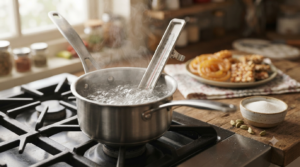
Checking a candy thermometer in boiling water helps assess its accuracy before preparing Indian sugar syrups and sweets.
Candy Thermometer Calibration at a Glance
- Read the exact model instructions before placing any thermometer in ice or boiling water.
- Use a boiling-water check for a suitable candy thermometer, since sweets rely on hot sugar readings.
- Compare the reading with the boiling point at your location, not automatically with 100°C.
- Try an ice bath only if the model measures around 0°C and allows that test.
- Check the maker’s stated accuracy limit before deciding whether a reading is wrong.
- Adjust only if the manufacturer provides an approved way to do so.
The key distinction is simple: checking accuracy tells you what the thermometer reports; adjusting calibration changes what it reports. Some kitchen models let you adjust the display. Others offer no user adjustment at all. ThermoWorks explains this distinction in its thermometer guidance.
What Candy Thermometer Calibration Actually Means
In everyday kitchens, people call any accuracy check a calibration. Strictly, you compare a reading with a known reference temperature. You may then record an error, arrange servicing, or adjust the instrument if its design permits. A proper laboratory calibration can also document results across several temperatures.
One home test cannot prove that every reading is accurate. A probe may behave well near boiling water but drift at a much higher sugar stage. For important batches, check the manufacturer’s tolerance across the intended range. If you need documented accuracy, use a qualified calibration service.
Also check whether the instrument has a true calibration setting. A movable coloured pointer often marks your desired cooking temperature. It does not necessarily correct the thermometer’s sensor. Likewise, an adjustable pan clip changes mounting depth, not measurement accuracy.
Choose the Right Accuracy Check for Your Thermometer
For candy thermometer calibration, start with the type of instrument, not a test copied from a video. A classic glass candy thermometer differs from a digital probe. An infrared thermometer measures surface radiation, so it needs a different verification method. Check the model number if the instructions are missing.
| Thermometer | Suitable check | Important limit |
|---|---|---|
| Glass candy thermometer | Boiling water, if permitted | Handle gently; do not assume it reads 0°C |
| Digital contact probe | Boiling water; sometimes ice slurry | Follow immersion depth and accuracy specifications |
| Dial candy thermometer | Boiling water within its rated range | A target marker or clip is not a calibration nut |
| Infrared thermometer | Model-specific surface reference test | Do not immerse the device or treat surface readings as syrup-core readings |
For example, Taylor’s model 3505 candy thermometer starts at 100°F, about 38°C. Therefore, a 0°C ice test falls outside that model’s measuring range. The listing also describes a sliding temperature marker, not a user calibration control.
Never submerge a digital display or electrical connector unless its manual explicitly allows it. Even a waterproof probe may have an unprotected head. Glass models also deserve care because sudden temperature changes can cause damage.
How to Check Candy Thermometer Calibration in Boiling Water
A boiling-water test is a practical hot-point check for a compatible candy thermometer. It is useful because sugar syrup cooking takes place above ordinary room temperature. However, this test measures one point near water’s local boiling temperature. It does not prove accuracy at every higher candy stage.
- Read the instructions. Confirm the temperature range, required immersion depth, cleaning advice, and safe mounting method.
- Prepare plain water. Use a stable, deep saucepan with enough water to cover the full sensing area safely.
- Bring it to a rolling boil. Keep the water boiling steadily while you take the reading.
- Position the sensor correctly. Keep the sensing zone in the water without touching the pan’s bottom or sides.
- Allow time to settle. Wait for a stable reading according to the manufacturer’s response guidance.
- Compare with a valid reference. Use the expected boiling point for your elevation and current air pressure.
- Record the result. Note the date, model, reference temperature, displayed temperature, and any action taken.
During candy thermometer calibration, the reference temperature matters as much as the reading. Near sea level under standard atmospheric pressure, pure water boils at about 100°C, or 212°F. At higher elevations, it boils at lower temperatures. The US National Institute of Standards and Technology also notes that barometric pressure matters.
Use oven mitts and keep your face away from the steam. Hot sugar causes serious burns, so perform this check with water before preparing syrup. Never attempt to adjust a hot glass thermometer by force.
Can You Use an Ice Bath Instead?
An ice slurry can check a compatible contact thermometer near 0°C. But it is not a universal candy thermometer calibration method. Some candy thermometers cannot display freezing temperatures, and some manufacturers restrict immersion. A good cold-point result also does not replace a hot-point check when candy temperatures matter.
For candy thermometer calibration on a suitable cold-range probe, an ice bath offers a second reference point. If your manual permits this test, fill a container mostly with crushed ice. Add just enough clean water to fill the gaps.
Stir gently, place the allowed sensing area in the centre, and wait for stability. The reference is approximately 0°C for a properly made melting-ice mixture.
Do not test a candy thermometer below its stated range. Also avoid dunking an entire device when only its probe may contact liquid. ThermoWorks provides instructions for a proper ice bath, but your own model manual takes priority.
Read the Result Before Trying to Adjust Anything
The manufacturer’s accuracy specification decides whether your candy thermometer calibration check is acceptable. An instrument may legitimately read a little above or below the reference. Therefore, a small difference does not automatically signal failure. Consult the model’s stated tolerance at the relevant temperature.
If the reading falls within the specified range, leave the calibration alone. When it falls outside, first repeat the test with correct placement and a reliable reference. Check for a flat battery, damaged probe, cracked glass, or poor electrical connection.
Only follow an adjustment procedure that the manufacturer explicitly supplies. A serviceable dial model may have an adjustment point, while another model may not. Some digital units allow a correction setting; others need service or replacement. If readings jump around or remain inconsistent, retire the thermometer from precision sugar work.
Altitude Changes the Reference and the Sweet
Altitude adds another layer to candy thermometer calibration because it has two separate effects. First, a lower boiling point changes the reference for a hot-water accuracy check. Second, lower air pressure changes the finish temperature required for similar sugar concentration. These are related effects, but they are not the same as thermometer error.
Colorado State University Extension gives a candy-making rule of thumb: reduce sea-level finish temperatures by about 2°F for every 1,000 feet of elevation. That is roughly 1.1°C per 305 metres. For the local boiling-point accuracy check, ThermoWorks advises checking the water’s local boiling point, while NIST explains why pressure matters.
However, elevation alone gives only an estimate. Weather affects pressure, while recipe ingredients change how syrup behaves. When cooking in a hill station, verify your local boiling-point reference rather than treating 100°C as a universal target. Do not apply the altitude change twice.
A Worked Example: Elevation Versus Instrument Error
Suppose a recipe uses a sea-level finish temperature of 118°C. For this example, assume the actual local boiling point is 96°C. Also assume a reliable reference confirms that your thermometer displays 98°C in that water. Its indicated reading is therefore 2°C high at the test point.
A simple altitude adjustment lowers the physical recipe target by about 4°C, to 114°C. Because this example thermometer reads 2°C high, its approximate displayed target becomes 116°C. This is an illustration, not a universal setting. It assumes the measurement error remains similar near the cooking temperature.
A useful shortcut combines both effects: displayed target ≈ sea-level recipe target + (displayed boiling-water reading − 100°C). Here, 118 + (98 − 100) gives 116°C. Use this only as an approximate kitchen aid, not proof of thermometer accuracy.
It cannot replace a known reference when you need to diagnose sensor error. Apply a reading correction only if the thermometer manufacturer recommends it.
Why Indian Sweets Need More Than a Number
Indian sweets rarely follow one shared sugar-temperature target. Chashni for a jalebi recipe may differ from syrup for a laddu or a soaking sweet. Meanwhile, chikki needs a firm, brittle result. The sweet’s ingredients, water content, and recipe method all matter.
| Sweet or process | What matters most | Thermometer’s role |
|---|---|---|
| Boondi or besan laddu chashni | Recipe-specific syrup thickness or thread stage | Track a repeatable temperature alongside texture |
| Jalebi syrup | Coating consistency and syrup behaviour | Help monitor concentration without replacing the recipe’s test |
| Gulab jamun soaking syrup | Suitable fluid syrup that can soak the sweet | Prevent cooking it to an unintended hard candy stage |
| Peanut chikki | Brittle sugar or jaggery mixture | Useful for tracking the hot stage, with texture confirmation |
| Kaju katli | Moisture loss and the mixture’s ability to come together | One clue among stirring, cooling, and texture checks |
For a one-thread syrup, follow the specific recipe’s description instead of adopting an unrelated temperature chart. Some recipes use a cooled drop to judge texture. Avoid placing hot syrup between bare fingers because it can cling and burn.
Likewise, sugar-stage tables describe general confectionery behaviour, not a guarantee for every milk, nut, or jaggery sweet. Using a thermometer helps you repeat a method. The finished sweet still tells you whether that method works.
Candy Thermometer Calibration Mistakes That Spoil a Batch
A common candy thermometer calibration mistake is blaming a sound sensor for a poor reading. Often, the real problem is positioning. A probe touching the metal base reads the pan’s heat, while a probe above the syrup may measure steam.
Clip the stem securely and watch the liquid level as it reduces.
- Testing at the wrong temperature: An ice test is meaningless when the device cannot measure 0°C.
- Assuming every dial adjusts: A movable recipe marker may not alter the measuring mechanism.
- Ignoring the local boiling point: A mountain kitchen cannot use a fixed sea-level reference.
- Stopping at the first reading: Wait for the display or column to stabilise.
- Confusing syrup tests with instrument tests: Cold-water sugar stages assess syrup texture, not thermometer calibration.
- Trusting one offset everywhere: An error measured near boiling may change at much higher temperatures.
Another easy mistake is reading a glass scale from an angle. View the marked scale at eye level, since parallax can distort the result. Also check the unit before starting. A Celsius and Fahrenheit mix-up can ruin even a well-tested recipe.
What to Do If the Thermometer Fails Its Check
Accurate readings are not guaranteed simply because a device is new. If the result seems wrong, repeat the check with steady boiling water and correct sensor placement. Compare it against an independent reference and the manufacturer’s tolerance. Then choose the safest next step.
- Within tolerance: Keep using the thermometer as instructed, and note the check for later comparison.
- Outside tolerance, adjustment supported: Follow the manual’s exact procedure, then repeat the accuracy check.
- No adjustment, but stable error: Ask the maker about service. A documented correction may help some cooking tasks, but avoid relying on it for critical sugar stages.
- Erratic, damaged, or outside useful range: Replace the thermometer or seek professional service before another precise batch.
Keep a backup method available. A recipe-specific cooled-drop test can help you judge sugar stage when a thermometer fails. Yet it cannot certify the sensor itself. If you cannot confirm the syrup stage safely, avoid risking a large batch.
A Better Routine Before Making Chashni
Good candy thermometer calibration records make repeat batches easier to troubleshoot. Keep the manual or a photo of its useful pages near your cooking notes. Check the stem, display, battery, clip, and sensing range before you start. If you suspect drift, do the model-approved accuracy check with water.
Write down the result and the conditions. For example, note the local boiling reference, measured reading, and whether the device needed service. When you repeat a recipe, keep the same probe depth and pan position. That makes changes in texture easier to diagnose.
Clean the sensing area as the maker directs after each batch. Avoid dropping the instrument or shocking hot glass with cold water. Also recheck the thermometer after a fall, an unusual reading, or damage. Follow your manufacturer’s recommended check interval for regular use.
Once the sweets are ready, use the Diwali sweets storage guide for cooling, packing, and storage advice.
The Bottom Line
Candy thermometer calibration is about confidence in the reading, not turning every thermometer into an adjustable tool. A model-approved boiling-water test is often useful for Indian sweets. However, your local boiling point and the maker’s stated tolerance are essential. Use the thermometer alongside the recipe’s texture cues, and replace an unreliable device before it spoils another batch.
Frequently Asked Questions
Do all candy thermometers have a calibration screw?
No. Some models include an approved adjustment method, while others do not. A clip or moveable temperature marker is not necessarily a calibration control. Check the manual for your exact model before trying to turn anything.
Should a candy thermometer always read 100°C in boiling water?
No. Pure water boils at about 100°C near sea level under standard pressure. At higher elevations or different air pressure, the boiling point changes. Compare your reading with an appropriate local reference, not a fixed number.
Can I test every candy thermometer in ice water?
No. Some candy thermometers cannot measure around 0°C, so that test falls outside their range. Other models may have immersion restrictions. Use an ice slurry only when the maker permits it and the sensing range includes the reference.
Does a correct ice reading guarantee accurate chikki temperatures?
No single home test proves the full measuring range. A good ice reading is reassuring for a compatible probe, but it does not directly verify a much hotter sugar stage. Check the maker’s accuracy specification and seek service if readings remain doubtful.
How often should I check candy thermometer accuracy?
Follow the manufacturer’s stated interval because designs differ. Also check after a drop, damage, strange readings, or a long period without use. Frequent sweet-making may justify more routine checks than occasional home cooking.
Can I correct a wrong thermometer reading with maths?
Sometimes a stable, verified error can guide a limited correction. But an error at one temperature may not remain constant at another. Apply a reading correction only if the thermometer manufacturer recommends it. If the device is outside specification, follow the maker’s service or replacement advice instead of assuming one offset fixes everything.
Does altitude change chashni temperature?
Yes, altitude can lower the finish temperature for a similar sugar concentration. Colorado State University Extension gives an approximate reduction of 2°F per 1,000 feet. Use the recipe’s visual or texture test too, since ingredients and local conditions matter.
Is the cold-water sugar test the same as ice calibration?
No. The cold-water sugar test checks how a drop of cooked syrup behaves as it cools. An ice slurry test checks a suitable thermometer against a near-0°C reference. They answer different questions, so one cannot replace the other.