Peanut Sesame Chikki: Untested Jaggery Recipe Trial
Peanut sesame chikki is a crisp jaggery brittle built around roasted peanuts and sesame seeds, but this version is deliberately presented as an untested recipe trial. The formula below is a development batch, not a kitchen-verified final recipe. Therefore, use the texture checks and troubleshooting notes as part of the test. That honesty matters because jaggery moisture, pan heat, and syrup stage can change the result quickly.
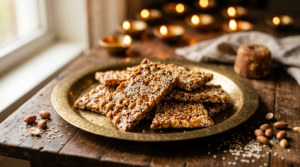
Thin peanut and sesame jaggery chikki pieces presented as an untested festive recipe trial.
Allergen note: this recipe contains peanuts and sesame. If you use ghee, it also contains a milk-derived ingredient. Anyone with a milk allergy should not assume ghee is safe.
The U.S. Food and Drug Administration lists peanuts, milk, and sesame among major food allergens. Therefore, read every ingredient label and avoid cross-contact when cooking for someone with an allergy. See the FDA food allergy guidance.
Hot-syrup safety: molten jaggery can cause serious burns because it sticks to skin. Keep children away from the stove, use a long-handled spoon, and do not touch the syrup to test it. If a burn happens, the NHS advises cooling it under cool running water for 20 minutes. Seek medical care when needed; see NHS burns and scalds guidance.
Peanut Sesame Chikki at a Glance
- Status: Untested recipe development trial; results have not been kitchen-verified.
- Style: Thin, crunchy Indian jaggery brittle with both peanuts and sesame.
- Trial balance: 1 cup peanuts, 3/4 cup sesame, and 1 cup grated jaggery.
- Key success point: Cook the jaggery until a cooled drop sets hard and snaps cleanly.
- Likely failure points: undercooked syrup, delayed rolling, excess moisture, or stale nuts and seeds.
- Allergens: Peanuts and sesame; milk/dairy if ghee is used.
- Expected yield: About 16 to 20 thin pieces, but this is an unverified estimate.
The useful test here is the ratio. Many til peanut chikki recipes use equal cups of peanuts, sesame, and jaggery, while other versions use much less jaggery. This trial shifts slightly toward peanuts and reduces sesame to keep the sheet easier to bind and cut.
Why This Peanut Sesame Chikki Trial Is Different
The aim is not to pretend this is a perfected family recipe. Instead, this peanut sesame chikki trial gives you a controlled starting point and tells you what to watch. That makes it easier to record the first result and adjust the next batch without guessing.
Peanuts bring larger, richer pieces, while sesame fills the gaps between them. Jaggery then acts as the brittle matrix that holds both together. Because the seed-and-nut mix is dense, the syrup must reach a true brittle stage before the solids go in.
Search results show both “peanut sesame chikki” and “til peanut chikki” as established recipe wording, and existing recipes use several different ratios. Some use equal parts of all three main ingredients, while others use less jaggery. That variation is exactly why this version is labelled a trial rather than a tested promise.
Ingredients for the Test Batch
| Ingredient | Trial amount | Why it is here |
|---|---|---|
| Raw peanuts | 1 cup | Main crunch and nutty flavour |
| White sesame seeds | 3/4 cup | Toasty flavour and smaller crisp bits |
| Grated or chopped jaggery | 1 cup, lightly packed | Brittle syrup and sweetness |
| Ghee | 1 teaspoon | Greasing and a light buttery note |
| Water | 1 tablespoon | Helps the jaggery begin melting evenly |
| Cardamom powder | 1/4 teaspoon, optional | Warm aroma |
| Fine salt | 1 small pinch | Balances sweetness |
Dairy-free trial: replace ghee with a very thin coating of neutral oil. However, check every packaged ingredient if you are cooking for someone with a serious allergy, because cross-contact can occur during processing.
Use fresh peanuts and sesame because rancid oil flavours become more obvious in a simple brittle. Jaggery also varies in moisture and purity, so the cold-water snap test matters more than a fixed cooking time.
How to Make Peanut Sesame Chikki
This peanut sesame chikki method is designed as a small, trackable trial. Prepare the rolling surface before starting the syrup because the mixture can stiffen fast once the roasted solids enter the pan.
Roast and Stage the Ingredients
- Prepare the surface. Lightly grease a steel plate, marble board, or sheet of baking parchment with ghee or neutral oil. Grease a rolling pin and knife too.
- Roast the peanuts. Dry-roast them over medium-low heat until fragrant and lightly coloured. Cool them, rub away loose skins, and crush them very coarsely so you still have visible pieces.
- Roast the sesame. Use the same dry pan and stir constantly. Stop as soon as the seeds smell nutty and a few begin to pop, because burnt sesame turns bitter quickly.
- Keep the solids warm. Mix the roasted peanuts and sesame in a bowl. Warm ingredients should help the jaggery stay fluid for a few extra moments.
Cook the Syrup and Shape the Chikki
- Melt the jaggery. Add jaggery and 1 tablespoon water to a heavy kadai or saucepan. Heat gently while stirring until the jaggery melts.
- Cook to a brittle stage. Once the syrup is smooth and bubbling, reduce stirring. Drop a tiny amount into a bowl of cold water, then wait a few seconds before touching that cooled drop.
- Check the snap. The cooled jaggery should harden rather than bend. When it breaks with a clean snap, immediately stir in salt and cardamom, followed by the warm peanut-sesame mixture.
- Roll quickly. Scrape the hot mass onto the prepared surface. Roll it to roughly 5 to 7 mm thick, or thinner if you prefer a more brittle bite.
- Score before fully cold. Cut guide lines while the slab is still warm but no longer flowing. Then cool completely before snapping apart.
Why the Cold-Water Test Matters
The recipe does not use a fixed syrup time because pan width, burner strength, and jaggery moisture differ. A cold-water test gives direct evidence of how the syrup will set after cooling. If the drop stays soft or bends, the chikki is likely to remain chewy.
Do not taste the syrup from the pan. Instead, cool each test drop fully in water before handling it. If the drop snaps, move quickly because the remaining syrup may continue cooking from residual pan heat.
How to Judge the First Peanut Sesame Chikki Batch
Because the recipe is untested, the first batch should be treated as data. A good peanut sesame chikki trial should cool firm, break with a clear snap, hold the nuts and seeds together, and avoid a burnt jaggery aftertaste.
Write down three things after the batch cools: thickness, bite, and sweetness. Also note whether sesame falls away from the sheet. Those observations will tell you whether the next trial needs more binder, less jaggery, or only a different syrup endpoint.
| Result | Likely cause | Next-batch adjustment |
|---|---|---|
| Soft or chewy | Syrup stopped too early | Cook to a firmer cold-water snap |
| Very hard or bitter | Syrup cooked too far | Stop as soon as the cooled drop snaps |
| Crumbles apart | Too little syrup coverage or mixture cooled too fast | Mix faster; if needed, test slightly more jaggery next time |
| Greasy surface | Too much ghee | Use only enough fat to prevent sticking |
| Thick and difficult to bite | Sheet rolled too thick | Roll earlier and thinner |
What Can Go Wrong With Peanut Sesame Chikki?
Success is not guaranteed because this is a development batch, and jaggery behaves differently from one brand or block to another. The most common problems are a soft set, burnt syrup, a crumbly slab, or a mixture that hardens before you can roll it.
If the syrup is soft after cooling, do not assume extra water will rescue the finished slab. Avoid recooking the pieces as a blind fix. A better test approach is to record the failure and repeat a smaller batch with a firmer syrup endpoint.
If the mixture hardens before rolling
Do not force a cold, brittle mass with bare hands because sharp edges and retained heat can injure you. Next time, warm the roasted solids before adding them, prepare every tool first, and transfer the mixture the moment the syrup reaches the snap stage.
If the chikki turns chewy after a day
Humidity is a likely culprit because cooked sugar and jaggery can pick up moisture from the air. Store fully cooled pieces in a tightly closed container, and keep them away from steam near the stove. For a first trial, make a modest batch rather than relying on a long shelf-life claim.
Festive Serving Ideas Without Overcomplicating the Recipe
This combination suits a Diwali sweets tray because it offers a crisp, nutty contrast to softer mithai. Still, the trial status should remain visible if you publish or share the recipe before you have cooked it yourself.
For gifting, cut small rectangles and separate layers with food-safe parchment. If you are sharing them outside your household, attach a clear note that they contain peanuts and sesame. Also declare milk/dairy when ghee was used.
For another festive setting, the Sankranti sweets guide covers sesame-jaggery treats alongside other traditional dishes. A second trial could add a small amount of cardamom or dry ginger, but test one change at a time. That way, you can tell whether a flavour addition changed the texture or whether the syrup stage caused the difference.
Peanut Sesame Chikki Allergen and Kitchen Safety Notes
Peanut sesame chikki is not suitable for anyone who must avoid peanuts or sesame. If ghee is included, treat milk/dairy as an additional allergen concern and use an appropriate alternative only when it fits the eater’s needs.
For packaged-food context, India’s Food Safety and Standards Authority of India publishes allergen-labelling rules in its Labelling and Display compendium. Home cooks are not using this article as a legal label. Still, the same practical habit helps: state clearly what went into the food instead of assuming guests will know.
The second safety issue is heat. Keep the rolling area clear before cooking the syrup, use stable cookware, and turn pot handles inward. Since hot jaggery can cling to skin, never use a fingertip test directly from the pan.
How to Improve Trial Two
Do not change several variables at once. First, decide whether the texture problem came from the jaggery stage, the solid-to-syrup ratio, or the rolling speed. Then alter only one factor in the next batch.
If trial one snaps well but tastes too sweet, reduce jaggery slightly in trial two. If it snaps but sheds sesame and peanut pieces, keep the syrup stage the same and increase jaggery modestly instead. Those changes are more useful than switching ingredients and cooking method together.
Once one batch works reliably, weigh the ingredients rather than relying only on cups. Weight-based measurements make later repetitions easier because peanut size, grated jaggery packing, and sesame volume can vary between cooks.
Final Notes Before You Test It
The strongest part of this recipe is its transparency: it gives you a reasoned starting formula without claiming a test that has not happened. Roast the solids carefully, judge the jaggery by a cooled snap test, and roll as soon as the mixture comes together.
Most importantly, record what happens. A single trial can show whether this peanut sesame chikki needs a ratio change or a better syrup endpoint. Then the second batch becomes far more informed.
Peanut Sesame Chikki FAQs
Is this peanut sesame chikki recipe tested?
No. This peanut sesame chikki recipe is explicitly an untested development trial, so the quantities and expected yield have not been kitchen-verified. Use the cold-water snap test, note the result, and adjust only one variable in the next batch.
Can I make til peanut chikki with jaggery instead of sugar?
Yes, jaggery is widely used in til peanut chikki recipes and is the sweetener used in this trial. However, jaggery varies in moisture and purity, so cook to the texture endpoint rather than trusting a fixed number of minutes.
How do I know when jaggery syrup is ready for chikki?
Drop a very small amount into cold water and let it cool. The cooled piece should become hard and snap cleanly instead of bending. If it stays soft, continue cooking briefly and test again.
Why did my peanut sesame chikki turn soft?
The syrup probably did not reach a firm brittle stage, although humidity can also soften stored chikki. On the next batch, cook until the cooled jaggery drop snaps and store the fully cooled pieces in an airtight container.
Can I make this recipe without ghee?
Yes. Use a very light coating of neutral oil on the plate, rolling pin, and knife. This removes ghee from the formula, but people with allergies should still check every ingredient label for cross-contact warnings.
What allergens are in peanut sesame chikki?
This recipe contains peanuts and sesame. It also includes milk/dairy when made with ghee, so declare all three when relevant. Never serve it to someone with a known peanut, sesame, or milk allergy unless their own medical guidance says the ingredients are safe for them.
Can I add other nuts to the first test batch?
It is better not to. Keep the first trial focused on peanuts, sesame, jaggery, and the optional flavouring. Extra nuts change both the solids ratio and syrup coverage. Add one new ingredient only after the base batch works.
How should I store the finished chikki?
Cool the pieces completely, then keep them in a tightly closed container away from steam and humidity. Because this specific formula is untested, avoid publishing a precise shelf-life claim until you have observed how the batch holds up in your own kitchen.