Everest Sambhar Masala Recipe: The Right Quantity, Salt and Tamarind
This Everest Sambhar Masala recipe makes a full pot of South Indian sambar in about an hour. One ready-made blend replaces the twelve or more spices a scratch podi needs. Most versions online tell you to stir in two teaspoons and stop there. Yet the brand’s own pack directions work out to nearly three times that amount, which is why so many home batches taste thin.
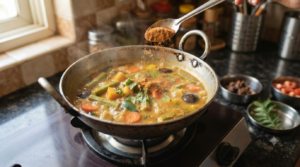
Sambar simmering with drumstick, pumpkin and toor dal — one level tablespoon of blend per cup of dal.
Bhimas Cook is an independent food blog. We are not affiliated with, endorsed by, or sponsored by Everest Food Products Pvt. Ltd. Brand names appear here only to describe the product used in this recipe.
Everest Sambhar Masala Recipe at a Glance
Here is the short version before the detail. This Everest Sambhar Masala recipe is a mixed-vegetable sambar built on toor dal and tamarind. A mustard-seed tempering finishes it.
- Masala quantity: 1 level tablespoon (about 12 g) per 1 cup of dry toor dal.
- When to add it: with 8–10 minutes of simmering still to go.
- Salt: start at ½ teaspoon only, because the blend already contains salt.
- Tamarind: juice from a lemon-sized ball, or roughly 1 teaspoon of shop concentrate.
- Serves: 4 generous portions with rice, or 5–6 alongside idli.
- Best for: cooks who want depth without roasting and grinding a spice mix.
| Detail | Value |
|---|---|
| Prep time | 15 minutes |
| Cook time | 45 minutes |
| Total time | 60 minutes |
| Servings | 4 |
| Difficulty | Easy to medium |
| Cuisine | South Indian |
Everest Sambhar Masala Recipe: How Much to Use per Cup of Dal
Use 1 level tablespoon of the blend for every 1 cup of dry toor dal. Then taste and adjust upward. That sits in the practical middle of the brand’s own advice, which is not consistent across its channels.
The recipe printed with the product starts from 100 g of soaked toor dal. It calls for one heaped tablespoon of the blend. Since 1 cup of dry toor dal weighs roughly 200 g, that ratio scales to about two heaped tablespoons. Meanwhile, the retail listing on major marketplaces suggests only 1–2 teaspoons for a whole pot.
| Source | Stated quantity | Per 1 cup dry dal |
|---|---|---|
| Pack recipe (Everest) | 1 heaped tbsp per 100 g dal | About 2 heaped tbsp |
| Retail product listing | 1–2 tsp per pot | About 1–2 tsp |
| This recipe | 1 level tbsp per cup | 1 tbsp, then adjust |
Start at one tablespoon, because you can always add more. An over-spiced pot is far harder to rescue. If the sambar still tastes flat after ten minutes, stir in another teaspoon and simmer two minutes longer. Most blog versions of the Everest Sambhar Masala recipe skip this calibration entirely.
What Is Inside the Blend This Everest Sambhar Masala Recipe Uses
The label lists coriander, chilli, Bengal gram, black gram, pigeon pea, cumin, rice, fenugreek and salt. It also carries curry leaf, tamarind, turmeric, cassia and asafoetida. Some packs add a souring agent such as citric or malic acid. Three of those ingredients change how you cook.
First, the blend contains salt, so heavy salting early on wrecks the balance. Second, it already carries tamarind and an acidity regulator. You therefore need less souring than a scratch recipe. Third, the roasted dals and rice thicken the sambar slightly as it simmers.
Two safety points are worth knowing before you start. The asafoetida used in Indian blends is usually compounded with a starch carrier. Several export labels for this product also carry a “may contain traces of gluten” warning, so it is not certified gluten-free. UK labelling notes it is made on equipment that handles mustard.
Anyone cooking for coeliac disease or a diagnosed allergy should read their own pack first. Where a medical condition is involved, check with a qualified professional. You can confirm the current listing on the official Everest product page, since formulations do change.
Ingredients for This Everest Sambhar Masala Recipe
Everything below is standard Indian pantry stock apart from the blend. That is sold in 15 g, 50 g, 100 g and 200 g packs. Retail listings put those roughly between ₹60 and ₹165 depending on size. Prices move, so check the current MRP printed on the box.
- 1 cup toor dal (split pigeon peas), rinsed
- 2 tbsp cooking oil, or 1 tbsp oil plus 1 tbsp ghee
- 1 tsp mustard seeds
- ½ tsp fenugreek seeds
- ¼ tsp asafoetida (hing)
- 8–10 curry leaves
- 2 dried red chillies, broken
- 1 medium onion, cubed
- 1 medium tomato, chopped
- ½ cup drumstick pieces
- ½ cup pumpkin cubes
- ½ cup carrots, chopped
- 1 small brinjal (eggplant), cubed
- 1 medium potato, cubed
- Tamarind: a lemon-sized ball soaked in warm water, or 1 tsp concentrate
- 1 level tbsp Everest Sambhar Masala (about 12 g)
- ½ tsp red chilli powder, optional
- Salt, starting at ½ tsp
- 1 tsp jaggery, optional
- 4 cups water, plus 2 cups for the dal
- Fresh coriander leaves to garnish
Do not treat tamarind pulp and tamarind concentrate as the same thing. Juice extracted from a lemon-sized ball gives mild, rounded sourness. Shop concentrate is roughly three times stronger. Swapping one for the other spoon-for-spoon is the commonest reason a pot turns unpleasantly sharp.
How to Cook This Everest Sambhar Masala Recipe Step by Step
Step 1: Cook the dal (20 minutes)
Rinse the toor dal until the water runs clear. Pressure cook it with 2 cups water for 3–4 whistles. A grain should crush easily between your fingers. Then mash it lightly with a ladle, leaving some texture rather than a smooth purée.
Step 2: Prepare the vegetables (5 minutes)
While the dal cooks, chop the drumstick, pumpkin, carrot, brinjal and potato into similar sizes. Even sizing matters more than it sounds, since drumstick and potato cook at different speeds. Keep the onion and tomato separate.
Step 3: Temper the spices (5 minutes)
Heat the oil in a deep pan over medium flame. Add mustard seeds and wait until they finish popping. Then add fenugreek seeds, dried chillies, asafoetida and curry leaves.
Stir for about 30 seconds until fragrant. Because fenugreek turns bitter fast, pull the pan off the heat if it darkens.
Step 4: Sauté the vegetables (3 minutes)
Add the onion and cook until it turns translucent. Stir in the tomato and let it soften for a minute or two. Now add the drumstick, pumpkin, carrot, brinjal and potato. Turn everything through the oil for two minutes.
Step 5: Simmer with tamarind (8 minutes)
Pour in 4 cups of water and bring it to a boil. Add the tamarind juice and ½ teaspoon salt. Simmer until the vegetables are about three-quarters cooked. Raw tamarind smells sharp at first, so let it bubble a few minutes before judging the sourness.
Step 6: Add the dal and the masala (8 minutes)
Stir the mashed dal into the vegetables. Loosen it with hot water if the pot looks too thick. Now add 1 level tablespoon of Everest Sambhar Masala, plus the optional chilli powder and jaggery. Simmer gently for 8–10 minutes so the powder loses its raw edge.
This is the step rushed recipes cut short, and it is why some pots taste powdery. Ground blends need real time in liquid. In this Everest Sambhar Masala recipe, that simmer does the work a slow-roasted podi would otherwise do.
Step 7: Taste, correct and finish (1 minute)
Taste before you serve, because this is where the pot is actually made. Add salt in ¼ teaspoon steps. Add more masala by the teaspoon, or a little jaggery if it leans too sour. Finally, turn off the heat and scatter fresh coriander over the top.
Everest Sambhar Masala Recipe: What Goes Wrong and How to Fix It
When this Everest Sambhar Masala recipe goes wrong, it goes wrong in predictable ways. The table below covers the five complaints that come up most often. Each fix works mid-cook, so nothing has to be thrown away.
| Problem | Likely cause | Fix |
|---|---|---|
| Tastes flat or watery | Too little masala for the dal | Add 1 tsp more, simmer 2 minutes |
| Powdery aftertaste | Masala added with no simmering | Simmer 8–10 minutes after adding |
| Too salty | Salted before the blend went in | Add a peeled potato and hot water |
| Too sour | Concentrate used instead of pulp | Add 1 tsp jaggery and more dal |
| Bitter edge | Burnt fenugreek in the tempering | Redo the tempering and stir it in |
Consistency is a matter of taste rather than a rule. Rice sambar is usually thicker. Sambar served with idli or vada runs looser, so it soaks in properly.
Pro Tips for a Better Everest Sambhar Masala Recipe
- Mash the dal lightly instead of blending it, because texture gives the sambar body.
- Top up with hot water, never cold, so the pot does not stall mid-simmer.
- Add drumstick early and brinjal late, since brinjal collapses in minutes.
- A second small tempering poured over the finished pot lifts the aroma noticeably.
- Store the blend in an airtight jar away from the stove, as steam dulls ground spices.
Everest Sambhar Masala Recipe Variations and Substitutions
No drumstick in the house? Use extra carrot and potato, or add okra in the last five minutes. Ash gourd, radish and ridge gourd all work well in the same pot.
For an idli or tiffin sambar, keep the vegetables to onion and tomato alone. Thin the pot with an extra cup of water, then finish with a teaspoon of jaggery. For a Jain version, drop the onion and potato entirely. Lean on drumstick, pumpkin and raw banana instead.
You can also run this Everest Sambhar Masala recipe without a ready blend. Roast and grind your own podi, then use about 2 tablespoons of it. Cooking without a pressure cooker works too. Soak the dal for 30 minutes, then boil it covered for about 45 minutes, adding hot water as needed.
Storage, Reheating and Make-Ahead Notes
Sambar from this Everest Sambhar Masala recipe keeps well. Cool it quickly and refrigerate it in an airtight container for up to 3 days. It thickens as it chills, so loosen it with hot water when you reheat. Reheat until it bubbles properly rather than just warming it through.
Sambar also freezes for about a month, though the vegetables soften noticeably. Freeze the dal-and-masala base alone for a better result. Then add fresh vegetables on the day you serve it. Leaving a cooked pot out all day is the one habit to avoid, especially in warm weather.
Nutrition Information Per Serving (Estimated)
These figures are calculated estimates for one of four servings of the Everest Sambhar Masala recipe, not laboratory values. Actual numbers shift with the oil you use and the vegetables you pick.
| Nutrient | Amount |
|---|---|
| Calories | 200–230 kcal |
| Protein | 8–10 g |
| Carbohydrates | 30–35 g |
| Fat | 6–8 g |
| Fibre | 6–8 g |
| Sodium | 450–550 mg |
Sodium deserves a second look here. The blend is already salted. A pot made with the full 1.5 teaspoons of extra salt that older recipes suggest climbs well above the range above. Anyone managing blood pressure or a low-sodium diet should salt lightly and ask their doctor or dietitian about daily limits.
Is Everest Sambhar Masala Safe? What the 2024 Recall Actually Covered
Search results still mix up which products were involved in the 2024 spice recalls. In April 2024, Hong Kong’s Centre for Food Safety and the Singapore Food Agency acted over ethylene oxide residues. The Everest product named in those actions was its Fish Curry Masala. The recalled sambhar powder belonged to a different brand, MDH.
India’s regulator, the Food Safety and Standards Authority of India (FSSAI), then ordered nationwide sampling of spice makers. Officials reported in May 2024 that the samples examined showed no traces of ethylene oxide. Standard kitchen sense still applies. Buy sealed packs, check the date on the box, and follow current advisories from FSSAI or your local regulator.
The Bottom Line
Ready-made blends earn their place on a weekday. This Everest Sambhar Masala recipe delivers a genuinely South Indian pot when you get three things right. Use a full tablespoon per cup of dal. Hold back on salt, because the blend brings its own.
Give the masala eight to ten minutes of simmering before you serve. Handle tamarind by strength rather than by spoon count, and the pot lands close to a good tiffin-centre sambar. If you like this shortcut, the Mangalore-style sambar and the Udupi idli sambar are worth cooking next. Both build flavour from a freshly ground podi instead.
Frequently Asked Questions
How much Everest Sambhar Masala should I add per cup of dal?
Add 1 level tablespoon, roughly 12 g, for every 1 cup of dry toor dal, then taste. The pack recipe scales to about two heaped tablespoons per cup. Meanwhile the retail listing suggests only 1–2 teaspoons. One tablespoon sits between the two and suits most home palates.
When should I add the masala in this Everest Sambhar Masala recipe?
Add it after the dal goes into the vegetables, with 8–10 minutes of simmering still to come. Ground blends need that time in liquid to lose their raw edge. Adding it at the very end is the commonest mistake with this dish.
Does the blend already contain salt and tamarind?
Yes. The label lists common salt and tamarind, plus a souring agent on some packs. Start with about ½ teaspoon of added salt. You will also need less tamarind than a scratch recipe would use.
Can I make this Everest Sambhar Masala recipe without a pressure cooker?
Yes, though it takes longer. Soak the toor dal for 30 minutes, then simmer it covered for around 45 minutes until soft. Top up with hot water as it cooks. Everything after that stage stays exactly the same.
Is Everest Sambhar Masala vegan and gluten-free?
The blend is vegetarian and contains no dairy, so the sambar is vegan when cooked in oil rather than ghee. Gluten is less clear-cut. Export labels carry a “may contain traces of gluten” warning, and the asafoetida used is normally compounded with a starch carrier. Check your own pack if you avoid gluten medically.
What is the difference between sambar masala and rasam powder?
Sambar masala leans on coriander, chilli and roasted dals to build a thick, tangy lentil stew. Rasam powder carries far more black pepper and cumin, since rasam is a thin broth. Substituting one for the other changes the dish rather than just the seasoning.
Can I make sambar without any ready-made masala?
Yes. Roast coriander seeds, chana dal, urad dal, dried red chillies, fenugreek and curry leaves, then grind them. It adds roughly 30 minutes and a fresher aroma, and you would use about 2 tablespoons here. The dish itself is described in more detail on Wikipedia.
How long does an opened pack stay good?
Use it within about three to four months of opening for the best aroma. Always stay inside the printed best-before date. Ground spices do not spoil quickly, yet they fade. Keeping the pack sealed, dry and away from the stove slows that down.
What can I serve with this sambar?
Steamed rice with a spoon of ghee is the classic pairing, while idli, dosa, vada and pongal all work well. A poriyal and a papad round out the plate. For a heavier meal, serve it with pavakkai pitlai and rice.