Hyderabadi Veg Biryani Recipe: Rice Cues, Dum Method & Fixes
Hyderabadi veg biryani recipe success depends less on a stopwatch than on recognising the right rice, masala and steam cues. This refreshed method keeps the layered pakki-style dum approach, but it removes untested yield claims and vessel-by-vessel timing promises. Instead, you will judge doneness by what the rice grain, masala and sealed pot are actually telling you.
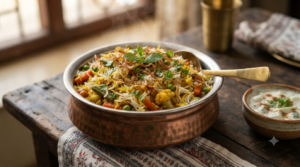
Hyderabadi veg biryani with fluffy basmati rice, vegetables, fried onions and fresh herbs, finished using the traditional dum method.
The key idea is simple: the rice must enter the dum stage undercooked, the vegetable masala must be thick rather than watery, and the final steam must finish both without turning the grains soft. Those three checks matter more than any single number on a timer.
Hyderabadi Veg Biryani Recipe at a Glance
- Style: pakki vegetable dum biryani, with the masala cooked before layering.
- Rice: aged long-grain basmati works best because it elongates well and stays separate.
- Rice cue before layering: the grain should look elongated but still have a firm, opaque core.
- Masala cue: thick enough to cling to the vegetables, with no loose water pooling in the pot.
- Dum cue: steady trapped steam, no aggressive boiling, and no wet liquid layer at the bottom when checked.
- Yield and vessel timing: we will add them only after recording this exact batch in a kitchen trial.
What Makes This Hyderabadi Veg Biryani Recipe Different
This Hyderabadi veg biryani recipe uses a pakki method, so the vegetable masala cooks before the rice goes on top. The rice boils separately and drains while still firm. Layering then lets the rice absorb aroma from the spiced base during dum.
That structure separates biryani from a typical pulao. Pulao usually cooks rice and vegetables together in measured liquid, while dum biryani builds distinct layers first. The difference is practical as well as stylistic because the rice and masala need separate doneness checks.
For the rice, aged basmati is the easiest choice for separate grains. The Agricultural and Processed Food Products Export Development Authority describes basmati as an extra-long, slender aromatic rice that elongates strongly during cooking. That is exactly the texture this method is trying to protect. APEDA’s basmati rice reference explains the grain characteristics in more detail.
Ingredients for This Hyderabadi Veg Biryani Recipe
For this Hyderabadi veg biryani recipe, the ingredient batch starts with two cups of raw basmati. We do not claim a serving yield because no kitchen trial has recorded the final cooked weight and plate count for this exact version.
| Component | Ingredients | Quantity |
|---|---|---|
| Rice | Aged basmati rice | 2 cups |
| Vegetables | Carrot, beans, cauliflower, peas and potato | About 2 1/2 cups, cut into sturdy pieces |
| Curd base | Thick curd | 3/4 cup |
| Aromatics | Onions, green chillies, mint and coriander | 3 onions, 3 to 4 chillies, generous handfuls of herbs |
| Spice paste | Ginger-garlic paste | 1 1/2 tbsp |
| Powders | Chilli powder, turmeric and biryani masala | 1 1/2 tsp, 1/2 tsp and 1 1/2 tsp |
| Whole spices | Cardamom, cloves, cinnamon, bay leaf, mace, star anise and shahi jeera | Use a modest mix to perfume the rice water |
| Finish | Ghee, saffron milk and fried onions | As needed for layering |
Keep the curd thick. Thin curd adds water before the vegetables begin releasing their own moisture. If your curd is loose, drain it briefly in a muslin cloth or fine sieve before mixing the marinade.
Choosing and soaking the basmati rice
Rinse the rice gently until the water becomes much clearer, then soak it for about 30 minutes. Soaking helps the grain hydrate more evenly, so the outside is less likely to soften before the centre catches up.
Drain it well before boiling. Do not leave the soaked rice sitting in water while the rest of the recipe runs late because prolonged soaking can make the grains fragile.
Step-by-Step Hyderabadi Veg Biryani Recipe
- Make the birista. Slice the onions evenly and fry them until deep golden. Remove them before they turn dark because they keep colouring after they leave the oil.
- Mix the curd base. Whisk the curd smooth with ginger-garlic paste, chilli powder, turmeric, biryani masala, salt, some fried onion, mint and coriander.
- Prepare the vegetables. Keep potato, carrot and cauliflower pieces large enough to survive the dum stage. Smaller pieces soften too fast.
- Cook the vegetable masala. Cook the vegetables in the curd mixture until the curd loses its raw look and the masala turns thick. Stop before the vegetables become fully soft.
- Boil the rice separately. Use plenty of boiling salted water with whole spices. Add the drained rice only when the water is actively boiling.
- Drain by texture, not by the clock. Begin checking early. Drain when the grain is elongated but still has a firm core and a noticeable bite.
- Layer immediately. Spread the drained rice over the thick vegetable masala. Add fried onions, mint, coriander, saffron milk and a little ghee.
- Seal for dum. Cover tightly so steam cannot escape freely. Keep the heat gentle enough to finish the rice without frying the base.
- Check the bottom, then rest. When the rice is tender and there is no loose liquid at the base, switch off the heat. Rest the covered pot before lifting and folding the layers.
How to Read Rice Doneness Before Dum
“Seventy percent cooked” is useful shorthand, but you cannot measure that percentage accurately by looking at a saucepan. A better home cue is the grain itself. It should be longer than raw rice, flexible at the surface, yet clearly firmer in the centre.
Take one grain out and cool it for a few seconds. Press it between your fingers or bite it. The outside should yield, while the middle should still resist and may show a small opaque core. If the grain is completely soft from edge to centre, it has gone too far for a long dum finish.
Do not rely on a fixed four- or five-minute boil. Rice age, soaking time, burner strength, pot width and water volume all change the clock. The sensory check travels from kitchen to kitchen much better than a universal minute count.
What if the rice is still too hard?
If the centre is chalky and the whole grain feels brittle, keep boiling briefly and test again. You want undercooked rice, not raw rice. A raw centre may remain hard even after the outer grains have absorbed steam on dum.
What if the rice already feels soft?
Drain it immediately and shorten the final heat exposure. Spread the rice gently so excess steam can escape before layering. You cannot reverse overcooking, so the safest recovery is a drier masala and a very cautious dum finish.
How Thick Should the Vegetable Masala Be?
In this Hyderabadi veg biryani recipe, the masala should cling to the vegetables with very little free liquid. A spoon drawn through it should not leave a path that instantly floods with thin curd water. The vegetables will release more moisture after you seal the pot.
If the masala is loose, cook it uncovered until the excess moisture reduces. If it is dry enough to catch on the base before the vegetables are partly tender, add only a small splash of hot water. The goal is a thick coating, not a gravy for serving separately.
This one check fixes many “mushy biryani” complaints. Soft rice often gets blamed first, but a watery base can overcook perfectly drained rice from underneath.
Dum Cooking Without Fake Vessel Timings
A Hyderabadi veg biryani recipe cannot promise one honest dum time for every steel, cast-iron, aluminium or cooker setup. Metal thickness, pot diameter, burner strength, tawa thickness and batch depth all change how quickly heat reaches the rice.
Use a heavy-bottomed pot or place a tawa under a thinner vessel to soften direct heat. Seal the lid well, then use low heat. Avoid a hard sizzle or burnt-spice smell from the base because both suggest the bottom is heating faster than the steam can finish the rice.
This refresh removes vessel-specific minute claims. During a kitchen trial, record the vessel, burner setting, batch depth and end-point signs before publishing a precise dum time.
How do you know the dum stage is finished?
Look for three cues together. The top rice should be tender without splitting into paste, the aroma should smell cooked rather than sharply of raw curd or spice, and the bottom should not hold loose water. If the base still looks wet, reseal and continue gently, checking in short intervals.
Troubleshooting This Hyderabadi Veg Biryani Recipe
| Problem | Likely cause | Best correction |
|---|---|---|
| Rice turns mushy | Rice was too soft before layering or masala was watery | Drain earlier next time and reduce the masala until thick |
| Rice stays hard | Rice entered dum too raw or steam escaped | Boil to a firmer-but-cooked outer texture and seal better |
| Bottom burns | Direct heat was too strong | Lower the heat and use a tawa under the pot |
| Top rice dries out | Lid leaked or there was too little steam | Seal tightly and avoid opening the pot repeatedly |
| Biryani tastes flat | Rice water or masala lacked enough salt | Season both components before layering |
| Curd splits badly | Thin curd or excessive heat | Use thick curd and cook the base at moderate heat |
| Vegetables collapse | Pieces were small or fully cooked before dum | Cut larger pieces and stop the masala stage while still firm |
If your biryani is slightly wetter than planned, do not stir aggressively. Rest it uncovered for a few minutes after the dum stage, then lift from the side with a flat spoon. Stirring hot, wet rice breaks the grains and makes the texture look even softer.
Colour, Aroma and the Final Layer
Good biryani does not need uniformly orange rice. Saffron milk creates uneven golden streaks, while fried onions and herbs add natural contrast. That patchy colour suits a layered dish because not every grain touches the same seasoning.
Use food colour only if you specifically want it and only from a permitted food-grade product used as directed. For an everyday home batch, saffron, fried onion and herbs are enough. The Food Safety and Standards Authority of India is the right reference for current food-additive rules, not recipe-blog folklore. Check FSSAI for current standards.
What to Serve Alongside
Mirchi ka salan and dahi chutney are classic partners because one adds a nutty chilli gravy while the other cools the plate. A crisp onion-cucumber-lemon salad also works well because it cuts through the ghee and fried onion.
If you want a milder extra gravy, the site’s South Indian veg kurma is a practical option. For a simpler rice meal on another day, bagara rice uses a lighter structure, while pudina rice is useful when you have extra mint.
Storing and Reheating Biryani Safely
Cooked rice can support foodborne bacteria if it sits warm for too long. FSSAI home-safety guidance advises keeping leftovers cold below 5°C or hot above 60°C, and its consumer guidance says perishable cooked food should be refrigerated promptly rather than left at room temperature. FSSAI’s Food Safety at Home guidance is the relevant India-facing source.
Divide leftover biryani into shallow containers so it cools faster, then refrigerate promptly. Reheat only the portion you plan to eat and heat it thoroughly.
The U.S. Food and Drug Administration identifies boiled or fried rice among foods associated with Bacillus cereus when prepared food sits without adequate refrigeration. FDA’s Bacillus cereus reference explains the organism and food risk.
The earlier page linked a dead NIFA document while calling it USDA guidance. This refresh removes that attribution. For this India-focused recipe, FSSAI carries the practical storage guidance, while FDA supplies the microbiological context.
Before You Cook
Set out the rice, herbs, fried onions and saffron milk before layering because this stage moves quickly. Decide what “done” means before sealing the pot: firm-centred rice, thick masala, sturdy vegetables and a tight lid.
Do not chase a restaurant result through extra colour or a longer dum. The strongest home version comes from controlling water and stopping each component at the right stage. Once those cues are reliable, a timed kitchen trial can document yield and vessel-specific timings without guessing.
Frequently Asked Questions
Is Hyderabadi veg biryani the same as vegetable pulao?
No. This Hyderabadi veg biryani recipe cooks the rice and vegetable masala separately, then layers and finishes them under a sealed lid. Pulao normally cooks the rice with the vegetables in the same measured liquid, so its texture and flavour distribution are more uniform.
Which rice works best for biryani?
Aged long-grain basmati is the easiest choice because it elongates well and stays separate. Sella basmati also works, but it cooks differently. Judge either rice by texture instead of copying a fixed minute count.
What does 70 percent cooked rice actually look like?
Treat “70 percent” as shorthand, not a measurement. The grain should be elongated and soft on the outside, yet still have a firm bite in the middle. A small opaque core is a useful sign that the rice still has cooking left for the dum stage.
Why did my biryani turn mushy?
The two most common causes are overcooked rice before layering and a watery vegetable base. Drain the rice while its centre is still firm, then reduce the masala until it clings to the vegetables. Also avoid vigorous stirring after the dum stage.
Why is the rice hard after dum?
The rice probably entered the pot too raw, or the lid allowed too much steam to escape. Next time, boil until the outside of the grain is cooked and only the centre remains firm. Also seal the pot more tightly before lowering the heat.
Can I use a pressure cooker for this Hyderabadi veg biryani recipe?
You can use the cooker body as a heavy sealed pot, but this refresh does not give a pressure-cooker minute count without a kitchen trial. Do not assume another vessel’s timing transfers directly. Judge the finish by rice tenderness, trapped steam and the absence of loose liquid at the bottom.
How much water should I use to boil the rice?
For the draining method, use enough water for the grains to move freely rather than treating it like an absorption ratio. The rice is drained before layering, so the critical step is not a precise water-to-rice ratio. The critical step is removing the rice at the right texture.
Do I need food colour for authentic-looking biryani?
No. Saffron milk, browned onions, mint and coriander already create natural colour variation. Uniform orange rice is optional, not a test of authenticity. If you choose a colour, use only a permitted food-grade product according to its label and current FSSAI rules.
Can I prepare this Hyderabadi veg biryani recipe ahead?
You can prepare components ahead, but rice handling needs care. Refrigerate cooked food promptly when you will not use it soon. For best texture, assemble and finish the biryani close to serving instead of holding a completed pot warm for a long period.