Andhra Stuffed Brinjal Curry (Gutti Vankaya) That Never Falls Apart
An Andhra stuffed brinjal curry lives or dies on one small detail: the brinjals must stay whole. Most home cooks lose them halfway through the simmer, so a proud dish collapses into peanut-thickened mash. The fix is not a rare spice. It comes down to which brinjal you buy, how deep you slit it, and how low you keep the flame.
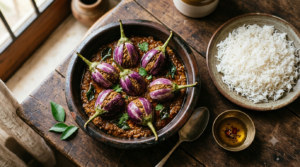
Whole stuffed brinjals resting in a thick peanut-sesame gravy, the way an Andhra stuffed brinjal curry should look off the flame.
This Andhra stuffed brinjal curry is the everyday coastal version, known at home as gutti vankaya kura. It needs nothing beside hot rice and a spoon of sesame oil. Below you will find the masala ratio, the cutting method, the real reason brinjals split, and the difference between this curry and Bagara Baingan.
Andhra Stuffed Brinjal Curry at a Glance
Gutti vankaya kura is an Andhra curry of small brinjals slit into quarters, stuffed with a roasted peanut and sesame masala, then simmered in a tangy tamarind gravy until soft. In Telugu, gutti means stuffed and vankaya means brinjal. The stem stays on so each brinjal holds together.
- Cuisine: Andhra, also cooked across Telangana and Rayalaseema
- Course: side dish for rice or roti
- Prep time: about 20 minutes, plus 10 minutes of soaking
- Cook time: about 30 minutes on a low flame
- Serves: 4 people as a side dish
- Best brinjal: small striped purple ones, roughly 5 to 6 cm long
- Allergens: peanuts and sesame, both central to the masala
- Texture goal: whole brinjals sitting in a thick, oil-glossed gravy
Andhra Stuffed Brinjal Curry vs Bagara Baingan
Search for stuffed brinjal curry and you will meet the same claim on page after page: gutti vankaya and Bagara Baingan are the same dish under two names. They are not, although they share a shopping list.
Bagara Baingan comes from the Hyderabadi kitchen, and its Mughlai lineage shows. The masala leans on dry coconut, sesame and a generous pour of oil, so the gravy turns silky and almost sweet against the tamarind.
An Andhra stuffed brinjal curry is blunter. Peanuts dominate, coriander seed carries the aroma, and the chilli is not softened by cream or extra coconut. Many coastal families skip coconut entirely. The gravy stays thick rather than pourable, because it is meant to be pressed into rice, not spooned over biryani.
That distinction matters when you cook. Follow a Bagara Baingan ratio while expecting an Andhra result, and the curry tastes rich but flat. Heat and sourness are the point here, as they are across Andhra cuisine generally.
Choosing Brinjals for Andhra Stuffed Brinjal Curry
This dish is really won at the vegetable shop, long before the stove is lit. Look for small, firm, glossy brinjals with a green calyx that covers at least a quarter of the body. That long green crown is the tenderness signal.
Striped purple varieties hold their shape better than the deep black ones, since the flesh is denser and the seed load is lower. Press gently with a thumb. If the skin dents and stays dented, the brinjal is old, and it will turn to pulp in the pan.
Avoid anything longer than about 7 cm. Larger brinjals carry mature seeds, so they cook unevenly and taste faintly bitter. Weight is another clue, because a heavy brinjal for its size usually means dense flesh and few seeds.
Ingredients for This Andhra Stuffed Brinjal Curry
The masala is roasted dry, then ground coarse. Do not grind it to a smooth paste, since a slightly grainy powder clings to the inside of the brinjal instead of sliding out.
| Component | Ingredient | Quantity |
|---|---|---|
| Main | Small tender brinjals | 8 to 10 |
| Masala | Raw peanuts | 3 tbsp |
| Masala | White sesame seeds | 2 tbsp |
| Masala | Coriander seeds | 1 tbsp |
| Masala | Cumin seeds | 1 tsp |
| Masala | Dry red chillies | 4 to 6 |
| Masala | Dry coconut, grated | 2 tbsp, optional |
| Masala | Fenugreek seeds | 1 quarter tsp |
| Gravy | Onion, finely chopped | 1 medium |
| Gravy | Tamarind pulp | 1 tbsp, thick |
| Gravy | Jaggery | 1 tsp |
| Gravy | Turmeric powder | 1 half tsp |
| Tempering | Sesame or groundnut oil | 4 tbsp |
| Tempering | Mustard seeds | 1 tsp |
| Tempering | Curry leaves | 1 sprig |
Four tablespoons of oil sounds like a lot, yet brinjal drinks oil and gives it back as the curry finishes. When the masala starts releasing oil at the edges, the dish is done.
Sensible swaps
Peanut allergy in the house? Roasted chana dal replaces peanuts almost perfectly, because it grinds to the same nutty thickness. Sesame can be swapped for a spoon of poppy seeds, which is the older Rayalaseema habit anyway.
Both swaps keep this Andhra stuffed brinjal curry workable for allergy-conscious tables. No tamarind on hand? Use two chopped tomatoes instead, although the sourness will read sweeter and rounder. Jaggery is optional, yet it does quiet the sharp edge of the tamarind.
Andhra Stuffed Brinjal Curry: Step-by-Step Method
Work through this Andhra stuffed brinjal curry in two stages. Everything up to stuffing can be done an hour ahead, while the cooking itself needs your attention.
Stage one: slit, roast and stuff
- Slit the brinjals. Keep the stem on. Stand each brinjal upright and cut a deep cross from the base, stopping about three quarters of the way up. The four quarters must stay joined at the crown.
- Soak them. Drop the slit brinjals into salted water for 10 minutes. This stops the cut flesh browning while you roast the masala.
- Roast the masala. Dry roast peanuts first on medium heat until they smell toasted and the skins loosen. Remove them, then roast sesame seeds until they pop, followed by coriander, cumin, fenugreek and chillies. Add coconut last and roast only until it turns pale gold.
- Grind coarse. Cool everything completely, then grind with salt and turmeric to a coarse powder. Warm spices sweat in the jar and clump, so patience helps here.
- Stuff. Drain and pat the brinjals dry. Open each cross gently and press the powder in with a spoon handle. Keep the leftover masala for the gravy.
Stage two: sear and simmer
- Sear. Heat oil in a wide pan and crackle the mustard seeds and curry leaves. Lay the brinjals in a single layer and roll them slowly for 5 minutes until the skins blister.
- Build the gravy. Lift the brinjals aside, then fry the onion until it turns soft and golden. Stir in the leftover masala, tamarind pulp, jaggery and about one cup of water.
- Simmer low. Return the brinjals, spoon gravy over them, cover and cook on the lowest flame for 20 to 25 minutes. Do not stir with a spoon; instead, swirl the pan.
- Rest. Switch off when oil pools at the edges. Let the curry sit for 15 minutes before serving, because the brinjals keep absorbing gravy as they cool.
What Beginners Get Wrong
Most failed attempts at an Andhra stuffed brinjal curry trace back to four habits. The most common error is trimming the stem. Several popular recipe pages tell you to cut it off, yet the calyx is the hinge holding the four quarters together. Remove it and the brinjal opens like a flower in the pan.
The second error is stirring. A spoon breaks the stuffed quarters within minutes, so shake the pan by its handle instead. Cooks in Guntur simply lift and tilt the vessel every few minutes.
Third, many cooks add water to the raw masala before stuffing. Wet masala slides straight out during the sear. Stuff dry, and let the gravy do the moistening.
Fourth, high heat. Brinjal skin sets and splits under a fierce flame while the inside stays raw. Low and slow is not a suggestion in this dish.
Quick troubleshooting
- Brinjals mushy: they were too large, or too old, or the flame was too high
- Gravy bitter: the coriander seeds or coconut caught colour while roasting
- Gravy thin: simmer uncovered for the last 5 minutes
- Masala falling out: the slit went all the way through the crown
- Curry tastes flat: it needs salt and a little more tamarind, not more chilli
Regional Versions of Andhra Stuffed Brinjal Curry
The recipe shifts a little by district. Rayalaseema kitchens push the peanut ratio higher and often skip coconut, so the curry tastes drier and nuttier. Coastal Andhra cooks lean on tamarind and sesame, which gives a looser, tangier gravy.
Telangana homes frequently add ginger garlic paste and a pinch of garam masala, moving the dish closer to its Hyderabadi neighbour. Brahmin and temple-style versions drop onion and garlic altogether, while extra tamarind and jaggery carry the flavour.
North Karnataka has a close cousin called ennegayi, built on a similar peanut and coconut stuffing. The names differ, although any cook from either state would recognise the other dish instantly.
What to Serve With Andhra Stuffed Brinjal Curry
Serve an Andhra stuffed brinjal curry hot, never straight from the fridge. Plain steamed rice is the classic partner, with a spoon of raw sesame oil poured over the first mound. Mudda pappu, a plain mashed dal, balances the heat well.
For a fuller Andhra plate, pair the curry with temple-style tamarind rice and a bowl of curd. If you would rather build a South Indian breakfast spread instead, the same masala instincts show up in our Andhra pesarattu recipe.
Roti and jowar bhakri also work, since the thick gravy clings to bread better than a thin pulusu would. Looking for another everyday vegetable side? Try this easy okra curry on days when brinjals are out of season.
Storing and Reheating Andhra Stuffed Brinjal Curry
This curry improves overnight. Cool it fully, then refrigerate in a covered box for up to two days, since the peanut gravy sours faster than a plain dal would.
Reheat gently in a pan with a splash of water. Microwaving works, although the brinjals soften further each time. Freezing is not worth it, because the flesh turns watery once thawed.
The Food Safety and Standards Authority of India advises cooling cooked food quickly and refrigerating it promptly rather than leaving it out. Their guidance is available at the FSSAI portal.
Nutrition and Safety Notes
Brinjal itself is light. According to the United States Department of Agriculture FoodData Central entry for raw eggplant, 100 grams carries about 25 calories, 3 grams of dietary fibre and roughly 1 gram of protein. You can check the full profile on the USDA FoodData Central database.
The brinjal contributes very little of the energy in a finished Andhra stuffed brinjal curry. The calorie count, however, comes mostly from peanuts, sesame and oil. A portion is satisfying rather than light, so treat it as a rich side dish and not a diet food.
One genuine caution: peanuts and sesame are both common allergens, and this masala is built on them. If you are cooking for guests, say so plainly before serving. Anyone with a diagnosed nut or seed allergy should use the roasted chana dal version, and severe allergies deserve a doctor’s advice rather than a kitchen workaround.
Before You Cook
A dependable Andhra stuffed brinjal curry comes down to four habits. Buy small striped brinjals with long green crowns, slit them three quarters deep, stuff dry masala, and simmer without ever stirring. Those four habits separate a curry with whole glossy brinjals from a pan of broken pieces.
Roast each masala ingredient separately, because peanuts, sesame and coriander seeds all need different lengths of time. Finally, give the finished curry 15 minutes of rest. It genuinely tastes better on the second day, so cook a slightly larger batch than you need.
Frequently Asked Questions
What does gutti vankaya mean?
Gutti means stuffed and vankaya means brinjal in Telugu, so gutti vankaya simply means stuffed brinjal. Kura means curry or cooked vegetable side dish. The name describes the technique rather than any particular spice blend.
Can I make Andhra stuffed brinjal curry without onion and garlic?
Yes, and many households cook this Andhra stuffed brinjal curry exactly that way. Skip the onion, increase the tamarind slightly, and add an extra teaspoon of jaggery to round the sourness. The peanut and sesame masala already carries enough body, so the gravy will not taste thin.
Which brinjal is best for stuffing?
Small striped purple brinjals around 5 to 6 cm long work best, because their flesh is dense and their seeds are immature. The green calyx should cover at least a quarter of the fruit. Large glossy black brinjals collapse during the simmer.
Why do my stuffed brinjals break while cooking?
Usually the slit went too deep, or the flame was too high, or a spoon was used to stir. Cut only three quarters of the way up, keep the stem intact, cook on the lowest heat, and swirl the pan instead of stirring.
Is Andhra stuffed brinjal curry the same as Bagara Baingan?
No, although the two dishes look similar and share peanuts, sesame and tamarind. Bagara Baingan is Hyderabadi and richer, since it uses more coconut and oil for a silkier gravy. The Andhra version is sharper, hotter and thicker.
How long does this curry keep?
Refrigerated in a sealed container, it stays good for about two days. The peanut-based gravy spoils faster than plain dal, so cool it quickly after cooking. Reheat only the portion you plan to eat.
Can I make it without peanuts?
Roasted chana dal is the standard substitute and grinds to a very similar thickness. Poppy seeds or cashews also work, although cashews make the gravy sweeter. Keep the roasting method the same whichever swap you choose.
Should the brinjals be fried before stuffing?
Not for this style. Deep frying first is a Bagara Baingan habit, whereas the Andhra method sears the stuffed brinjals directly in tempered oil. Searing keeps the skins intact while using far less oil.
What is the ideal gravy consistency?
Thick enough to coat the brinjals and cling to rice, rather than pourable like sambar. If it looks watery near the end, uncover the pan and simmer for another 5 minutes. Oil separating at the edges is the reliable finish signal.