Boli with Payasam Recipe: Soft Kerala Boli & Paal Payasam
Boli with payasam is the classic southern Kerala pairing of a thin, soft lentil-filled sweet flatbread with creamy milk payasam. The best version depends on contrast: the boli should stay flexible and lightly sweet, while the payasam should remain pourable enough to soak into each torn piece. This method makes both components together without rushing either one.
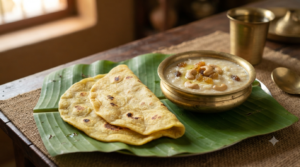
Soft Kerala-style sweet boli served warm with creamy paal payasam for a southern Kerala sadya-style dessert pairing.
Kerala Tourism notes that palada, paal payasam and semiya payasam are eaten with boli in parts of southern Kerala. That regional detail matters because boli is not an essential part of every sadya across the state. The combination is especially associated with Thiruvananthapuram and nearby southern districts.
Boli with Payasam at a Glance
- Style: southern Kerala sweet boli with milk-and-rice paal payasam
- Total time: about 1 hour 30 minutes when the tasks overlap
- Yield: about 10 to 12 boli and 6 small bowls of payasam
- Best texture: thin, flexible boli with a smooth, flowing payasam
- Main ingredients: chana dal, maida, sugar, sesame oil, rice, milk and cardamom
- Best serving method: serve the boli warm and add payasam only when eating
The pairing is more than two sweets placed side by side. Boli is sweet and dense, so the payasam should not be reduced into a thick pudding. A slightly loose paal payasam balances the flatbread and keeps the final bite soft.
Recipe Card
| Detail | Time or Yield | Key Check |
|---|---|---|
| Prep | 25 minutes | Drain the cooked dal very well |
| Dough rest | 30 minutes | Keep it soft and coated with sesame oil |
| Cooking | 55 to 65 minutes | Use low to medium heat |
| Total | About 1 hour 30 minutes | Cook the payasam while the dough rests |
| Yield | 10 to 12 boli | Plus about 6 small payasam servings |
Ingredients for Boli with Payasam
Use ordinary pantry ingredients, but measure the flour and dal carefully because their ratio controls the boli texture. Sugar works especially well for the southern Kerala-style boli served with milk payasam. Jaggery can be used as a variation, although it changes both flavour and moisture.
For the Sweet Boli
- 1 cup chana dal or kadala parippu
- 2 1/2 cups water for cooking the dal
- 1 cup white sugar
- 3/4 cup all-purpose flour or maida
- 1/4 teaspoon turmeric powder, mainly for colour
- 1/2 teaspoon green cardamom powder
- 1 small pinch nutmeg powder, optional
- 1 small pinch salt
- 2 to 3 tablespoons sesame oil or gingelly oil
- About 1/4 cup rice flour for dusting
- 1 to 2 tablespoons ghee for cooking, as needed
- Water as needed to make a very soft dough
For the Paal Payasam
- 1/2 cup short- or medium-grain raw rice, such as Sona Masuri or Ponni
- 1.2 litres full-fat milk
- 1/3 cup white sugar, plus more only after tasting
- 1/4 teaspoon green cardamom powder
- 1 tablespoon ghee
- 10 to 12 cashews, optional
- 1 tablespoon raisins, optional
- 1 small pinch salt, optional
Kerala Tourism describes paal payasam as a rice, milk and sugar dessert cooked until the milk reduces. For this pairing, stop the reduction earlier than you would for a thick bowl dessert because the payasam must still flow over the boli.
How to Make Boli with Payasam Step by Step
The easiest workflow is to start the dal first, prepare the boli dough next, and cook the payasam while the dough rests. That order saves time because the payasam can reduce gently while you finish the filling. It also prevents the common mistake of rushing the dough rest.
1. Cook and Drain the Chana Dal
Rinse the chana dal until the water runs mostly clear. Pressure-cook it with 2 1/2 cups water until tender but not soupy. The dal should crush easily between your fingers, yet it should not dissolve into the cooking water.
Drain it thoroughly in a colander because excess water makes the filling sticky. Leave it for 5 to 10 minutes after draining, so steam can escape. Do not discard the texture check just because a cooker timer or whistle count has finished.
2. Make and Rest the Boli Dough
Mix the maida, turmeric and salt in a bowl. Add water little by little and knead until the dough feels softer than chapati dough. A soft dough stretches around the filling, while a firm dough tends to crack at the edges.
Coat the dough with sesame oil and cover it for 30 minutes. Traditional recipes often use this oil-resting step because it improves elasticity. Meanwhile, start the payasam so both components finish close together.
3. Cook the Paal Payasam
Rinse the rice and soak it for about 15 to 20 minutes if time allows. Bring the milk to a gentle boil in a wide, heavy-bottomed pan, then add the drained rice. Lower the heat and cook until the rice becomes completely tender.
Stir more often as the milk reduces because the base can scorch quickly. Add the sugar only after the rice is soft, then simmer for another 5 to 8 minutes. Finish with cardamom and the optional pinch of salt.
Heat the ghee separately and fry the cashews until pale golden. Add raisins and switch off the heat once they puff. Stir the garnish into the payasam, then keep the pan covered on very low residual heat.
4. Make the Smooth Dal Filling
Transfer the drained dal to a wide pan and add sugar. Cook over medium-low heat while stirring because the sugar first releases moisture. Continue until the mixture becomes thick enough to leave the sides of the pan.
Add cardamom and nutmeg, then cool the filling until it is safe to handle. Mash or pulse it briefly if the dal still looks coarse. The finished filling should roll into a smooth ball without sticking heavily to your palm.
5. Fill, Roll and Cook the Boli
Divide the filling into 10 to 12 balls. Use smaller portions of outer dough because the traditional style has a thin covering and a generous centre. Keep unused dough covered, since even a few minutes of drying can make rolling harder.
Flatten one dough portion in your palm, place a filling ball in the centre, and stretch the edges over it. Pinch away any thick excess dough. Dust lightly with rice flour, then roll gently into a thin circle about 15 to 18 cm wide.
Heat a tawa over low to medium heat and cook the boli until pale golden spots appear. Flip carefully, brush with a little ghee, and cook the second side. Avoid deep browning because overcooked boli becomes firm once it cools.
Why This Boli with Payasam Method Works
Three texture decisions make this boli with payasam version dependable. First, the dal is cooked until tender but drained before sweetening, so the filling stays smooth rather than wet. Second, the outer dough rests under oil, which gives it enough stretch to wrap a larger filling ball.
The third decision is to keep the payasam pourable. A thick payasam tastes good by itself, yet it overwhelms the boli and can turn the pairing heavy. Stop reducing once the rice is soft and the milk lightly coats a spoon.
This is also why a fixed “hotel-style” formula is misleading. Restaurants and caterers use different rice ratios, sweeteners and reduction times. A better target is the final texture: soft boli, smooth filling and flowing payasam.
How to Serve Boli with Payasam for a Sadya
Serve boli with payasam while the flatbread is warm and flexible. Place one boli on the plate or banana leaf, then spoon a small amount of paal payasam over part of it. You can also tear the boli into pieces and dip each piece into a bowl of payasam.
Kerala Tourism explains that southern Kerala sadyas may pair boli with palada, paal payasam or semiya payasam. Therefore, this rice-based version is one traditional option rather than the only correct combination. If your meal already has a rich jaggery pradhaman, a lighter milk payasam gives better contrast.
Do not pour payasam over every boli in advance because the flatbread softens rapidly. Keep the stack covered and add the payasam at the table. That simple serving change preserves the delicate layers much better.
Boli with Payasam: Common Problems and Quick Fixes
| Problem | Likely Cause | Fix |
|---|---|---|
| Boli tears while rolling | Dough too firm or filling too coarse | Rest the dough longer and smooth the filling |
| Filling leaks out | Dal mixture still wet | Cook it until it leaves the pan cleanly |
| Boli turns hard | High heat or too much browning | Cook briefly on low-medium heat |
| Payasam scorches | Thin pan or too little stirring | Use a heavy pan and stir more near the end |
| Payasam becomes too thick | Too much reduction | Stir in a little hot milk before serving |
| Payasam tastes too sweet | Sugar added all at once | Start with the listed amount and adjust after tasting |
If a boli tears at one small spot, dust that area with rice flour and continue gently. However, repeated tearing usually means the dough lacks rest or the puran is too coarse. Fix the cause before rolling the remaining batch.
Boli with Payasam: Make-Ahead, Storage and Food Safety
You can make the dal filling several hours ahead and refrigerate it after cooling. Bring it closer to room temperature before shaping because a very cold filling can make the dough harder to stretch. The dough itself is best mixed and rested on the day you cook the boli.
For the payasam, cool leftovers promptly and refrigerate them within two hours. FoodSafety.gov advises refrigerating perishable leftovers within two hours, or within one hour when the temperature is above 32°C. FSSAI also notes that milk-based sweets have a shorter shelf life and need careful storage.
Do not keep homemade boli at room temperature for three or four days, especially in warm Indian weather. For a cautious home approach, refrigerate leftovers in an airtight container and reheat them briefly on a tawa. Store the payasam separately so the boli does not become soggy.
Useful Variations Without Losing the Pairing
You can serve the same boli with semiya payasam or palada instead of rice paal payasam. That swap changes the texture but keeps the southern Kerala serving idea intact. For a quicker milk dessert, Bhimas Cook’s instant pal payasam recipe is a useful alternative.
If you prefer jaggery, use it in a separate payasam method rather than stirring raw jaggery directly into boiling milk. The paal payasam with jaggery guide explains the safer heat sequence. You can also compare the milk-to-rice balance in the rice payasam recipe.
For the boli itself, a tiny pinch of turmeric is enough for a warm yellow colour, so food colour is optional. Nutmeg is also optional. Keep cardamom, though, because its aroma links the lentil filling naturally with the milk payasam.
Allergens and Serving Notes
This recipe contains milk and wheat, and the garnish may contain cashews. Use clean utensils if you are cooking for someone with a food allergy, since even a small amount of cross-contact can matter. Skip the nuts entirely if they are not suitable for your guests.
For boli with payasam, sweetness is easy to increase but difficult to remove, so begin with the listed sugar amounts. Taste the payasam near the end and adjust only then. The boli filling should taste slightly sweeter on its own because the milk payasam softens that sweetness when served together.
Key Points Before You Cook
Boli with payasam works best when both components are deliberately kept soft. Drain the dal well, rest the dough fully, roll with a light hand, and stop the payasam before it becomes pudding-thick. Those four checks matter more than copying an exact hotel formula.
For cultural accuracy, describe this as a southern Kerala or Thiruvananthapuram-area sadya pairing rather than a universal rule for every Kerala feast. Kerala Tourism’s sadya guidance specifically notes regional differences, while its paal payasam recipe confirms the core milk-rice-sugar method.
Frequently Asked Questions About Boli with Payasam
What is boli with payasam?
Boli with payasam is a festive pairing of a thin sweet flatbread filled with chana dal and sugar, served with a milk-based payasam. It is especially associated with southern Kerala sadya traditions. The boli can be eaten plain, dipped into payasam, or partly covered with it just before eating.
Is Kerala boli the same as puran poli?
They belong to the same broad family of stuffed sweet flatbreads, but regional recipes differ. Southern Kerala boli commonly uses a very soft maida covering, chana dal, sugar, cardamom and sesame oil. Other puran poli versions may use wheat flour, jaggery or different spice ratios.
Which payasam is best with boli?
Paal payasam, palada and semiya payasam all work well because their milk base softens the sweet flatbread. Kerala Tourism specifically mentions these combinations in southern Kerala. Choose a pourable payasam because an extremely thick version can make the pairing feel heavy.
Can I make the boli one day ahead?
Yes. Cool the cooked boli, refrigerate it in an airtight container, and reheat briefly on a tawa before serving. Do not soak it in payasam ahead of time because it will lose its layered texture and become soggy.
Why does my boli tear while rolling?
Boli usually tears because the outer dough is too firm, the filling is coarse, or the dough has not rested enough. Keep the covering very soft and let it rest under sesame oil. Also make sure the dal filling is smooth and dry enough to roll into a ball.
Can I make boli without yellow food colour?
Yes. Yellow food colour is not necessary because a small pinch of turmeric gives a gentle golden tone. Use only a little turmeric, since too much can affect the flavour. You can also leave both out and keep the boli naturally pale.
Can I use jaggery instead of sugar?
You can use jaggery in the boli filling, but the result will taste different and may need extra cooking to remove moisture. For milk payasam, use a tested jaggery method because hot milk can split when jaggery contains acidic impurities. Sugar is the simpler choice for this combined recipe.
How do I keep paal payasam from becoming too thick?
Stop cooking while the payasam still flows easily from a ladle because it thickens as it cools. If it becomes too thick, stir in a little hot milk before serving. Avoid adding cold milk directly to a very hot pan, since that can interrupt the texture.
Is boli served in every Kerala sadya?
No. Boli is strongly associated with southern Kerala traditions, especially around Thiruvananthapuram and nearby areas, but sadya menus vary across the state. Kerala Tourism also describes regional differences in how payasam is served. Treat the combination as a regional specialty, not a statewide requirement.