Parippu Payasam Recipe: Easy Pressure Cooker Method
Parippu payasam recipe is easiest to get right when you roast the moong dal, cook it until soft, simmer it with jaggery, and add thick coconut milk only at the end. This version keeps the familiar Kerala combination of cherupayar parippu, jaggery, coconut milk and ghee, but uses a pressure cooker to shorten the cooking time. The result should be creamy and pourable, with a nutty dal flavour and a clean jaggery finish.
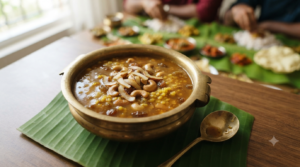
Kerala-style parippu payasam made with roasted moong dal, jaggery and coconut milk, finished with fried coconut and nuts.
“Hotel style” does not mean one fixed formula because Kerala hotels and homes use different ratios. Here, it means a smooth, rich payasam that still flows from a ladle instead of setting like pudding. Kerala Tourism lists parippu payasam among common Sadya desserts made with lentils, coconut milk and jaggery.
Parippu Payasam Recipe at a Glance
- Prep time: about 15 minutes.
- Cook time: about 35 to 40 minutes.
- Total time: about 50 to 55 minutes.
- Yield: about 6 small dessert servings.
- Main ingredients: yellow moong dal, jaggery, coconut milk and ghee.
- Best texture: thick enough to coat a spoon lightly, yet loose enough to pour.
- Key technique: add thick coconut milk last and avoid a hard boil afterward.
This parippu payasam recipe is a quicker pressure-cooker method rather than a truly “instant” dessert. The cooker saves time on the dal, but jaggery and coconut milk still need gentle simmering. That finishing stage gives the payasam a rounded flavour.
Why This Parippu Payasam Recipe Works
The method separates the recipe into three texture stages. First, dry-roasting removes the raw lentil smell and adds a warm, nutty aroma. Next, the cooked dal simmers with jaggery so the sweetness moves through the lentils instead of sitting only in the liquid.
Finally, thin coconut milk builds the body while thick coconut milk finishes the dessert. This order matters because thick coconut milk can lose its smooth texture when boiled hard. Low heat at the final stage reduces oil separation.
The garnish stays flexible. Fried coconut pieces are a strong Kerala-style choice, while cashews and raisins are common additions. If you want the most traditional flavour profile, use coconut pieces first and treat nuts and raisins as optional.
Ingredients for This Parippu Payasam Recipe
| Ingredient | Quantity | Purpose |
|---|---|---|
| Yellow moong dal | 1 cup | Creates the nutty lentil base |
| Water | 3 cups, plus 1/4 cup for jaggery | Cooks the dal and melts jaggery |
| Grated jaggery | 1 to 1 1/4 cups | Sweetens the payasam; adjust to taste |
| Thin coconut milk | 2 1/2 cups | Builds the main liquid body |
| Thick coconut milk | 1 1/2 cups | Adds the final creamy finish |
| Ghee | 2 tbsp | Roasts the garnish and adds aroma |
| Coconut pieces | 2 tbsp, optional | Adds a classic toasted coconut bite |
| Cashews | 10 to 12, optional | Adds crunch |
| Raisins | 1 tbsp, optional | Adds small bursts of sweetness |
| Cardamom powder | 1/2 tsp | Provides the main spice aroma |
| Dry ginger powder | 1/4 tsp, optional | Adds a warm Kerala-style note |
| Cumin powder | 1/8 tsp, optional | Adds a subtle savoury-spice edge |
| Salt | 1 small pinch | Balances the sweetness |
In this parippu payasam recipe, start with 1 cup jaggery if you prefer moderate sweetness. You can increase it toward 1 1/4 cups after tasting the cooked dal-jaggery base. Jaggery varies by brand, so sweetness will not be identical every time.
Which dal should you use?
Use split yellow moong dal, also called cherupayar parippu or pasi paruppu. It cooks quickly and turns creamy without becoming gluey. Whole green gram gives a different texture, while chana dal stays firmer and needs separate timing.
Dry-roast the moong dal before rinsing it. Stop when the grains smell nutty and show a light golden tint. Dark brown spots mean the dal has gone too far and may give the dessert a bitter edge.
Fresh coconut milk or packaged coconut milk?
Fresh coconut-milk extracts give the most traditional layering. However, packaged coconut milk also works. Keep the thicker milk for the final stage, while a diluted portion can stand in for thin coconut milk.
Brands differ a lot in thickness, so use texture rather than a rigid dilution ratio. The thin portion should pour like light milk, while the final portion should coat the spoon more heavily.
How to Make Parippu Payasam Recipe Step by Step
Build the dal and jaggery base
- Roast the dal. Heat a heavy pan on medium-low. Add 1 cup yellow moong dal and dry-roast for 3 to 4 minutes. Stir constantly until the dal smells nutty and turns lightly golden.
- Rinse and pressure-cook. Rinse the roasted dal quickly, then transfer it to a pressure cooker with 3 cups water. Cook until the grains crush easily between your fingers. In many stovetop cookers this takes about 2 to 3 whistles, although cooker size and heat level vary.
- Make the jaggery syrup. While the dal cooks, warm 1 to 1 1/4 cups grated jaggery with about 1/4 cup water. Stir until dissolved, then strain if the jaggery contains grit or visible impurities.
- Mash the dal lightly. Let the pressure release naturally, then open the cooker. Mash roughly one-third to one-half of the dal. Leave some grains visible because the contrast gives the payasam a better texture.
- Cook dal with jaggery. Add the strained jaggery syrup to the cooked dal. Simmer on low to medium-low for 5 to 7 minutes, stirring often. The mixture should become glossy and slightly thicker.
Finish the Parippu Payasam Recipe With Coconut Milk
- Add thin coconut milk. Pour in 2 1/2 cups thin coconut milk. Simmer gently for another 5 to 7 minutes. Stir across the bottom because the dal can settle and catch as the mixture thickens.
- Add the spices. Stir in cardamom, the optional dry ginger and cumin, and a small pinch of salt. Taste now because this is the easiest stage to adjust sweetness.
- Finish with thick coconut milk. Lower the heat completely. Add 1 1/2 cups thick coconut milk and warm only until the payasam steams. Do not bring it back to a vigorous boil.
- Fry the garnish. Heat ghee in a small pan. Fry coconut pieces until golden, then add cashews. Add raisins last and remove the pan once they puff.
- Rest before serving. Stir the garnish into the payasam and switch off the heat. Rest for 10 to 15 minutes because the dal continues to absorb liquid as it sits.
Do not judge the final consistency while the payasam is bubbling. It thickens noticeably during resting and even more after refrigeration. Stop when it looks a little looser than the texture you eventually want.
Pressure-cooker doneness matters more than whistle count
A fixed whistle count is only a guide because pressure cookers behave differently. The dal is ready when every grain is soft and you can crush it without resistance. If the centre still feels chalky, add a little hot water and cook again before adding jaggery.
This cue is more reliable than a fixed whistle rule. Undercooked dal is one of the main reasons parippu payasam feels grainy. Fully soft dal also blends with jaggery more evenly.
How to Get a Smooth Hotel-Style Finish
For this parippu payasam recipe, a smooth hotel-style finish comes from controlled thickness, not extra cream or condensed milk. The dal should remain visible, but the liquid around it should feel silky. If the dessert turns stiff in the pan, it will become even thicker after it rests.
- Use a heavy pan during the jaggery and coconut-milk stages because thin pans scorch quickly.
- Keep the flame low after jaggery goes in, since the mixture becomes thicker and catches more easily.
- Add thick coconut milk last, then warm gently instead of boiling hard.
- Use fried coconut pieces for a deeper Kerala-style aroma.
- Rest the payasam before adjusting its final thickness.
If the rested payasam becomes too thick, stir in a small amount of warm thin coconut milk or hot water. Add only a little at a time because an over-diluted payasam tastes flat. Then warm it gently and recheck the sweetness.
Common Parippu Payasam Recipe Problems and Fixes
| Problem | Likely cause | Best fix |
|---|---|---|
| Grainy texture | Dal was undercooked | Cook the dal until fully crushable before adding jaggery |
| Payasam is too thick | Too much reduction or long resting | Loosen with warm thin coconut milk or hot water |
| Oily or separated finish | Thick coconut milk boiled too hard | Add thick milk last and keep the heat very low |
| Burnt taste | Dal-jaggery mixture caught at the base | Move the unburnt portion to a clean pan without scraping |
| Too sweet | Jaggery added all at once | Start lower next time; dilute this batch with thin coconut milk |
| Weak flavour | Dal was not roasted or spices were old | Roast lightly and use fresh cardamom |
Do not fix every problem with more coconut milk because it changes the dal-jaggery balance. Fix texture first, then taste again.
Traditional Kerala Flavour Without Overcomplicating It
A traditional parippu payasam recipe often includes more than cardamom alone. Small amounts of dry ginger and cumin appear in many traditional preparations, while fried coconut pieces add a distinct roasted aroma. These ingredients should stay in the background rather than make the dessert taste strongly spiced.
Kerala Tourism includes parippu payasam among the common payasams served with a Sadya. Its broader payasam guidance also notes the use of coconut milk, jaggery, ghee, spices, cashews and raisins across Kerala payasam styles. You can read the cultural background on Kerala Tourism’s payasam page and its Sadya guide.
Families differ on garnish and spice ratios. Keep dal, jaggery and coconut milk as the core, then treat the garnish as a house-style choice.
Easy Variations Without Losing the Main Recipe
If you want a coconut-free version, use the dedicated parippu payasam without coconut milk recipe instead of making a direct swap here. Milk and jaggery need different heat control, so treating them as a separate method reduces the chance of curdling.
For a fresh-coconut version with a stronger traditional emphasis, compare the cherupayar parippu payasam with coconut milk. If you want a lighter milk-based dessert for another occasion, the semiya payasam recipe uses vermicelli instead of lentils.
To make this version vegan, replace ghee with coconut oil and skip dairy-based garnishes. Coconut milk already forms the main base, so no other change is needed. The flavour will be slightly more coconut-forward, which works well with dark jaggery.
How to Store and Reheat Parippu Payasam
Because this parippu payasam recipe uses coconut milk, cool leftovers promptly and refrigerate them in a clean, covered container. FSSAI consumer guidance advises refrigerating cooked food promptly and not leaving cooked food at room temperature for more than two hours. For best quality, use this coconut-milk payasam within 2 to 3 days.
Reheat only the amount you plan to serve. Warm it on low heat while stirring, then loosen it with a little water or thin coconut milk if needed. Avoid repeated heating and cooling because both texture and food safety become harder to control.
For general cooked-food safety guidance, see the Food Safety and Standards Authority of India food-safety tips. If the payasam smells sour, shows unusual bubbling, or has sat out too long, discard it rather than trying to rescue it by boiling.
Serving Parippu Payasam for Sadya or at Home
Serve parippu payasam warm or at room temperature when you want the jaggery and roasted-dal aromas to stay prominent. Chilled payasam tastes denser, so loosen it before serving if it has been refrigerated. Small bowls work well because the combination of dal, jaggery and coconut milk is naturally rich.
During a Kerala Sadya, payasam appears as the sweet course and may be served with other festive dishes. At home, it also works as a stand-alone dessert after a simple South Indian meal.
If you are serving a crowd, cook the dal and prepare the jaggery syrup ahead. Finish the coconut-milk stages closer to serving time. That keeps the aroma fresher and makes final thickness easier to control.
Parippu Payasam Recipe: Final Texture Check
Before serving, check three things: the dal should be fully soft, the jaggery should taste integrated, and the payasam should still pour. If all three are right, avoid further simmering. Extra cooking at this point usually makes the dessert thicker without adding much flavour.
Keep the original idea simple. Roast the dal, cook it properly, simmer with jaggery, build body with thin coconut milk, and finish with thick coconut milk on low heat. That sequence gives this easy pressure-cooker version its most reliable texture.
Frequently Asked Questions
Is parippu payasam the same as parippu pradhaman?
The names often overlap, especially for Kerala preparations made with lentils, jaggery and coconut milk. “Pradhaman” commonly refers to a richer jaggery-and-coconut-milk style served during feasts. Household naming varies, so the ingredient method is more useful than the label alone.
Can I make this parippu payasam recipe without a pressure cooker?
Yes. Simmer the roasted and rinsed moong dal in a heavy pot until every grain becomes soft enough to crush. Add more hot water as needed, then continue with the jaggery stage. The stovetop method takes longer, but the rest of the recipe stays the same.
Can I use canned coconut milk?
Yes. Reserve some undiluted canned coconut milk for the final thick stage, then dilute another portion with warm water for the earlier thin stage. Since brands vary in richness, judge by consistency instead of relying on one fixed water ratio.
Why did my parippu payasam become too thick after cooling?
Moong dal keeps absorbing liquid as the payasam rests, so the dessert naturally thickens after cooking. Stir in warm thin coconut milk or hot water a little at a time. Then warm gently and taste again before adding more jaggery.
Can I replace jaggery with sugar?
You can, but the flavour changes significantly because jaggery provides the caramel and mineral notes associated with this style. If you use sugar, add it gradually after the dal cooks. The finished dessert will taste cleaner and lighter, but less like Kerala-style parippu pradhaman.
Can I make parippu payasam ahead for a party?
Yes, but make it slightly looser than your serving target because it thickens while resting. Refrigerate it promptly once cooled, then reheat gently before serving. Add a small amount of warm thin coconut milk if the chilled payasam becomes dense.
How long does parippu payasam keep in the fridge?
For best quality, use refrigerated parippu payasam within 2 to 3 days. Store it in a covered container and refrigerate cooked food promptly. If it has remained at room temperature for more than two hours, the safer choice is to discard it.
Can I make it fully vegan?
Yes. Replace ghee with coconut oil and keep the coconut-milk base unchanged. If you use packaged ingredients, check their labels for added dairy. The result stays rich because coconut milk provides most of the body.