Diwali Sweets Storage: Cooling, Refrigeration and Gifting Guide
Diwali sweets storage starts with one simple question: how much moisture and fresh dairy does each mithai contain? A khoya peda, a soft coconut barfi and a dry besan ladoo should not share the same storage plan. Here is how to cool, chill, pack and gift them without guessing an expiry date.
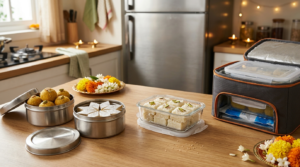
Traditional Indian sweets arranged in separate containers to illustrate safe cooling, refrigeration and Diwali gifting.
Sugar and ghee can help a sweet keep its texture, but they do not make every recipe shelf-stable. The Food Safety and Standards Authority of India (FSSAI) lists different illustrative shelf-life groups for traditional sweets. Your homemade batch still needs its own cautious handling plan.
Diwali Sweets Storage at a Glance
- Fresh dairy sweets: Keep khoya, chhena, rabri and other moist milk sweets refrigerated. Make them near serving time.
- Moist coconut sweets: Refrigerate fresh-coconut, milk-rich or fruit-filled barfi and ladoo promptly.
- Truly dry sweets: Use clean, dry, airtight containers away from heat and humidity. Check the full ingredient list first.
- Cooling: Move perishable sweets into shallow containers and refrigerate promptly. Do not leave a tray out all night.
- Gifting: Use an insulated cooler with frozen gel packs for sweets that need refrigeration. A decorative cardboard box is not a cold chain.
For perishable foods, FoodSafety.gov advises refrigeration within two hours, or within one hour above 32°C. Keep the fridge at 4°C or below. These are food-safety limits for time outside temperature control, not promises of how many days mithai will last.
Which Sweet Needs Which Storage Method?
The ingredient that makes a sweet creamy can also make it harder to store. Fresh milk, khoya, chhena, fruit and wet coconut add moisture. By contrast, well-cooked flour-and-ghee sweets often have less free water, though every formulation differs.
| Sweet type | Examples | Practical storage choice |
|---|---|---|
| Moist dairy | Kalakand, rasmalai, rabri, soft peda | Refrigerate promptly; plan short holding and chilled travel |
| Moist coconut or fruit | Fresh coconut barfi, condensed-milk coconut ladoo, pineapple-coconut barfi | Refrigerate promptly; keep cold during gifting |
| Lower-moisture sweets | Plain besan ladoo, chikki, some well-set kaju katli | Use a dry airtight box if the recipe and conditions support room-temperature storage |
| Mixed or uncertain | Filled gujiya, milk-enriched dry sweets, experimental batches | Follow the most perishable ingredient; refrigerate if unsure |
This ingredient-based split makes Diwali sweets storage more useful than a single expiry table. This is a decision guide, not a fixed shelf-life chart.
FSSAI’s traditional milk-products guidance places kalakand and rasmalai in much shorter illustrative groups than plain besan ladoo. It also separates kaju katli from moist coconut sweets. Those examples do not certify a homemade batch for any set number of days.
Diwali Sweets Storage for Khoya and Milk Sweets
Diwali sweets storage for khoya peda, milk cake and kalakand starts with rapid chilling because their milk solids and moisture vary. Put them into clean, covered, shallow containers and chill promptly. Then return the box to the fridge after serving, rather than leaving it beside the puja thali.
Keep portions small when guests visit. Set out only what people will eat, while the rest stays cold. If you buy loose sweets, ask the shop when they were made and what storage conditions the maker recommends.
Do not assume that extra sugar or a thick-looking surface makes a milk sweet safe at room temperature. Nor should you treat refrigeration as a way to extend an already questionable batch. If it spent too long warm, chilling it later cannot undo that exposure.
What about rasgulla and syrup sweets?
Syrup is not automatic protection against spoilage. Rasgulla, rasmalai and similar moist products still need careful handling, especially when they contain fresh dairy. Refrigerate them in clean, food-safe containers with the appropriate syrup. Use a clean spoon each time to prevent contamination.
Diwali Sweets Storage for Coconut Barfi and Ladoo
For Diwali sweets storage, coconut needs its own moisture check. Coconut sweets are not one storage category.
Fresh grated coconut holds moisture, while desiccated coconut starts much drier. Add milk, condensed milk or fresh fruit, and the finished sweet changes again. Treat soft, milk-rich coconut sweets as perishable instead of copying the storage advice for dry ladoos.
Consider Bhimas Cook’s pineapple coconut barfi trial. Its fruit, coconut and milk powder make moisture control central to the recipe. The page calls the formula untested and gives no proven shelf life. Therefore, refrigerate a safely prepared batch promptly and do not promise that it can travel without cooling.
The same caution applies to coconut ladoo made with condensed milk. Although the mixture may firm up in the fridge, firm texture alone does not prove safety. Pack it only after safe, prompt cooling, and keep it chilled until serving.
Fresh coconut versus desiccated coconut
Fresh coconut and dried coconut behave differently, but the finished recipe matters more than the ingredient name. A dry coconut filling may become moist after you add milk or fruit. Check the recipe’s final texture and ingredients before deciding whether a gift box can travel unchilled.
What About Dry Ladoo, Kaju Katli and Chikki?
Diwali sweets storage is simpler for well-roasted besan ladoo, crisp chikki and some firmly set nut sweets than for rabri or soft barfi. They still need clean handling and protection from humidity. Keep each type in a separate dry, airtight food-safe container, away from direct sunlight and a hot stove.
Our Diwali sweets recipes include besan ladoo, kaju katli, Mysore pak and moist coconut ladoo. These recipes do not all belong in one storage group. A milk addition, damp garnish or altered cooking method can change the plan.
For example, pistachio besan ladoo remains an untested recipe trial. Its extra nuts and unverified final texture mean no tested expiry date exists. Make a small trial batch and assess handling before considering a large gift order.
Remember that an airtight tin prevents outside moisture from entering only when the sweet goes in dry and the seal stays intact. It cannot remove moisture already trapped inside. If oil smells rancid or the batch looks doubtful, discard it rather than masking the flavour.
How to Cool Sweets Before Refrigerating
Good Diwali sweets storage begins during cooling, because perishable sweets should not face long exposure to warm conditions. Do not wait until a large hot tray becomes completely cold on the counter. Instead, spread or portion the cooked mixture into shallow food-safe containers, then refrigerate promptly within the recommended time limit.
- Finish cooking with clean tools. Keep hands, trays, knives and serving spoons clean before food touches them.
- Divide large batches. A shallow layer loses heat faster than a deep mound, so avoid one large container of hot halwa.
- Refrigerate on time. For perishable sweets, count the time from when they leave safe hot holding. Do not exceed two hours, or one hour above 32°C.
- Cover appropriately. Keep food protected from spills and drips. Once chilled, close lids securely to limit odours and drying.
- Mark the batch. Write its preparation date, ingredients and “keep refrigerated” note where relevant.
The two-hour rule is an upper limit, not a target. Faster chilling is preferable when practical. Follow official cooling guidance rather than leaving a large pot or tray at room temperature until morning.
Refrigeration Without Soggy or Dry Mithai
Refrigeration controls temperature, but it can also alter a sweet’s texture. Soft barfi may firm up, while exposed peda can dry on the surface. Keep types apart in clean sealed containers, with food-safe paper between layers where that suits the recipe.
For Diwali sweets storage, use the main fridge shelves instead of repeatedly moving boxes in and out. Check the temperature with an appliance thermometer, since a crowded fridge may cool slowly. A set point of 4°C or below matters more than whether the box feels cool to your hand.
Do not place uncovered sweets near strong-smelling foods. Also avoid returning a partially eaten serving plate to the main batch. Set out a smaller plate instead, and keep the reserve sealed and chilled.
If you see water droplets inside a box, review the cooling and packing method next time. Condensation can wet a surface that was meant to stay dry. However, wiping away droplets does not make a poorly handled perishable batch safe.
Diwali Sweets Storage for Gifting and Travel
A Diwali sweets storage plan for gifting must cover the journey, not only the box. A gift box is packaging, not preservation. For a short local visit, dry sweets may be the simpler choice when their ingredients and preparation support it. Milk-rich or moist coconut sweets require continuous cold handling, even if the box has a tight lid.
- Choose the sweet first. Match the recipe to journey time, weather and the recipient’s fridge access.
- Pack by category. Keep moist dairy away from dry chikki, kaju katli and roasted ladoo.
- Keep perishable boxes cold. Transfer them straight from the fridge to an insulated cooler with frozen gel packs.
- Check temperature. Use a thermometer to confirm cold food stays at 4°C or below throughout travel.
- Arrange handover. Make sure someone can receive and refrigerate the gift without delay.
- Label allergens. State milk, nuts, wheat, sesame and coconut where the recipe contains them.
FoodSafety.gov recommends cold packs and a cooler thermometer for outdoor food handling. A parked car can get hot, so do not leave sweet boxes on the seat while running errands. If cold control is uncertain, choose a different gift instead.
Can you courier homemade Diwali sweets?
Choose only a product whose storage requirements the shipping service can meet. Ordinary parcel transit does not guarantee refrigeration, and delivery delays can defeat a carefully packed box. For perishable sweets, use a proven refrigerated delivery arrangement or avoid shipping them. Confirm delivery before dispatch.
Small Details That Prevent Big Storage Mistakes
The biggest error is often mixing sweets that merely look similar. White coconut barfi with fresh milk behaves differently from a firm nut sweet. A glossy syrup does not turn a chhena sweet into a dry one. Therefore, sort by ingredients and moisture, not colour or price.
- Do not use damp tins, wet hands or a shared spoon for several gift boxes.
- Avoid pressing warm, steamy sweets into a sealed decorative box.
- Do not add fresh fruit garnish to a dry sweet and then keep the original storage assumption.
- Do not treat a printed recipe estimate as a laboratory-tested expiry date.
- Never rely only on smell or appearance to decide whether warm-held food is safe.
Dry and moist sweets also affect each other inside a mixed pack. A moist piece may soften a neighbouring crisp sweet, while cold storage may change a brittle texture. Separating compartments helps preserve quality and makes handling safer.
Shop-Bought Sweets: Ask the Right Questions
Packaged mithai should carry its applicable label information, so read the storage directions and date marking. Loose sweets need an extra conversation with the seller. Ask about the making date, milk or nut ingredients and refrigeration, then follow the maker’s instructions where safe and clear.
There is a common outdated claim that every tray of loose sweets must display a best-before date. FSSAI withdrew that specific mandatory direction on 7 November 2023 and made such tray displays optional pending further decision. Therefore, the absence of a tray date does not alone establish a breach of that withdrawn direction. Ask the seller directly rather than guessing.
If Storage or Delivery Goes Wrong
Safe arrival is not guaranteed simply because the sweet left home cold. A delayed courier, a warm cooler or a box forgotten in a car can break the plan. If a perishable sweet exceeds recommended time and temperature limits, discard it instead of chilling it again or tasting a sample.
When no reliable cold transport is available, the best fallback is to gift a suitable lower-moisture sweet. Another option is to deliver the perishable mithai directly when the recipient can refrigerate it. Never promise that reheating, extra sugar or freezing will rescue food after unsafe handling.
Before You Fill the Gift Boxes
The most useful Diwali sweets storage rule is to classify the finished sweet, not its festive name. Chill dairy and moist coconut recipes promptly, and keep genuinely dry sweets protected from heat and moisture. For gifting, plan the journey before choosing the recipe. When a batch has an unknown history, safety matters more than saving the box.
Frequently Asked Questions
How long can homemade Diwali sweets be stored?
There is no reliable universal number for homemade sweets. Ingredients, final moisture, hygiene, temperature and the time spent outside refrigeration all matter. FSSAI gives illustrative categories for traditional products, but those are not tested expiry dates for your recipe. Prepare moist varieties close to serving.
Should all Diwali sweets go in the fridge?
No, but milk-rich and moist coconut sweets usually need prompt refrigeration. Truly dry sweets may suit a cool, dry cupboard when the recipe supports that choice. Do not decide only by appearance. Check whether you added milk, cream, fresh fruit or wet coconut.
Can coconut ladoo stay at room temperature?
Do not assume it can, especially when it contains condensed milk or fresh coconut. Those ingredients change the moisture and storage needs. Refrigerate such ladoos promptly, and use cold transport for gifting. A ladoo that holds its shape is not necessarily shelf-stable.
Can I pack warm barfi in an airtight container?
Avoid sealing warm, steamy barfi directly into a final gift box because trapped moisture can cause condensation. For a perishable batch, portion it into shallow food-safe containers and refrigerate promptly. Once adequately chilled, transfer it with clean tools into suitable covered packaging.
How do I transport milk sweets to relatives?
Use a chilled, insulated cooler with frozen gel packs and a thermometer. Keep the sweets at 4°C or below, and confirm someone can refrigerate them on arrival. If the journey cannot maintain that temperature, choose a different sweet or arrange reliable chilled delivery.
Can I refrigerate sweets after leaving them out overnight?
Do not try to rescue perishable sweets that have spent the night without safe temperature control. Refrigeration cannot reverse exposure that may have allowed harmful germs to grow. Discard the batch rather than judging safety by smell, taste or appearance.
Is kaju katli safer for gifting than rasmalai?
A well-set, lower-moisture kaju katli is generally easier to transport than chilled rasmalai, but formulation matters. Check for added milk, wet fillings or unusual ingredients. Pack kaju katli in a clean dry container, and follow its actual maker’s storage instructions.
Should I freeze Diwali sweets to make them last longer?
Freezing can affect texture, and it does not make previously mishandled sweets safe. Some recipes may freeze well, while delicate dairy sweets can split or turn grainy. Freeze only a freshly prepared, safely chilled product when the recipe supports it. Thaw perishable portions in the refrigerator.