Pineapple Coconut Barfi: Festive Untested Recipe Trial
Pineapple coconut barfi sounds like a natural festive pairing, but this version should be treated as an untested recipe trial, not a proven formula. The main challenge is not flavour; it is controlling pineapple moisture so the coconut mixture can cool into clean, sliceable pieces instead of staying sticky or turning jammy.
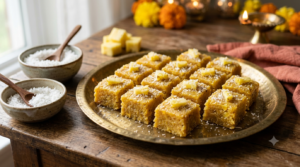
A festive pineapple coconut barfi concept showing golden fruit-and-coconut squares with a simple Diwali presentation.
Untested recipe trial: The ingredient ratios and method below have not been kitchen-tested by Bhimas Cook. Use the texture cues as the main guide, record what happens in your batch, and adjust only after you see how your pineapple behaves.
This trial uses fresh pineapple, unsweetened desiccated coconut, sugar, milk powder and ghee. That gives the fruit room to taste fresh while the dry ingredients help manage water. For the 2026 festive season, both India Post and Drik Panchang list Diwali on 8 November 2026, so this is a timely sweet to test before making a larger festival batch.
Pineapple Coconut Barfi at a Glance
Pineapple coconut barfi works only when you remove enough water before setting. Fresh pineapple brings far more moisture than a classic dry coconut barfi. Therefore, the best trial method is to reduce the fruit first, then add coconut, sugar and milk powder in stages while watching the texture closely.
- Recipe status: untested trial, not a guaranteed formula.
- Target texture: moist and fudgy, yet firm enough to cut after cooling.
- Main risk: excess pineapple water can leave the slab soft or sticky.
- Best control: reduce the pineapple puree before adding the remaining ingredients.
- Allergens: contains milk from ghee and milk powder; coconut is also present. Optional pistachios or cashews add tree nuts.
- Storage: no shelf-life guarantee is given because this recipe has not undergone storage testing.
Fresh pineapple also contains bromelain, an enzyme that breaks down proteins. University of Georgia Extension teaching material demonstrates how fresh pineapple bromelain acts on protein gels, while heat treatment changes that behaviour. This barfi does not rely on gelatin, but cooking the fruit first still gives a more controlled base before dairy ingredients go into the pan.
Pineapple Coconut Barfi Trial Ingredients
The quantities below are a starting formula for one small test batch. A small batch matters because pineapple sweetness, acidity and water content vary from fruit to fruit. If the first trial works, you can repeat it before scaling rather than doubling an unproven mixture immediately.
| Ingredient | Trial quantity | Why it is here |
|---|---|---|
| Fresh ripe pineapple flesh | 300 g | Fruit flavour and acidity |
| Unsweetened desiccated coconut | 160 g | Body and moisture absorption |
| Granulated sugar | 150 g | Sweetness and set |
| Full-fat milk powder | 50 g | Dry solids and softer barfi texture |
| Ghee | 30 g, plus a little for greasing | Richness and easier release |
| Green cardamom powder | 1/4 tsp | Light festive aroma |
| Fine salt | Small pinch | Balances sweetness |
| Chopped pistachios or cashews | Optional | Garnish and crunch |
A 15-18 cm square tray should suit this trial, though final thickness will depend on reduction. Line the base with baking paper or grease it lightly with ghee before cooking. Keep the tray ready because the mixture may become difficult to spread once it reaches the right point.
Why Pineapple Coconut Barfi Can Fail to Set
The most likely reason pineapple coconut barfi stays soft is simple: too much water remains in the fruit. Sugar first draws out more liquid, so a mixture that looked thick before sweetening can loosen again. That is why the pineapple should be reduced separately and the final mixture must cook beyond the glossy, jam-like stage.
Fresh coconut would add another large source of water, so this trial deliberately uses desiccated coconut. Milk powder adds more dry solids without pouring fresh milk into an acidic fruit base. However, neither ingredient can rescue a mixture that is still obviously wet when it goes into the tray. Our rava laddu with jaggery recipe also compares fresh and dry coconut.
The best setting cue is the behaviour of the mass in the pan. It should gather together as you push it, expose the pan for a moment after each stroke, and hold a soft mound instead of flowing straight back. If it still spreads like thick porridge, continue cooking gently.
Reduce the Pineapple Before Anything Else
Blend the 300 g pineapple flesh without adding water. Transfer the puree to a wide, heavy pan. Cook it over medium-low heat while stirring often, especially as it thickens and starts catching around the edges.
A scale gives a useful trial control. Reduce the puree until it weighs about 120-140 g, then note the exact figure for your batch. This target is intentionally a range because pineapple water content varies, and the final visual texture matters more than a fixed cooking time.
The reduced puree should look thick, bright and spoonable rather than pourable. If it is still bubbling with obvious free liquid, keep cooking. Do not rush this stage with very high heat because concentrated fruit sugars can catch quickly.
How to Make Pineapple Coconut Barfi
- Prepare the tray. Lightly grease or line a small square tray, then keep it within reach.
- Reduce the fruit. Blend 300 g pineapple with no added water and cook it down to roughly 120-140 g.
- Add the coconut. Stir in the desiccated coconut and cook on low heat until the mixture looks evenly hydrated.
- Add the sugar. Stir in the sugar. The mixture will loosen as the sugar dissolves, so continue cooking instead of judging the set too early.
- Add the milk powder. Lower the heat, sprinkle it in gradually and stir well to avoid dry pockets.
- Finish with ghee. Add the ghee in two or three additions. Stir until each addition disappears into the mixture.
- Season lightly. Add cardamom and a small pinch of salt near the end.
- Cook to the setting cue. Stop when the mixture gathers as one mass, leaves the pan briefly after a stroke and holds a soft mound.
- Press into the tray. Transfer immediately, press into an even layer and smooth the top with a greased spoon or spatula.
- Cool safely before cutting. Let the slab settle briefly in its shallow tray, then refrigerate promptly; do not wait indefinitely for complete room-temperature cooling. Refrigerate within 2 hours of cooking, or within 1 hour if the surrounding temperature is above 32°C. Cut once firm.
This pineapple coconut barfi trial is designed around visual cues rather than a strict minute count. Pan width, heat output and fruit ripeness can change the cooking time considerably. Therefore, write down the puree weight and final texture so the second attempt starts with real evidence.
How to Know Pineapple Coconut Barfi Is Ready to Set
Pineapple coconut barfi is ready for the tray when the mixture behaves like a soft dough rather than a spoonable preserve. Drag a spatula through the centre. If the line stays visible for a moment and the mixture moves back as one mass, you are near the setting point.
A second check is the spoon test. Lift a small amount and let it sit for 20-30 seconds on a cool plate. It should remain as a mound with only slight settling, although it will still be soft while hot.
Do not wait for the mixture to become dry and crumbly in the pan. Coconut continues to absorb moisture as the slab cools. A batch taken too far may slice neatly but eat dry, so the goal is firm movement with a slight sheen rather than a powdery finish.
The Moisture-Control Logic Behind This Trial
Three decisions make this trial more controllable. First, the pineapple loses water before sugar enters the pan. Second, desiccated coconut replaces fresh coconut, so the recipe does not introduce another wet ingredient. Third, milk powder joins only after the fruit and coconut have already thickened.
That order also makes troubleshooting easier. If the puree refuses to reduce, the problem appears before you spend the rest of the ingredients. If the final mixture loosens sharply after sugar, you know to keep cooking rather than adding more dry ingredients immediately.
What to Do if the Barfi Does Not Set
An untested recipe needs a failure plan. If the slab is still loose after cooling, do not pretend refrigeration has solved the formula. A barfi that cuts only when very cold but slumps at normal serving temperature was probably under-reduced.
Safety limit: Only try the recooking suggestions below on a freshly prepared batch that you have handled safely and kept within refrigeration time limits. Chilling or recooking cannot make food safe once unsafe handling or prolonged time out of refrigeration has put it at risk. If you are unsure how long it sat out or whether it stayed safe, discard it and do not serve it.
| Problem | Likely cause | Trial correction |
|---|---|---|
| Soft and sticky | Too much moisture | Only if freshly prepared and safely handled, return to the pan and cook gently for longer |
| Wet after sugar | Sugar released more liquid | Keep cooking before adding extra solids |
| Dry and crumbly | Cooked too far | Press firmly while warm; add ghee only in tiny amounts if needed |
| Greasy surface | Too much fat or weak emulsion | For a fresh, safely handled batch only, stir briefly over low heat |
| Scorched taste | Heat too high | Start again; burnt fruit flavour is difficult to hide |
For a freshly prepared, safely handled mixture that is still wet during the cooking trial, a little extra desiccated coconut may help. Add only one tablespoon at a time because too much can turn the barfi coarse. Record any correction, since the aim of a recipe trial is to learn what the next batch needs.
Flavour Balance: Keep Pineapple in Front
The fruit should remain the first flavour, while coconut gives body and a rounded finish. Cardamom can easily dominate pineapple, so this trial uses only a quarter teaspoon. A small pinch of salt also keeps the sweetness from tasting flat.
Avoid heavy saffron, rose water or several nut flavours in the first trial. Those additions make it harder to judge whether the pineapple-coconut balance works. Once the base formula sets well, you can test one variation at a time.
For garnish, a light dusting of desiccated coconut gives a clear visual cue to the flavour. Pistachios add colour, but they also add another allergen. If gifting the sweet, label every nut and dairy ingredient clearly instead of relying on appearance. Our coconut-jaggery modak recipe offers a different festive use for coconut.
Allergen and Food-Safety Notes
This trial contains milk because it uses ghee and milk powder. It also contains coconut, and optional pistachios or cashews add tree nuts. Anyone cooking for a person with a known allergy should check every packaged ingredient for its own allergen statement and cross-contact warning.
No shelf-life guarantee is provided for this pineapple coconut barfi because the formula has not undergone storage testing. Do not treat it as a shelf-stable mithai simply because it contains sugar. Refrigerate the barfi in a shallow, clean container within 2 hours of cooking, or within 1 hour if the surrounding temperature is above 32°C. Do not wait indefinitely for the slab to reach room temperature before refrigerating it.
Chilling or recooking cannot reliably rescue food that may already be unsafe. If the batch exceeded these time limits, or you cannot confirm safe handling, discard it instead of tasting or serving it. Keep the refrigerator at 4°C or colder, and avoid making an exact shelf-life claim for this untested recipe.
FoodSafety.gov advises using shallow containers for rapid cooling and the 2-hour rule, shortened to 1 hour above 32°C. The USDA Food Safety and Inspection Service also warns that some toxins formed after unsafe handling resist heat. These precautions matter more than an unsupported storage-life promise.
Pineapple Coconut Barfi Trial Notes to Record
A simple test log can turn this from a guess into a repeatable recipe. Note the weight of the raw pineapple, the weight after reduction and whether the final slab stays firm after returning to room temperature. Also record sweetness, chewiness and how cleanly the pieces cut.
- Raw pineapple weight and variety, if known.
- Reduced pineapple weight before coconut goes in.
- Pan size and approximate heat level.
- Whether the mixture held a mound before setting.
- Cooling method and cutting quality.
- Any extra coconut or ghee added during correction.
- Whether the texture stayed firm after chilling and then warming slightly.
For a second batch, change only one major variable. For example, keep everything else the same and reduce the pineapple 10-15 g further if the first slab is too soft. That gives you a useful comparison instead of another completely different experiment.
Why This Makes Sense for Diwali Testing
This is a good recipe to trial before the festival rush because it brings a familiar coconut-barfi format together with a sharper fruit flavour. Diwali falls on Sunday, 8 November 2026, according to both India Post and Drik Panchang. That leaves time to test the method and decide whether it deserves a larger festive batch. You can also compare our Diwali sweets recipes when planning the menu.
Do not make the first-ever attempt as the only sweet for guests. Run a small batch first, ideally early enough to observe the set after cooling. If it fails, the notes above give you a controlled way to adjust the next attempt instead of guessing.
Final Notes Before You Try It
The success of this pineapple coconut barfi rests on one thing: moisture control. Reduce the fruit before sweetening, use dry coconut, and stop cooking only when the mixture moves as one soft mass. Those cues matter more than a fixed clock time.
Because this is an untested recipe trial, treat the first batch as data rather than a promise. Keep the ingredient list visible for allergen awareness, avoid shelf-life claims, and record what happens. If the texture works, repeat the same small batch once before scaling for Diwali gifting or a larger family table.
Frequently Asked Questions
Can I use fresh coconut instead of desiccated coconut?
You can test it, but fresh coconut adds more water and changes the setting behaviour. For the first trial, desiccated coconut is the safer control because it reduces one major moisture variable. If you test fresh coconut later, treat it as a new formula and record the result separately.
Can I use canned pineapple?
Yes, but only as a separate trial because canned pineapple can vary in syrup, juice and drained weight. Drain it very well before weighing. Do not copy the fresh-pineapple quantities blindly, since the starting water and sugar may be different.
Why is my pineapple coconut barfi still soft after cooling?
The most likely reason is that too much water remained in the mixture. Only for a freshly prepared, safely handled batch, return it to a heavy pan and cook gently while stirring. If it stays wet, add desiccated coconut one tablespoon at a time. If handling or time out of refrigeration is uncertain, discard it instead.
Should I refrigerate the barfi to make it set?
Refrigeration can make cutting easier, but it should not hide an under-reduced batch. If the pieces collapse once they warm slightly, the cooking stage probably stopped too soon. Chilling cannot make an unsafe batch safe, so discard food with uncertain handling.
Can I leave out the milk powder?
You can experiment without it, but the recipe will no longer be the same trial. Milk powder contributes dry solids and body, so removing it may produce a wetter or chewier result. If you omit it, reduce the pineapple more aggressively and expect a different texture.
Does this recipe contain allergens?
Yes. The trial contains milk from ghee and milk powder, plus coconut. Optional pistachios or cashews add tree nuts, so leave them out when needed and always check packaged ingredients for cross-contact warnings.
How long does pineapple coconut barfi keep?
No exact shelf life is promised here because this recipe has not been storage-tested. Do not treat it as shelf-stable. Refrigerate promptly within 2 hours of cooking, or within 1 hour above 32°C. If the batch sat out too long or you cannot confirm safe handling, do not serve it.
Can I double the recipe for Diwali?
Not for the first attempt. A larger batch evaporates water differently because pan depth and surface area change, so the same visual timing may not transfer. Test the small batch first, repeat it once successfully, and only then consider scaling with careful notes.