Baked Jowar Sesame Crackers: An Untested Diwali Trial
Baked jowar sesame crackers could bring a nutty, savoury bite to a Diwali snack plate, but this version is an untested kitchen trial. The proposed dough combines sorghum flour, rice flour, sesame and spices. Its formula, yield, oven setting and cooking time still need a real bake before anyone can call it a reliable recipe.
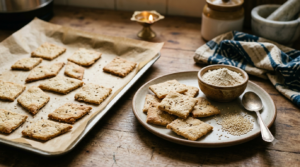
Illustrative baked jowar sesame crackers on a festive snack plate; the proposed recipe has not yet been kitchen-tested.
Untested recipe notice: No finished batch, confirmed cracker count, safe shelf life or verified nutritional values are claimed here. All quantities and cooking settings below are provisional starting points. Any food photograph accompanying this article should carry an illustrative-image label unless it shows the actual test batch.
Baked Jowar Sesame Crackers at a Glance
- Recipe status: Proposed first-batch experiment, not kitchen-tested.
- Main ingredients: Jowar (sorghum) flour, a smaller amount of rice flour, sesame seeds, oil and spices.
- Target texture: Thin, dry crackers with a clean snap after cooling.
- Starting dough thickness: Compare approximately 2 mm and 3 mm samples; neither thickness is confirmed.
- Provisional oven setting: Try 175°C in a preheated conventional oven and document the actual oven behaviour.
- First inspection: Begin checking a small test tray around 8–10 minutes; this is not a promised cooking time.
- Finished yield: Unknown until the fully cooled crackers are counted and weighed.
- Allergens: Contains sesame. Check all packaged ingredients and equipment for other allergens and gluten cross-contact.
The purpose of this trial is to identify which variables give jowar a crisp bite without turning it hard. A thin cracker can brown while its centre still feels damp, so colour alone will not decide when the batch is ready.
Why This Jowar and Sesame Trial Is Different
Jowar is sorghum, a grain with a distinctive earthy taste. The Whole Grains Council lists sorghum among grains that do not naturally contain gluten. That matters here because gluten-free dough does not stretch like wheat dough.
A thin sheet therefore needs careful handling and a measured amount of water. The Food and Agriculture Organization of the United Nations describes how hot-water treatment improves sorghum dough’s ability to hold together. However, a finding about sorghum roti is not proof that this cracker formula will succeed. For another oven-baked experiment, see the baked methi mathri trial.
In baked jowar sesame crackers, sesame adds another test variable. Whole seeds may create small weak points in a thin sheet, while lightly crushed seeds could distribute differently. Their flavour may also deepen before the flour appears brown. For that reason, the first trial keeps the sesame amount fixed rather than adding several seed variations at once.
Provisional Ingredients for Baked Jowar Sesame Crackers
For baked jowar sesame crackers, the following table describes a proposed small test dough, not a measured kitchen result. Use a digital scale because flour volume changes with packing. Keep the original measurements in a notebook so the same trial can be repeated.
| Ingredient | Trial starting amount | Purpose |
|---|---|---|
| Fine jowar flour | 150 g | Main flavour and flour body |
| Fine rice flour | 30 g | Proposed aid to a drier bite |
| White sesame seeds | 20 g | Seed flavour and texture |
| Neutral cooking oil | 25 ml | Fat for a less tough bite |
| Cumin seeds | 1/2 tsp | Warm savoury flavour |
| Red chilli powder | 1/4 tsp | Optional mild heat |
| Salt | 1/2 tsp | Initial seasoning baseline |
| Hot water | Start near 110 ml | Add gradually; record actual use |
Each number is a working hypothesis. In particular, the water quantity may need adjustment for flour freshness, milling and seed size. Do not increase the batch size for guests before its texture and cooking method have passed a kitchen test.
This baseline uses oil rather than ghee, so it adds no dairy ingredient deliberately. Still, that does not prove the finished crackers are dairy-free or suitable for every allergy. Ingredient labels and shared tools remain important.
What Should the Trial Dough Feel Like?
A promising dough should press into a flat piece without crumbling at every edge. It should also lift between sheets of parchment without smearing or breaking into fragments. These are test targets, not observations from a completed batch.
Because sorghum lacks gluten, expect less stretch than wheat dough. If the sheet cracks, record that before changing the water. Adding too much water could solve one problem while creating a sticky sheet that dries unevenly.
How to Prepare Baked Jowar Sesame Crackers for a Test Bake
This trial uses hot water to explore better binding, then a small oven calibration before baking the remaining dough. The sequence aims to limit wasted ingredients. It does not guarantee crisp crackers, and no step replaces a proper kitchen test.
Prepare the dough safely
- Prepare the test area. Wash hands and clean the counter, scale, utensils and tray. Keep allergen-sensitive foods away from the sesame work area.
- Weigh the dry ingredients. Combine jowar flour, rice flour, sesame, cumin, chilli and salt. Mix well so seeds do not collect in one corner.
- Add oil. Stir until the flour feels evenly coated. Note any large oily lumps because they can affect rolling.
- Add hot water cautiously. Stir in an initial portion with a spoon, then add more little by little. Let the mixture cool enough to handle safely before pressing it by hand.
- Record the actual water. Stop when a small ball presses flat with limited cracking. Do not add water merely to reach a number in the table.
Shape the crackers and calibrate the oven
- Rest briefly and reassess. Cover the dough while it settles. Record the rest period because a wetter dough may change feel after standing.
- Roll between parchment. Make two small test sheets with measured, even thickness. Keep one near 2 mm and another near 3 mm as provisional comparison points.
- Cut and dock. Cut manageable shapes and prick each piece with a fork. Leave a little space between pieces on a parchment-lined tray.
- Begin with a test tray. Preheat a conventional oven to a proposed 175°C. Bake only a few pieces first and check frequently from roughly the 8–10 minute mark.
- Assess after cooling. Once the pieces have cooked fully, cool them on a rack. Record the snap, centre texture, edge colour and exact time before changing the larger batch.
Use oven-safe parchment within its manufacturer’s stated temperature limit. Watch the tray closely because thin pieces may darken suddenly. If a cracker still has a raw or pasty centre, do not taste it; continue cooking safely or discard it.
What Oven Settings Should You Test for Baked Jowar Sesame Crackers?
There is no verified final temperature or cooking duration for these baked jowar sesame crackers. A conventional oven setting of 175°C is only an initial calibration choice. Start examining the small trial tray after about 8–10 minutes, then check in short intervals as needed.
Those figures are not a tested recipe card. A fan oven, dark metal tray or thinner sheet may behave differently. Therefore, log oven type, tray colour, rack position and thermostat reading if an oven thermometer is available.
King Arthur Baking’s cracker guidance recommends docking to discourage puffing and rotating trays for more even browning. That principle may help this trial, although its published sourdough timings do not transfer directly to a jowar dough.
Why Compare Two Thicknesses?
Thickness can change the texture more than extra chilli or cumin. A thicker piece may need more drying, while a thinner edge may become bitter before the middle finishes. Measuring both sheets gives the kitchen a useful comparison instead of a vague impression.
Keep ingredient ratios, tray material and oven setting identical during this comparison. Change only the sheet thickness. After cooling, compare centre snap, breakage and colour so you can choose the next test intelligently.
How to Tell Whether the Crackers Are Fully Cooked
Look for an evenly dry surface, a cooked centre and a firm structure after cooling. A clean snap is a useful texture goal, but it is not a laboratory food-safety test. The first batch must cook thoroughly, not merely turn golden at the edges.
The U.S. Food and Drug Administration’s flour safety guidance says not to taste raw flour or uncooked dough. Flour can carry harmful germs, and milling does not make it ready to eat. So judge seasoning only after a sample has fully baked and cooled.
Sesame seeds can brown faster than the pale flour around them. Also, an oily patch may look glossy even when nearby dough seems dry. Photograph both sides and note any uneven spots for the next test rather than declaring success on appearance alone.
Troubleshooting Baked Jowar Sesame Crackers
An untested recipe needs a diagnosis plan because the first batch may not behave as expected. Keep one main variable per follow-up batch. Otherwise, you cannot tell whether water, thickness, fat or oven heat caused the change.
| What happens | Possible cause | Next trial action |
|---|---|---|
| Edges crack while rolling | Dry or poorly bound dough | Record water; adjust gradually next time |
| Sheet sticks to parchment | Excess moisture or warm dough | Measure hydration and rest consistently |
| Edges darken first | Uneven sheet or hot tray | Match thickness; check rack and tray |
| Centre bends after cooling | Thick or under-dried centre | Use a smaller test piece; check full cooking |
| Cracker snaps but feels hard | Thickness or fat balance | Test one controlled change |
| Seeds taste bitter | Sesame may have over-browned | Inspect earlier; avoid dark edges |
Do not simply raise the heat when a cracker remains soft. Extra heat can burn the outside while leaving moisture in the middle. A thinner, more even sheet might help, but it still needs testing.
Sesame Allergy and Gluten Cross-Contact
Allergen alert: These trial crackers contain sesame (til). The U.S. Food and Drug Administration identifies sesame as a major food allergen. Anyone with a diagnosed sesame allergy should avoid this recipe rather than assume baking makes sesame safe.
The planned formula does not deliberately use wheat, egg, milk, peanuts, soy or tree nuts. However, flour packs, spice mixes, oil, baking sheets and shared equipment may introduce cross-contact. Always check relevant labels and clean equipment, especially when preparing snacks for visitors.
Jowar and rice do not naturally contain gluten. Yet that alone does not make a home batch certified gluten-free or suitable for someone with coeliac disease. Use appropriately labelled ingredients and separate equipment when strict gluten avoidance is necessary.
Do not replace sesame with peanuts or tree nuts without a new allergen notice and separate formulation test. These swaps change both safety information and texture. For a sesame-allergic guest, choose a different verified sesame-free snack prepared without cross-contact.
Is Baking Automatically Healthier Than Frying?
Baking avoids immersing these crackers in deep-frying oil, but that does not establish a health benefit. The proposed recipe still contains added oil, salt and sesame. Without a tested yield and a defined serving size, there is no defensible per-cracker calorie count.
Similarly, “millet-based” does not mean suitable for every medical diet. Anyone managing diabetes, coeliac disease or food allergies should consider the full recipe and their clinical advice. Avoid marketing this untested batch as weight-loss food or a medically approved snack.
For a Diwali spread, the practical benefit is variety rather than a health promise. These would be savoury crackers alongside sweets if testing succeeds. For another millet snack experiment, compare the ragi ribbon pakoda trial. Until then, present these crackers as a proposed oven-baked alternative, not a guaranteed crowd-pleaser.
Serving Ideas for a Diwali Snack Table
When tasting baked jowar sesame crackers, first try one fully cooked, cooled sample on its own. Tea, chutney and pickle can hide a hard centre or weak seasoning, so the plain test gives clearer feedback. Next, try a second piece with a dip to assess normal serving appeal.
Keep the sesame warning visible when offering food to guests. Separate serving tongs can also limit cross-contact between different snack bowls. Do not mix the trial batch with allergen-free food simply to make a festive platter look full.
A small batch makes more sense than festival-scale preparation while the formula remains untested. If the crackers break too easily, serve another established snack rather than presenting the fragments as a proven recipe. For a different rice-flour cracker, see the biyyam pindi chekkalu recipe. The aim is useful kitchen learning, not a forced successful result.
Storage and Shelf-Life Limits for Baked Jowar Sesame Crackers
No safe storage duration has been established for these baked jowar sesame crackers. Shelf life depends on moisture, cooking, handling, packaging and room conditions. A dry-looking surface or crisp snap cannot prove that a snack remains safe over several days.
Cool the fully baked test pieces completely on a clean rack before placing them in a clean, dry container. Keep raw flour, unwashed utensils and other potential contaminants away from the cooked batch. If storage conditions are uncertain or spoilage seems possible, discard the food.
Record when texture changes, but do not treat that as a shelf-life study. Reheating a softened cracker may alter its snap, yet it cannot reliably reverse unsafe storage. Do not promise “stays fresh for weeks” or assign an expiry date without suitable evidence.
Kitchen-Test Log for Baked Jowar Sesame Crackers
For baked jowar sesame crackers, the completed log matters more than a polished recipe card at this stage. Note what actually happened while the tray is still in front of you. Each entry should let another cook repeat the same experiment without relying on memory.
| Record | Write down | Why it matters |
|---|---|---|
| Flours | Brand, age, exact gram weights | Controls water variation |
| Sesame | Seed type, exact weight | Tracks seed texture and colour |
| Water | Starting heat and actual ml used | Explains cracks or stickiness |
| Dough | Rest, feel and rolling method | Tests repeatability |
| Thickness | Measured mm for each group | Connects snap to sheet size |
| Oven | Mode, rack, tray and setting | Explains browning differences |
| Cooking | Check times and final actual time | Replaces guessed timings |
| Result | Cooled count, weight and notes | Establishes measured yield |
| Storage | Handling, container and conditions | Documents conditions; not safe shelf life |
For the second batch, change only the weakest variable from the first. If the dough rolls well but crackers stay soft, focus on thickness and oven drying. If rolling fails, examine water and dough handling before changing the spice blend.
Before These Crackers Join the Festive Menu
The useful promise of baked jowar sesame crackers is a distinctive sorghum-and-til flavour, not a guaranteed result. The initial formula, oven temperature and timings remain provisional. Test a small batch, cook it fully, record the cooled texture and measure the actual yield before turning these notes into a final recipe.
Keep sesame disclosure prominent and avoid claims about medical benefits or storage life. A repeatable second batch would strengthen the method, while an unsuccessful tray still provides useful evidence. That is a better outcome than publishing an invented “perfectly crisp” recipe.
Frequently Asked Questions
Have these baked jowar sesame crackers been kitchen-tested?
No. This article outlines a proposed first-batch trial rather than a completed recipe. The measurements, dough thickness and oven checks still need validation. Final yield and a safe storage duration are not known.
Can I make these crackers using only jowar flour?
You can plan a separate all-jowar experiment, but it would not be this same formula. Removing rice flour may change how the dough binds and dries. Test the alternative in a small batch before claiming it works.
Do I need hot water for jowar crackers?
Hot water is a sensible variable to test because it can improve sorghum dough binding. However, the required amount and temperature are not confirmed for this cracker mixture. Stir safely, allow cooling and record exactly what you use.
Why do jowar crackers crack when rolled?
Sorghum has no gluten network to provide wheat-like stretch. A dry dough or uneven pressure may increase cracking. Try gradual hydration changes in later tests while keeping other ingredients constant.
How long should I bake jowar sesame crackers?
No final baking time has been established for this trial. Begin checking a few pieces around the provisional 8–10 minute mark at 175°C in a conventional oven. Continue until they cook fully and assess texture after cooling.
Are these crackers safe for someone with a sesame allergy?
No. Sesame is an intentional ingredient and a recognised allergen. Baking does not remove that concern, so serve a separate verified sesame-free option instead. Prevent shared-equipment cross-contact as well.
Are baked jowar sesame crackers gluten-free?
The proposed ingredients contain no deliberately added gluten grain. However, cross-contact can occur during milling, packing or home preparation. Do not claim a certified gluten-free product without appropriate ingredient and process controls.
Can I use ghee instead of oil?
That would be a separate formula test because the fat behaves differently. Ghee also introduces a milk-derived ingredient and requires clear dairy-allergen advice. The current first-batch plan uses neutral oil to keep variables limited.
How many crackers will this batch make?
The yield is unknown. Cracker size, rolling thickness, trimming and cooking loss affect the final count and weight. Count and weigh only the fully cooled pieces after the kitchen test.
How long can I store these crackers for Diwali?
No safe shelf life has been validated for baked jowar sesame crackers. Storage conditions and remaining moisture affect both quality and safety. Do not assign an expiry period based on crispness alone; prepare only a manageable test quantity.