Air Fryer Chapati: Correct Dough Weights & Cooking Guide
Air fryer chapati can be made at home, but the result depends heavily on basket size, fan strength, dough moisture and how close the bread sits to the heating element. The safest way to publish this method is to use corrected dough weights and treat the cooking time as a first-batch calibration, not a guaranteed setting. This refresh therefore fixes the old yield mismatch and removes unsupported nutrition and substitution promises.
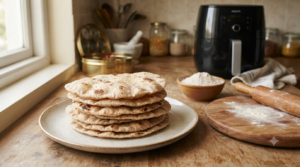
Homemade whole wheat chapatis prepared using an air fryer, with carefully measured dough portions and cooking times adjusted to the appliance.
Kitchen-test status: the dough quantities below are internally consistent, but the air-fryer cooking settings have not yet been verified in the Bhimas Cook kitchen. Use the timing range as a controlled first test, record what your appliance does, and replace the range with your measured result after a real kitchen test.
Air Fryer Chapati at a Glance
- Yield: 8 medium chapatis, usually enough for about 4 servings at 2 chapatis each.
- Flour: 260 g whole-wheat atta.
- Water: start with 170 g and add up to 10 g more only if the flour needs it.
- Portion size: about 54–56 g dough per chapati when using the full water range and optional oil.
- Rolling size: roughly 15–17 cm across, with even thickness.
- First-batch air-fryer range: 200°C, one chapati at a time, about 2–4 minutes total with close checking.
- Texture: expect a drier surface than a tawa chapati unless the appliance and timing suit the dough very well.
The old version mixed three different yields: 260 g flour, eight dough balls, and a stated yield of only four or five chapatis. With about 170–180 g water, the mixed dough weighs roughly 430–445 g before dusting losses. Dividing that into eight pieces gives a practical target near 54–56 g each, so the revised numbers now agree.
Ingredients with Corrected Dough Weights
| Ingredient | Weight | Purpose |
|---|---|---|
| Whole-wheat atta | 260 g | Main flour |
| Water | 170–180 g | Add gradually |
| Salt | 3 g, optional | Seasoning |
| Neutral oil | 5 g, optional | Dough softness |
| Extra atta | As needed | Light dusting only |
Use grams as the main measurement because cup weights vary with the flour brand and how tightly you fill the cup. If you prefer cups, 260 g is roughly two cups for many atta brands, but weighing the flour gives a more repeatable dough.
Start with 170 g water because atta absorbs water differently by brand, age and grind. Add the final 10 g in small amounts only if dry flour remains. The finished dough should feel soft and smooth, yet it should still release cleanly from your fingers after kneading.
How to Make Air Fryer Chapati Dough
- Mix the dry ingredients. Put 260 g atta and the optional salt in a wide bowl. Stir briefly so the salt spreads evenly.
- Add most of the water. Pour in about 160 g water first, then mix with your fingers. Add the rest gradually because flour absorption can change from one bag to another.
- Knead until smooth. Knead for about 7–10 minutes. Add the optional 5 g oil near the end if you use it.
- Rest the dough. Cover it and rest for 15–20 minutes. This makes rolling easier because the flour hydrates and the dough relaxes.
- Weigh the finished dough. Divide the total weight by eight. With this formula, each ball should usually land near 54–56 g.
Do not force extra water into the dough just to hit 180 g. A brand that absorbs less may already feel soft at 170 g. The important result is a pliable dough that rolls without cracking and does not smear onto the work surface.
Air Fryer Chapati Portioning and Rolling
Divide the rested dough into eight equal balls, then keep them covered while you roll. A kitchen scale is useful here because equal dough weights cook more consistently. Roll one ball to roughly 15–17 cm across, turning it often so the thickness stays even.
A very thin chapati can dry before the centre develops enough steam, while a thick one may brown outside before the middle cooks. For the first trial, aim for the thickness of your normal home chapati rather than chasing an exact millimetre figure. Consistency across all eight pieces matters more than a number that has not been kitchen-tested on this dough.
Use only a light dusting of atta because loose flour can scorch or move around in strong airflow. Shake off visible excess before the chapati goes into the basket.
Air Fryer Chapati Cooking Method: Untested First-Batch Range
The cooking range below is not yet kitchen-tested by Bhimas Cook. Air fryers differ in wattage, basket depth, fan speed and heater distance, so a single “perfect” time can be misleading. Treat 200°C and 2–4 minutes total as a starting test, then document the setting that works in your own appliance.
- Preheat only if your model recommends it. Set the air fryer to 200°C and preheat for about 3 minutes if that matches your appliance instructions.
- Cook one chapati first. Put one rolled chapati flat in the basket or approved rack. Do not stack or overlap pieces.
- Check early. Start checking around 90 seconds because thin dough can dry quickly in strong airflow.
- Turn once. Flip with tongs when the first side has set and shows light spots.
- Finish in short intervals. Continue for 30 seconds at a time until the surface is cooked and the bread remains flexible. A reasonable first-batch window is about 2–4 minutes total.
- Record the result. Note the exact model, preheat choice, total time, colour and texture. Use that measured setting for the next chapati.
If the first chapati becomes brittle, reduce either the total time or temperature on the next one. If the centre remains doughy, roll slightly thinner or add short cooking intervals rather than immediately adding several minutes. This approach is slower for the first piece, but it prevents an entire batch from drying out.
Why the Old 6–8 Minute Setting Was Too Confident
The previous version told readers to cook at 200°C for 3–4 minutes per side and called 6 minutes the soft option. That same site previously carried a much shorter 2–3 minute instruction, so the page had no stable tested setting. The refresh removes that contradiction instead of choosing one number without evidence.
Air-fryer manufacturers themselves warn that settings are only indications because food size, shape and appliance design change cooking performance. That is why this page now uses a calibration method. Once Bhimas Cook tests a real batch, replace the range with the measured setting and name the appliance used.
Can Air Fryer Chapati Puff Like Tawa Roti?
Puffing is possible, but it is not guaranteed. Traditional chapati cooks through strong contact heat on a tawa, and phulka may then puff over direct flame. An air fryer surrounds the dough with moving hot air instead, so the surface can dry before the same puffing pattern develops.
Small bubbles or partial puffing are a more realistic first-batch expectation. If a chapati puffs fully in your machine, record the dough weight, diameter, time and temperature because those details are more useful than claiming every air fryer will behave the same way.
How to Keep Air Fryer Chapati Softer
- Use a soft dough instead of a stiff one, but stop adding water once the dough becomes smooth.
- Keep unused dough balls covered so the surface does not dry while you roll.
- Cook the first chapati by itself because a full basket makes timing harder to judge.
- Remove the bread as soon as the raw flour look disappears and light brown spots develop.
- Stack cooked chapatis and cover them with a clean cloth so trapped steam softens the surface slightly.
- Brush with a little ghee only if you want it for flavour and softness; it is optional.
Do not spray oil automatically just because the recipe uses an air fryer. Chapati is normally cooked dry on a tawa, so air frying is not automatically a lower-fat method. The final fat level depends mainly on whether you add oil to the dough or brush the cooked bread with ghee.
Safety: Watch Light Flatbreads Near the Heating Element
Thin breads are light enough to lift in strong air circulation, especially after they dry and become rigid. Philips support notes that light ingredients can be drawn toward the heating element in some air fryers; see its light-ingredient safety guidance. Therefore, stop cooking if the chapati lifts, folds upward or approaches the heater.
Follow the manual for your exact appliance and use only accessories the manufacturer allows. Philips also advises leaving space for air circulation in its basket-loading guidance. Do not place a loose sheet of baking paper in an empty preheating basket because strong airflow can move it toward the heater.
For broader beginner guidance, see the Bhimas Cook air fryer guide. Always let hot baskets and trays cool before handling or cleaning them.
Substitutions: What This Recipe Does Not Guarantee
The earlier article suggested replacing part of the atta with besan or sattu for a “high-protein” version and presented jowar or bajra as gluten-free chapati substitutes. Those changes need separate formulas because they alter gluten development, water absorption and rolling behaviour. A substitution that works in one dough may fail in another.
For this refresh, keep the baseline formula as whole-wheat atta plus water. If you want a besan, sattu, jowar or bajra version, test it as a separate recipe with its own measured hydration, yield and air-fryer timing. Do not promise a one-for-one swap until the replacement dough has been cooked successfully.
Nutrition: Use Your Flour Label Instead of a Generic Estimate
This page no longer gives a fixed calorie, carbohydrate, protein or fibre number per chapati. The old table did not identify the atta brand, the final dough yield or whether optional oil and ghee were included. Those details can change the result enough that a generic number looks more precise than it really is.
If you need nutrition data, use the packet values from the exact flour you cooked with. Eight chapatis from 260 g flour contain about 32.5 g dry flour each before dusting. Calculate each nutrient from that flour share, then add any oil or ghee you actually used.
Serving the Chapatis
Serve the chapatis as soon as possible because air-fried flatbread can firm as it cools. Keep them stacked under a clean cloth while the next piece cooks. For a South Indian meal, they pair well with the site’s tomato kurma for chapathi.
If you are cooking for four people, eight medium chapatis gives two per person. For a larger meal, scale the dough by weight rather than by cups. Doubling the ingredients should produce about sixteen pieces when you keep the same portion weight.
Air Fryer Chapati Troubleshooting
| Problem | Likely cause | Next batch |
|---|---|---|
| Hard or cracker-like | Too much time or very thin rolling | Shorten cook time and check earlier |
| Raw centre | Too thick or too short a cook | Roll more evenly; add 30-second intervals |
| Dry edges | Uneven thickness | Roll with lighter, even pressure |
| Does not puff | Airflow and heat pattern differ from tawa | Judge doneness, not puff alone |
| Lifts in basket | Strong airflow and light dough | Stop and follow appliance safety guidance |
| Sticks | Wet dough or unsuitable basket surface | Use slightly less water or approved accessory |
The most important troubleshooting rule is to change one variable at a time. If you alter temperature, dough hydration and thickness together, you will not know which change improved the result. Start with timing, then adjust rolling thickness, and only then alter the dough.
What to Record During the Real Kitchen Test
Bhimas Cook’s own editorial standard says recipes should be cooked and checked before they are treated as final. For this page, the next useful update is not more prose. It is one documented batch with a kitchen scale and timer.
- Air fryer brand and model.
- Basket or tray dimensions.
- Flour brand and exact flour weight.
- Exact water used, not just the planned range.
- Finished dough weight.
- Weight and diameter of each chapati.
- Preheat setting, if used.
- Temperature, first-side time and second-side time.
- Whether the chapati lifted toward the heater.
- Final texture after 1 minute and after 10 minutes.
Once those figures exist, the recipe card can state the tested setting confidently. Until then, this page should keep the untested label because it is more useful than pretending one air-fryer number works everywhere.
Air Fryer Chapati: Final Method to Use Now
For the current version, make eight chapatis from 260 g atta and 170–180 g water, then portion the dough at about 54–56 g each. Roll evenly, cook one piece at a time, and treat 200°C for about 2–4 minutes total as a starting test rather than a promise.
Check early, turn once, and stop when the chapati is cooked but still flexible. If the first one dries out, shorten the next run. A real kitchen test should then replace the range with the exact model-specific result.
Frequently Asked Questions
Can I make chapati in an air fryer?
Yes, but the texture may differ from a tawa chapati because the heat source is different. Start with one chapati and watch it closely. For air fryer chapati, the goal is a cooked, flexible bread, not necessarily a full balloon-like puff.
What temperature should I use for air fryer chapati?
Use 200°C only as a first-batch starting point because this page has not yet kitchen-tested a final model-specific setting. Check the chapati early and adjust in small steps. Your appliance manual should take priority if it gives different limits or safety guidance.
How long does air fryer chapati take?
For the untested trial method on this page, begin with a 2–4 minute total window and inspect from about 90 seconds onward. Turn once, then continue in short intervals. Record the exact time that works in your appliance before treating it as a recipe standard.
How many chapatis does 260 g atta make?
This formula is written for eight medium chapatis. With 170–180 g water and optional oil, the dough supports portions around 54–56 g each. If you prefer smaller or larger chapatis, weigh the finished dough and divide it by your chosen yield.
Should I spray oil on the basket?
Not automatically. Many baskets are non-stick, while some doughs may need an approved accessory or a very light coating. Follow your appliance manual and avoid adding oil just to support a “healthier” claim, because traditional chapati can also cook without oil.
Why did my chapati turn hard?
It probably cooked too long, rolled too thin, or dried under strong airflow. Reduce the time first and check sooner. Also keep cooked chapatis covered, because trapped steam helps the surface stay more flexible.
Can I replace atta with jowar, bajra or besan?
Not as a guaranteed one-for-one substitution in this recipe. Those flours absorb water and bind differently, so they need separate testing. Build a dedicated formula for each flour instead of assuming the same water and air-fryer time will work.
Is air fryer chapati healthier than tawa chapati?
Not automatically. Traditional chapati can be dry-cooked on a tawa, so the air fryer does not inherently reduce fat. Nutrition depends on the flour, portion size and whether you add oil or ghee.