Ragi Ribbon Pakoda: Untested Air Fryer Recipe Trial
Ragi ribbon pakoda is a traditional South Indian snack that we are exploring for an air-fryer adaptation. This version is an untested trial recipe, not a kitchen-tested method. The ingredient proportions and cooking settings below are proposed starting points. We have not yet confirmed the final water quantity, cooking temperature, time, texture or yield through a completed kitchen trial.
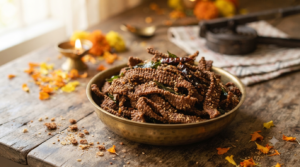
Illustrative representation of ragi ribbon pakoda for a proposed air-fryer experiment. The pictured texture and appearance are not verified results from a kitchen test.
Traditional ribbon pakoda uses a dough that passes through a murukku press fitted with a flat, slotted plate. The familiar snack usually cooks in hot oil. However, an air fryer changes how heat reaches the dough, so the same mixture may not give the same result.
This guide explains the proposed method, the reasoning behind the ingredients and the observations needed during testing. It does not promise a crispy finished snack until a real kitchen trial demonstrates that result.
Ragi Ribbon Pakoda: Untested Trial Overview
This proposed air-fryer recipe combines finger millet flour with rice flour and besan. The aim is to explore whether the dough can form thin ribbons and cook evenly without deep-frying. The final texture remains unknown because the proposed formula has not undergone a completed kitchen test.
- Recipe: Ragi ribbon pakoda
- Cooking method: Experimental air-fryer adaptation
- Recipe status: Untested trial
- Primary ingredient: Ragi flour, also called finger millet flour
- Additional flours: Rice flour and besan
- Equipment: Murukku press with ribbon plate and an air fryer
- Cooking temperature: Not experimentally confirmed
- Cooking time: Not experimentally confirmed
- Finished yield: Not measured
- Finished texture: Not verified
The quantities below describe one proposed small-batch formulation. They are not the results of an actual cooking trial. Readers should therefore treat this as a recipe-development experiment rather than a reliable, ready-to-cook recipe.
Why Explore Air Fryer Ragi Ribbon Pakoda?
Air fryers circulate hot air around food, whereas traditional deep-frying immerses it in hot oil. Consequently, the two cooking methods transfer heat differently. A ribbon pakoda dough that works in hot oil may behave differently inside an air-fryer basket.
Ragi flour also has a naturally dark colour. That makes visual browning less useful as a sign of doneness. A ribbon might look dark before it becomes fully dry, or its edges might overcook while the middle retains moisture.
Rice flour, besan and added fat may help adjust the dough’s structure. However, their exact effects in this proposed formulation remain untested. No claim about a successful crispy result should be drawn from the ingredient list alone.
Proposed Ingredients for Ragi Ribbon Pakoda
The following measurements are planning quantities for an initial experiment. They do not represent a completed batch or a validated formula. Measuring everything by weight during the actual trial will help establish whether these proportions need adjustment.
| Ingredient | Proposed quantity | Purpose |
|---|---|---|
| Ragi flour | 120 g | Main millet ingredient |
| Rice flour | 35 g | Potentially helps create a lighter bite |
| Besan | 30 g | May help dough binding |
| Butter or ghee | 28 g | Provides fat within the dough |
| Sesame seeds | 1 teaspoon | Traditional flavour |
| Cumin seeds | ½ teaspoon | Savoury seasoning |
| Red chilli powder | ½ teaspoon | Heat and flavour |
| Asafoetida | ⅛ teaspoon | Savoury aroma |
| Salt | ½ teaspoon initially | Seasoning |
| Warm water | Amount not established | Forms the dough |
| Neutral cooking oil | 1–2 teaspoons proposed | Optional light surface coating |
Measurement note: The gram quantities above are proposed ingredient weights, not recorded measurements from an actual trial. The final water requirement is unknown. Flour moisture, particle size and the absorbency of the mixture can all affect dough consistency.
For that reason, no exact total water quantity is presented as a proven measurement. A real trial must determine how much liquid allows the dough to pass through the ribbon plate without cracking or losing shape.
Understanding the Flour Combination
What Does Ragi Flour Contribute?
Ragi, or finger millet, gives the proposed snack its main grain flavour and naturally brown appearance. According to the ICAR–Indian Institute of Millets Research, finger millet belongs to the millet group. Its use in traditional Indian cooking makes it a suitable ingredient to explore in savoury snacks.
However, the proportion of ragi flour affects dough behaviour. This proposed formula uses more ragi than either supporting flour. Whether that balance works well in an air fryer remains an open test question.
Why Add Rice Flour and Besan?
Rice flour commonly appears in South Indian savoury snacks because it can support a firm, brittle texture after cooking. Besan may help the dough hold together while adding its characteristic flavour.
These are reasons for including the ingredients, not proof that the proposed air-fried version will become crispy. The combination still needs testing for pressing, cooking and eating quality.
Proposed Ragi Ribbon Pakoda Preparation Method
The steps below form an experimental procedure, not a tested set of cooking instructions. They show how a kitchen trial could evaluate the formulation while recording the variables that influence the outcome.
- Measure the dry ingredients. Weigh the ragi flour, rice flour and besan separately. Record their actual weights before combining them.
- Add the seasonings. Mix in sesame seeds, cumin, chilli powder, asafoetida and salt. Stir until the mixture looks uniform.
- Incorporate the fat. Add the proposed butter or ghee quantity and distribute it through the flour. Record whether the mixture becomes evenly crumbly.
- Introduce warm water gradually. Add small measured amounts while mixing. Stop when the dough reaches a consistency suitable for the murukku press.
- Evaluate the dough. Check whether the mixture feels excessively sticky, crumbly or difficult to press. Record any adjustments instead of treating the starting formulation as final.
- Fit the ribbon plate. Use the flat slotted disc in the murukku press. Record the approximate width and thickness of the extruded ribbons.
There is no experimentally confirmed resting period for this formula. If the dough rests during testing, record that duration because moisture absorption may change its pressing behaviour.
Preparing the Trial Ribbons
For an air-fryer experiment, the ribbons should remain separate enough to allow moving air around them. Overlapping pieces may cook unevenly, while very thin strips may dry sooner than thick ones.
The actual ribbon thickness must be measured during the trial. Without that measurement, cooking results may be difficult to reproduce. The press plate’s opening size and the dough’s consistency can both affect the finished shape.
Use an accessory approved for the air fryer and keep lightweight parchment away from the heating element. Loose paper may move in the circulating air, so follow the appliance manufacturer’s instructions.
Air Fryer Settings: Experimental Starting Points Only
No cooking temperature or duration has been established for this exact ragi ribbon pakoda formulation. Some published air-fryer murukku methods use temperatures around 180°C. However, those recipes have different ingredients and may produce different results.
A trial could investigate 180°C as an initial comparison point. That figure must not be represented as the correct temperature for this recipe. The kitchen must determine whether a lower or higher setting produces a satisfactory result.
| Variable | Current status | Trial observation needed |
|---|---|---|
| Air-fryer model | Not recorded | Brand, model and basket capacity |
| Preheating | Not verified | Actual setting and duration |
| Ribbon thickness | Not measured | Thickness in millimetres |
| Cooking temperature | Not tested | Actual appliance setting |
| Cooking duration | Not tested | Total minutes for each batch |
| Turning or flipping | Not established | Whether handling was necessary |
| Final cooled texture | Not evaluated | Snap, hardness and moisture |
| Final cooled yield | Not measured | Weight after cooling |
Other murukku recipes cannot establish this formulation’s finished cooking time. Therefore, this guide does not provide an exact duration or claim that a particular temperature guarantees a crispy snack.
How to Assess the Ragi Ribbon Pakoda Trial
Texture evaluation is especially important because the goal is still experimental. The first observation concerns whether the dough presses into an even ribbon. Next comes its behaviour inside the air fryer, followed by its texture after cooling.
A finished ribbon may feel different when hot and after cooling. Therefore, judging the sample immediately after cooking could give an incomplete picture. A trial should record the cooled texture and whether the snack bends, snaps, crumbles or feels unusually hard.
Signs That Need Investigation
- Cracking during pressing: The dough may lack enough moisture or binding.
- Loss of ribbon shape: The dough may contain too much water or lack structure.
- Dark or bitter edges: The temperature or cooking duration may be excessive.
- Soft centres: Moisture may remain after cooking.
- Very hard pieces: The dough composition or drying process may need adjustment.
- Uneven colour: Airflow, basket arrangement or ribbon thickness may affect heating.
These are potential failure modes, not observations from a completed batch. A kitchen trial must establish which problems actually occur with this mixture.
Possible Adjustments if the Trial Does Not Work
If the dough does not press smoothly, moisture is one variable to examine. A small increase in measured water may help a crumbly mixture. However, excess liquid may cause the ribbons to lose their shape.
If the cooked sample feels unusually hard, the balance of supporting flour, fat and moisture may need further study. The cooking temperature may also affect the result. Changing several factors together makes it harder to identify the cause.
For a controlled experiment, adjust one major variable at a time. Record the revised quantity or appliance setting, then compare the outcome with the previous batch. This method can reveal whether an apparent improvement is repeatable.
Can Ragi Ribbon Pakoda Become Crispy Without Deep-Frying?
Air frying can produce crisp textures in some dough-based snacks, but that does not prove this ragi ribbon pakoda formulation will do so. The outcome depends on dough composition, ribbon thickness, residual moisture and appliance performance.
The intended goal is a dry, pleasant bite without excessive hardness. However, no successful result has yet been observed or documented for this specific recipe.
Until testing confirms the texture, it would be misleading to describe the method as guaranteed crispy or claim that it matches traditional deep-fried ribbon pakoda.
How the Air-Fryer Trial Differs from Traditional Ribbon Pakoda
| Feature | Traditional method | Proposed air-fryer method |
|---|---|---|
| Heat transfer | Immersion in hot oil | Circulating hot air |
| Cooking oil | Oil bath | Small proposed surface coating |
| Dough suitability | Established in many recipes | Not established for this formula |
| Cooking time | Depends on recipe and oil heat | Not tested |
| Finished crispness | Characteristic of correctly cooked ribbon pakoda | Not confirmed |
| Yield | Depends on batch | Not measured |
Air frying uses a different heating environment, so copying deep-frying times and temperatures would be unreliable. Also, using less cooking oil does not automatically make every version nutritionally superior. The total ingredients and portion size still matter.
Ragi Ribbon Pakoda for Diwali: What Is Known?
Ribbon pakoda belongs to the savoury snack tradition associated with South Indian festive cooking. Ragi flour offers a variation on the usual flour mixture. However, this particular air-fryer adaptation remains at the recipe-development stage.
For Diwali cooking, the practical question is whether the snack can retain a pleasant texture after cooling and storage. Neither feature has been demonstrated by this proposed batch. Therefore, readers should not depend on this formula for an important festive occasion without first establishing the outcome themselves.
For a wider festive menu, Bhimas Cook also has a collection of Diwali sweets recipes. Those recipes cover a different part of the Diwali menu.
Common Mistakes to Avoid During an Air-Fryer Trial
Assuming Dark Colour Means Fully Cooked
Ragi has a naturally dark colour, so visual browning cannot independently confirm doneness. Instead, evaluate the surface, centre and texture after cooling. A dark ribbon may still contain moisture, while prolonged heating may create an unpleasant bitter taste.
Adding Water Without Measuring It
Dough moisture affects pressing and cooking. If extra water goes in without measurement, reproducing the batch becomes difficult. Use a measuring jug or digital scale, then record the total amount used.
Ignoring Ribbon Thickness
A thick ribbon and a thin ribbon may cook at different rates. Consequently, a final cooking time has little meaning without a description of the ribbon size. Measure the approximate thickness and record the type of press plate.
Judging Texture Before Cooling
Food can change texture as moisture escapes during cooling. Therefore, record both the initial and cooled texture. A successful result cannot be established from appearance alone.
Changing Several Ingredients Together
Changing fat, water, flour ratio and heat simultaneously makes comparisons difficult. Test one change at a time where practical. This gives each trial more useful information, even when the result is unsatisfactory.
Ragi Ribbon Pakoda and Finger Millet Nutrition
Ragi is another name for finger millet, a grain used widely in Indian cooking. The Indian Council of Agricultural Research provides information about millet production and nutrition. Finger millet contributes nutrients including dietary fibre and minerals.
However, a ragi-based snack is not automatically low in calories or suitable for every dietary requirement. The complete formula contains flour, fat and salt. Its nutritional profile would depend on the final tested quantities and serving size.
This untested version has no confirmed nutritional calculation. Therefore, no calorie, protein or fat value is supplied for the finished snack.
For another use of the same grain, see the ragi dosa recipe on Bhimas Cook. Dosa batter and ribbon pakoda dough behave differently, but both demonstrate how cooks incorporate finger millet into South Indian food.
What About Storage and Shelf Life?
No storage-life claim can be made for an air-fryer recipe that has not produced a tested batch. The final moisture level affects how well a savoury snack retains its texture. Storage conditions also influence quality.
In general, dry snacks should cool completely before entering a clean, airtight container. However, that principle does not establish how many days this specific formulation would remain acceptable.
A later storage evaluation would need to observe changes in smell, taste, texture and moisture. Until those results exist, this article does not provide a fixed shelf life.
Other Air-Fryer Snacks and Recipe Development
Air fryers can handle several vegetarian foods, but each recipe requires suitable cooking conditions. A vegetable cutlet, dosa-based snack and pressed flour dough do not behave identically. Their moisture, shape and surface area differ substantially.
Beginners can review Bhimas Cook’s air fryer recipes for beginners for general appliance guidance. The manufacturer’s instructions should also take priority when choosing baskets, accessories and safe operating settings.
This trial remains separate from those established methods because its final cooking performance has not yet been demonstrated.
Current Status of This Ragi Ribbon Pakoda Recipe
This page documents an untested air-fryer recipe concept. The flour combination and ingredient amounts are proposed, while the completed cooking observations are unavailable. No real measurements have established water absorption, appliance performance, final time, cooled yield or eating texture.
The goal is to explore a ragi-based variation of traditional ribbon pakoda without assuming that an air fryer can reproduce the deep-fried result. Until an actual trial confirms the outcome, the method should be read as experimental information, not a proven Diwali snack recipe.
Frequently Asked Questions
Can ragi ribbon pakoda be made in an air fryer?
It may be possible, but this particular formulation has not yet undergone a completed kitchen trial. Air frying works for some pressed savoury doughs. However, the exact temperature, moisture balance and final texture must be established separately for this mixture.
Is this ragi ribbon pakoda recipe kitchen-tested?
No. This is an untested trial recipe. The proposed ingredient measurements have not been validated in a completed cooking session, and no actual finished yield or texture result is available.
What temperature should I use for air fryer ragi ribbon pakoda?
No temperature has been confirmed for this exact formulation. Around 180°C is an experimental reference from other air-fryer murukku methods, not a tested recommendation for this recipe. Follow the air-fryer manufacturer’s safety instructions and evaluate any experimental batch carefully.
How long does ragi ribbon pakoda take in an air fryer?
The cooking time is currently unknown because no completed trial has established it. Ribbon thickness, dough moisture, temperature and appliance design can all affect cooking duration. A reliable recipe must record the actual time rather than borrow it from another snack.
Why does the proposed recipe contain rice flour?
Rice flour commonly supports the structure and texture of savoury Indian snacks. This recipe includes it as a supporting flour alongside ragi and besan. However, its precise effect in the proposed air-fryer formulation has not been tested.
Can I replace besan with more ragi flour?
That substitution would change the original experimental formula. Besan may contribute binding and texture, while extra ragi could affect moisture absorption. Since the starting formula itself remains untested, no successful substitution can currently be recommended.
Is this a guaranteed crispy Diwali snack?
No. Crispness has not been demonstrated for this particular formulation. The intended texture is a pleasant, dry bite, but no finished sample has been evaluated. Readers should not treat the proposed method as a guaranteed festive snack.
How much water does the dough need?
The exact amount has not been established. Water absorption varies with flour characteristics and dough formulation. A completed kitchen trial must record the measured quantity needed to produce ribbons that hold their shape.
What is the finished yield of this recipe?
There is no confirmed yield because no completed batch has been weighed after cooling. The proposed flour amounts do not establish the finished weight or number of servings. Reporting a definite yield now would be misleading.
Can the air-fried ribbon pakoda be stored for several days?
Its shelf life has not been tested. Moisture, fat content and storage conditions can affect savoury snack quality. A reliable storage recommendation requires observations from an actual finished batch, so no fixed duration is claimed here.