Gavvalu Recipe with Jaggery (Bellam Gavvalu) — Crisp Andhra Sweet
This Gavvalu Recipe with Jaggery gives crisp shell-shaped sweets that hold a glossy coating, so they never turn sticky in the tin. Most home cooks fry the shells well, yet the syrup stage is where a batch quietly fails. Andhra kitchens call the sweet version teepi gavvalu, while the jaggery version is known as bellam gavvalu. Below you get exact quantities, the syrup test that actually works, and fixes for shells that go soft.
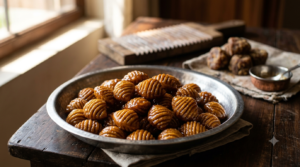
Bellam gavvalu coated in one-string jaggery syrup, cooled on a tray so the glaze sets glossy and firm.
Gavvalu Recipe with Jaggery at a Glance
- Yield: roughly 45–55 small shells, or about 6–8 servings.
- Prep: 15 minutes for the dough, then 25–30 minutes of shaping.
- Cook: about 15 minutes of frying, plus 10 minutes for the syrup.
- Difficulty: medium, because shaping and syrup both need patience.
- Keeps: 7–10 days in a dry, airtight tin at room temperature.
- Key tool: a serrated wooden gavvalu peeta, although a new comb works.
One line is worth remembering before you start. The jaggery syrup must reach a one-string stage, since a thinner syrup soaks straight into the shells and softens them within hours.
Bellam, Teepi or Karam: Which Gavvalu Is This?
Three household versions share the same name, so the recipes get mixed up online constantly. Knowing which one you actually want saves a wasted batch of maida.
| Version | Telugu name | Coating |
|---|---|---|
| Jaggery sweet | Bellam gavvalu | Molten jaggery syrup, deep caramel notes |
| Sugar sweet | Teepi gavvalu | Sugar syrup, whiter and more brittle |
| Spicy savoury | Karam gavvalu | No syrup; chilli powder goes into the dough |
This page covers the jaggery one. If you prefer the paler, crisper finish, our gavvalu sweet recipe with sugar follows a two-string syrup instead. For the savoury tea-time version, see the karam gavvalu recipe with wheat flour.
Families make these mainly for Sankranti and Deepavali. Many Andhra homes also prepare them for Krishna Janmashtami, because shell-shaped sweets are offered to Lord Krishna. The Wikipedia entry on sweet shells records the same basic method, though it is a short stub rather than a detailed source.
Ingredients for This Gavvalu Recipe with Jaggery
For the dough
- 1.5 cups all-purpose flour (maida), about 180 g
- 2 tbsp hot ghee or oil, poured in while still hot
- 1 tbsp fine semolina (rava), optional but it adds crunch
- 1/2 tsp cardamom powder, optional
- 1 pinch salt
- Water or warm milk, roughly 1/3 cup, added little by little
- Oil for deep frying, about 2 cups
For the jaggery syrup
- 1 cup grated jaggery, about 200 g
- 1/4 cup water
- 1 pinch salt, which sharpens the sweetness
- 1/4 tsp cardamom powder, stirred in at the end
Choose dark, soft jaggery that crumbles easily. Hard, pale blocks often carry grit and extra impurities, so the syrup then needs straining. Milk instead of water gives a slightly richer, shorter-textured shell.
The Tool: Gavvalu Peeta, a Comb or a Fork
The traditional tool is a small serrated wooden board called a gavvalu peeta or gavvalu chekka. You press a dough ball flat on the ridges and roll it away from you, until the edges curl into a shell.
No board at home? Then reach for one of these:
- A new, clean comb. Grease the teeth lightly first, or the dough sticks and tears.
- The back of a large fork. This gives shallower ridges, so use slightly thinner dough balls.
- A gnocchi board. The ridge spacing is almost identical, since both tools do the same job.
Shape every shell before you light the stove. Rolling is slow work, and half-fried shells waiting beside a hot kadai turn greasy while you catch up.
Step-by-Step Gavvalu Recipe with Jaggery
Step 1: Make the dough (15 minutes)
Tip the maida, semolina, cardamom and salt into a wide bowl. Heat the ghee until it is hot but not smoking, then pour it over the flour. Rub it in until the mixture holds its shape when you squeeze a fistful.
Add water a spoon at a time, kneading into a stiff dough. It should feel firmer than chapati dough, because a soft dough will not hold ridges. Cover with a damp cloth and rest it for 15 minutes.
Step 2: Shape the shells (25–30 minutes)
Pinch off marble-sized balls, keeping them even so they fry at the same rate. Flatten each one on the greased board, then roll it forward with your thumb in a single motion. The curled edge should stay open, since that hollow is what traps syrup later.
Step 3: Fry on low-medium heat (15 minutes)
Heat oil in a deep kadai and test it with a scrap of dough. It should rise steadily rather than shoot to the surface. Fry 8–10 shells per batch on low-medium flame for about 4 minutes, until they turn even golden brown.
High heat is the classic mistake. The outside browns fast while the inside stays raw, so those shells go leathery once cool. Drain each batch upside down on paper, because the hollows hold trapped oil.
Step 4: Cook the jaggery syrup (10 minutes)
Melt the jaggery with the water over medium heat, stirring until it dissolves. Strain it if you see sediment, then return it to the pan. Simmer until it thickens and froths, and start testing early.
Step 5: Coat and cool (10 minutes)
Kill the heat as soon as the syrup hits one-string stage. Tip in the fried shells and fold them gently with a flat ladle, so every ridge picks up syrup. Spread them on a greased tray in a single layer, then leave them alone until the coating sets hard and glossy.
Getting the Syrup Stage Right in a Gavvalu Recipe with Jaggery
Recipes disagree here, which is exactly why batches fail. Some sources call for a soft-ball stage, while most Andhra cooks work to one string. Both produce edible sweets, yet the texture differs noticeably.
| Stage | How to test | What you get |
|---|---|---|
| Thin syrup | Runs off the spoon freely | Shells go soggy within hours |
| One string | A drop pulls one thread between finger and thumb | Glossy set coating, shells stay crisp |
| Soft ball | A drop in cold water rolls into a soft ball | Thicker, slightly chewy coating |
| Hard ball | The drop sets brittle at once | Rock-hard coating that cracks off |
Aim for one string, because that is the stage this Gavvalu Recipe with Jaggery is built around. Test by lifting a little syrup on a spoon, cooling it for a few seconds, then pressing it between finger and thumb. If a single thread forms as you separate them, switch the flame off immediately.
Jaggery behaves differently from sugar, so a true two-string thread is hard to reach without scorching. That is normal. A syrup that coats the back of a spoon thickly and pulls one thread is the practical target.
Where This Gavvalu Recipe with Jaggery Usually Goes Wrong
| Problem | Likely cause | Fix next time |
|---|---|---|
| Shells soft by evening | Syrup was under-cooked | Cook to one string; store only when fully cool |
| Coating rock-hard | Syrup went past soft ball | Test from the second minute of simmering |
| Shells lose their shape | Dough too soft or too wet | Knead a stiffer dough; add water by the spoon |
| Greasy, heavy bites | Oil was too cool | Keep a steady low-medium flame between batches |
| Dark outside, raw inside | Flame too high | Lower the heat and fry longer |
| Syrup slides off | Shells were still hot | Cool them for five minutes before coating |
If a whole batch turns soft, you can rescue it. Spread the shells on a tray and warm them in a low oven for eight minutes, then cool them completely before sealing the tin.
Gavvalu Recipe with Jaggery: Nutrition and the Bellam Myth
These figures are calculated estimates for one of eight servings, based on standard values for maida, ghee, jaggery and absorbed frying oil. Actual numbers shift with shell size and how much oil the batch takes up.
| Per serving | Estimate |
|---|---|
| Calories | 270–300 kcal |
| Carbohydrates | 44–50 g |
| Protein | 2–3 g |
| Fat | 8–10 g |
| Sugars from jaggery | 25–30 g |
Now the part most recipe pages get wrong. Jaggery is widely described as a safe sweetener for diabetics, and that claim does not hold up. Published reviews put the glycaemic index of cane jaggery near 84, while white sugar sits around 65.
Cane jaggery does carry iron and other minerals that refined sugar loses during processing. Even so, it raises blood glucose at least as fast as sugar does. Anyone managing diabetes or insulin resistance should treat bellam gavvalu as an occasional festival sweet, and should ask their own doctor or dietitian first. A 2025 review of jaggery and glycaemic index sets out the evidence in detail.
Deep frying deserves one practical caution too. Festival kitchens get crowded, so keep the kadai handle turned inward and keep small children well away from the stove.
Storage, Make-Ahead and Festival Planning
Storage decides whether this Gavvalu Recipe with Jaggery still tastes good on day five. Cool the shells completely before storing, because trapped steam is what turns a crisp batch limp. Once cool, pack them into a dry glass or steel container with a tight lid. They keep well for 7–10 days.
Humidity is the real enemy during Sankranti in coastal Andhra. Add a small paper packet of dry roasted rava to the tin, since it absorbs stray moisture without touching the flavour.
Planning several sweets at once? Fry the shells up to two days ahead and store them uncoated. Then make the syrup and coat them on the morning you need them, so they reach the table at their crispest. Our Sankranti special recipes guide sets out a fuller festival timeline.
What Experienced Cooks Do Differently
- They add a spoon of semolina. It changes the bite from merely firm to properly crunchy.
- They salt the syrup. A pinch flattens the cloying edge, so the jaggery reads as caramel.
- They roll shells slightly thin. Thick dough puffs and closes the hollow, and then syrup has nowhere to sit.
- They work in two pans. Frying and syrup run together, because cold shells and hot syrup coat badly.
- They never double the syrup blindly. A larger volume reaches one string slower, so testing matters even more.
- They keep the first batch aside. That batch tells you whether the oil temperature is right before you commit the rest.
Before You Start This Gavvalu Recipe with Jaggery
This Gavvalu Recipe with Jaggery rewards patience more than skill. Get three things right and the rest follows: a stiff dough, a steady low-medium flame, and a syrup stopped at one string. Shape everything before frying, keep tasting notes on your first batch, and cool the shells fully before they go into the tin. If you want the paler, more brittle version instead, the wheat flour gavvalu recipe is a good next attempt.
Gavvalu Recipe with Jaggery: Common Questions
Can I make this Gavvalu Recipe with Jaggery without a mould?
Yes. A greased new comb or the back of a large fork both produce workable ridges. The ridges matter more than the tool, because they create the hollow that holds syrup. Grease whatever you use, or the dough will stick and tear.
Why did my gavvalu turn soft the next day?
Under-cooked syrup is the usual culprit. A thin syrup keeps releasing moisture into the shells overnight. Storing them before they cooled completely does the same damage, since trapped steam condenses inside the tin.
Is this Gavvalu Recipe with Jaggery suitable for diabetics?
No, not as a routine sweet. Cane jaggery has a glycaemic index around 84, which is higher than white sugar. It is a festival treat rather than a diabetic-friendly swap, so anyone managing blood sugar should check with their doctor before eating it.
Can I use wheat flour in this Gavvalu Recipe with Jaggery?
You can, although the texture changes. Wheat flour gives a denser, darker shell that browns faster, so drop the flame slightly. Many cooks use half maida and half wheat as a compromise.
How long does gavvalu stay fresh?
Seven to ten days in a dry airtight container at room temperature. Humid weather shortens that considerably. Keep the tin away from the stove and the sink, because both add moisture to the air around it.
Why is my jaggery syrup grainy?
Either the jaggery held impurities, or the syrup crystallised from over-stirring. Strain the melted jaggery through a fine sieve before simmering. Then stir only occasionally once it starts to thicken.
What is the difference between bellam gavvalu and teepi gavvalu?
Bellam gavvalu uses jaggery syrup, while teepi gavvalu generally means the sugar-syrup version. Both are sweet, and the jaggery one tastes deeper and more caramelised. Karam gavvalu is the savoury cousin, with chilli powder worked into the dough.
Can I reuse the frying oil?
Yes, once or twice, provided it did not smoke. Strain it through muslin after it cools, then store it in a sealed jar away from light. Reuse it for savoury frying rather than another sweet, since traces of flavour carry over.