Brahmin Style Sambar Powder: Authentic Kannada Huli Pudi Recipe
Brahmin style sambar powder is what separates a home-cooked Kannada sambar from the flat, one-note version out of a packet. The ingredient list is not the secret, because almost every recipe online uses the same nine or ten items. The ratio is the secret, and so is the order you roast things in.
This guide explains both. It also corrects two measurement errors that quietly wreck first batches, since a wrong cup equivalent ruins a batch before the pan even heats up.
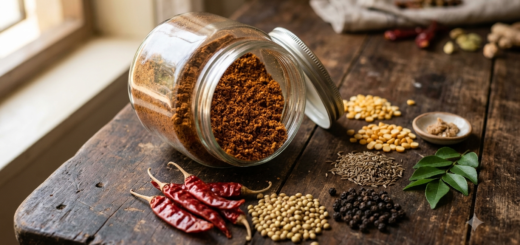
Freshly ground Brahmin style sambar powder, deep red from Byadagi chillies and coriander-forward in the Udupi tradition.
Kannada households call this blend huli pudi. Every family grinds it a little differently, though the backbone stays constant. Coriander seeds dominate, Byadagi chillies do the colouring, and the dals carry body. Once you know why each ratio sits where it does, you can adjust the blend to your own taste.
Brahmin Style Sambar Powder at a Glance
- Active time: about 45 minutes of roasting, plus 15 minutes to grind.
- Cooling time: 30 minutes, and skipping it is the most common mistake.
- Yield: roughly 500–530 g of finished powder.
- Covers: about 70–100 pots of sambar for a family of four.
- Peak aroma: the first 3 months, though it stays usable for about 6.
- Heat level: mild to medium, because Byadagi chillies carry colour rather than burn.
- Watch out: most supermarket asafoetida contains wheat flour, so this blend is not automatically gluten-free.
What Makes Brahmin Style Sambar Powder Different
Brahmin style sambar powder is coriander-forward, lightly spiced, and deliberately restrained on heat. Coriander seeds make up roughly a third of the raw weight. Chillies come next, but they are picked for colour rather than fire. Cumin, fenugreek and pepper stay in the background as accents.
That restraint is the whole point. A Udupi or coastal Kannada sambar usually carries a pinch of jaggery and a splash of coconut. An aggressive masala would fight that sweetness. The powder is built to support the pot, not to dominate it.
Compare it with a commercial blend and the gap shows. Packet powders lean on salt, rice flour and cinnamon to stretch volume. A freshly ground batch has none of that, which is why the aroma hits when you open the jar.
Udupi, Mysore and Tamil Blends: The Real Difference
People often treat “South Indian sambar powder” as one thing. It is not. The lentils change, the chilli share changes, and a couple of signature spices come and go by region.
| Blend | Lentils used | Signature additions | Character |
|---|---|---|---|
| Udupi / coastal Kannada | Urad and chana dal | Heavy coriander, Byadagi chillies, curry leaves | Mild, deep red, aromatic |
| Mysore / Bengaluru | Toor and urad dal | Mustard seeds, sometimes cinnamon | Darker and sharper |
| Tamil Brahmin podi | Toor, chana and urad dal | Higher chilli share, mustard seeds | Hotter, less coriander-forward |
The recipe below follows the Udupi-leaning Kannada style. That is the version most Karnataka families keep in a steel dabba year-round. If you prefer the Mysore character, swap the chana dal for toor dal and add a teaspoon of mustard seeds.
Ingredients for Brahmin Style Sambar Powder
Weigh these if you can. Volume measures for whole spices vary wildly with how tightly you pack the cup. The cup equivalents below are corrected, because earlier versions of this recipe listed several of them wrongly.
| Ingredient | Weight | Approximate volume |
|---|---|---|
| Coriander seeds (kottambari) | 200 g | About 2½ cups |
| Byadagi dried red chillies | 125 g | About 90–110 chillies |
| Guntur dried red chillies | 25 g | About 20–25 chillies |
| Urad dal (split black gram) | 100 g | About ½ cup |
| Chana dal (split Bengal gram) | 50 g | About ¼ cup |
| Cumin seeds (jeera) | 20 g | About 3 tablespoons |
| Fenugreek seeds (menthya) | 10 g | About 2½ teaspoons |
| Black peppercorns | 10 g | About 1 tablespoon |
| Turmeric powder | 15 g | About 2 tablespoons |
| Asafoetida (hing) | 5 g | About 1½ teaspoons |
| Dried curry leaves (optional) | 10 g | About 1 cup, loose |
Two corrections matter most here. Fenugreek at 25 g is roughly two tablespoons, not two teaspoons, so anyone who reads “2 tsp” and then weighs 25 g gets a bitter batch.
Cumin also sat far too high before, at 50 g against 100 g of coriander. That ratio pushes the blend towards a rasam powder instead.
Why These Ratios Work
Coriander is the body of Brahmin style sambar powder. It grinds into a sweet, citrusy base that carries everything else. So it has to outweigh the chillies, otherwise the powder tastes raw.
Byadagi chillies handle colour. They are wrinkled, deep red and fairly mild, which is why Karnataka kitchens use them in bulk. Guntur chillies bring the heat, so they stay at about a fifth of the chilli weight. Adjust that split first if your sambar runs too hot or too bland.
The dals do something people rarely notice. Roasted urad and chana dal thicken the sambar slightly. They also round off the tamarind’s sourness. Skip them and the pot tastes thin, even when every other spice is right.
Fenugreek, pepper and cumin are accents. Fenugreek turns harsh fast, so a light hand and a low flame matter more than the exact gram count.
How to Make Brahmin Style Sambar Powder Step by Step
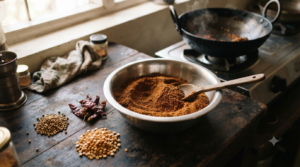
Roast each group separately. It takes longer, though it is the single biggest quality difference between a good batch and a mediocre one. Dals, seeds and chillies all reach their aroma point at different times.
Sun-dry and sort first
Spread the coriander seeds, dals and chillies in the sun for two to three hours if the weather allows. Otherwise warm them briefly in a low oven. Pick out stones, stems and any chilli that looks mouldy. Moisture is the enemy of shelf life, so this step earns its time.
Roast the lentils
Heat a heavy iron kadai on low, then add the urad dal and stir for 6–8 minutes. It is ready when it turns the colour of light honey and smells nutty.
Next add the chana dal and roast for another 5–6 minutes. Tip both onto a wide plate while the pan is still hot.
Roast the seeds and pepper
Add the coriander seeds to the same pan and roast for 8–10 minutes on low. They are done when a seed crushes crisply instead of bending. Add the cumin, peppercorns and fenugreek for the last 2 minutes only. These three scorch quickly and turn bitter.
Roast the chillies last
Wipe the pan, then roast the chillies for 5–7 minutes. They should darken a shade and puff slightly. Keep a window open while you do this, because roasting chillies releases fumes that sting the eyes and throat. Do not let them blacken, since burnt chillies turn the whole batch acrid.
Add turmeric, hing and curry leaves off the heat
Switch off the flame. Sprinkle the turmeric and asafoetida over the warm chillies. Stir for 30 seconds so the residual heat wakes them up. If you are using curry leaves, crisp them separately for 2–3 minutes first.
Cool completely, then grind
Spread everything on a wide plate and leave it for at least 30 minutes. Warm spices release steam inside the grinder jar. That condensation is exactly what makes a powder clump a week later. Grind in two or three small batches, pulsing rather than running the motor without a break.
Rest and store
Sieve once for an even texture. Let the powder sit uncovered for 20 minutes before you jar it. Transfer to a dry glass jar and label it with the grinding date.
How Much Brahmin Style Sambar Powder This Recipe Makes
Raw ingredients here total about 570 g. Roasting drives off roughly 5–8% as moisture, so the finished weight lands near 500–530 g. Older versions of this recipe claimed a 200 g yield. That is less than half of what the same ingredient list produces.
At 2–3 teaspoons per pot for four people, this Brahmin style sambar powder covers roughly 70–100 batches of sambar. One level teaspoon of the ground powder weighs about 2.5 g.
| Batch | Coriander | Byadagi chillies | Urad dal | Yield |
|---|---|---|---|---|
| Half (trial) | 100 g | 65 g | 50 g | About 260 g |
| Standard | 200 g | 125 g | 100 g | About 515 g |
| Double (yearly) | 400 g | 250 g | 200 g | About 1.03 kg |
Scale every other ingredient by the same factor. Grind large batches in stages, though, because an overloaded mixer heats up and dulls the aroma.
Is Brahmin Style Sambar Powder Gluten-Free?
Brahmin style sambar powder is not automatically gluten-free, and this correction matters if you cook for a coeliac. Most supermarket asafoetida is compounded hing. The raw resin has been cut with wheat flour to make it pourable, and that wheat can make up a large share of the packet.
Every other ingredient in this blend is naturally gluten-free. The hing is the single point of failure, so check the label before you assume anything. Brands that use rice flour or maize starch as the carrier do exist. They are usually marked “gluten-free hing” on the front.
If you or a guest has coeliac disease, buy pure resin hing or a labelled gluten-free version. Speak to your doctor or dietitian too, rather than relying on a recipe note. The Celiac Disease Foundation covers hidden gluten sources in more detail.
Brahmin Style Sambar Powder Troubleshooting
Almost every fault traces back to heat control or moisture. Both are easy to correct once you know the signature of each one.
| Problem | Likely cause | Fix |
|---|---|---|
| Bitter aftertaste | Fenugreek over-measured or over-roasted | Cut methi to 1½ tsp; add it last |
| Dull brown colour | Too few Byadagi chillies | Raise the Byadagi share |
| Powder clumps | Ground warm, or a wet spoon went in | Cool 30 minutes; keep a dry spoon |
| Sambar tastes floury | Dals under-roasted | Roast until they snap when bitten |
| Far too hot | Guntur share is above a fifth | Rebalance towards Byadagi chillies |
| Aroma gone in weeks | Big jar stored beside the stove | Decant into small jars |
Storing Brahmin Style Sambar Powder
Keep the jar dry, airtight and out of the sunlight, in glass or steel. Aroma peaks in the first three months. After that it stays safe to eat for about six months, though the fragrance flattens.
Split the batch across two jars. Keep one small working jar on the counter and seal the rest at the back of a cupboard. Humid coastal kitchens are harder on spice powders, so refrigerating the bulk jar there is sensible. Bring it to room temperature before opening.
Here is a quick test. Rub a pinch between your palms. If the smell is faint rather than sharp, add more to the pot or grind a fresh batch.
How Much to Use in Sambar
For four people, start with 2 teaspoons of Brahmin style sambar powder and taste. Push it to 3 teaspoons for vegetable-heavy pots such as drumstick sambar. Tiffin sambar for idli and dosa usually needs slightly less.
Add the powder after the tamarind has boiled for a few minutes, not at the very end. Raw masala floating on top tastes powdery, so give it at least five minutes of simmering.
The same blend works in bisi bele bath and in vegetable palya with a squeeze of tamarind. It also carries a quick Udupi idli sambar well.
Homemade Brahmin Style Sambar Powder vs Store-Bought
Packet powders are convenient, and nobody should feel bad about keeping one for weeknights. Still, the homemade version wins on several counts.
- Fillers: commercial blends often include salt, rice flour or cinnamon.
- Chilli quality: home batches let you pick Byadagi for colour, while packets rarely name the chilli.
- Freshness: a packet may have been ground months before it reached the shelf.
- Cost: grinding at home usually costs less per kilo, although the upfront spend feels larger.
- Control: you can drop the fenugreek, skip the hing, or push the heat up.
Nutrition per Teaspoon (Estimated)
| Per 1 tsp (about 2.5 g) | Estimate |
|---|---|
| Energy | 7–9 kcal |
| Carbohydrate | 1–1.5 g |
| Protein | About 0.3 g |
| Fat | About 0.3 g |
| Fibre | About 0.6 g |
| Iron | About 0.3 mg |
These figures are calculated from standard composition tables for the individual spices. They are not laboratory results for this blend, so treat them as indicative. A teaspoon of spice powder is a seasoning, and it adds very little either way.
What Home Cooks Usually Get Wrong
- Roasting everything together, which leaves the dals pale while the chillies burn.
- Grinding warm spices, because trapped steam causes clumping within days.
- Using only Guntur chillies, so the powder turns fiery and orange.
- Adding turmeric to a hot pan, where it scorches and turns muddy.
- Storing the whole batch in one large jar that gets opened twice a day.
- Assuming the blend is gluten-free without checking the hing packet.
One more thing worth trying. Grind a small trial batch before you commit to two kilos of whole spices. Tastes vary between families, so a half batch costs an hour rather than an afternoon.
Before You Grind Your First Batch
A good jar of Brahmin style sambar powder comes down to three habits. Weigh your ingredients, roast in groups, and cool everything before the mixer goes near it. Choose Byadagi chillies for the bulk of the chilli weight if you want that Karnataka red, and keep Guntur to a fifth or less.
Start with a half batch. Cook one pot of Kannada Brahmin style sambar with it, then adjust the chilli split before you scale up. That trial run saves more disappointment than any amount of reading. For background on how sambar sits across South Indian cuisines, and on Indian chilli grades, the Spices Board of India is a reliable reference.
Frequently Asked Questions
Can I add coconut to Brahmin style sambar powder?
You can, though it changes how long the blend keeps. Dry-roasted desiccated coconut adds body and a faint sweetness that suits Udupi-style sambar. Coconut carries oil, so the powder turns rancid in roughly a month at room temperature. Refrigerate any batch with coconut in it.
What is the difference between Udupi and Mysore sambar powder?
The lentils, mainly. Udupi blends use urad dal with chana dal and lean heavily on coriander, which gives a mild, red, aromatic powder. Mysore blends bring in toor dal and mustard seeds, and some families add a little cinnamon. The result tastes darker and sharper.
Why does my sambar powder taste bitter?
Fenugreek is almost always the culprit. It turns bitter as soon as it browns past golden. Older recipes also list it in grams while giving a teaspoon equivalent that does not match. Add methi in the final two minutes of roasting only.
Can I make sambar powder without a mixer grinder?
Yes, although the texture will be coarser. A stone mortar works for small quantities. Many spice shops will also grind a weighed batch for a small charge. Ask for the machine to be cleaned first if a strong masala was ground before yours.
Is Brahmin style sambar powder very spicy?
Not usually. The blend is built around Byadagi chillies, which give deep colour with modest heat. Guntur chillies supply the actual burn and stay at about a fifth of the chilli weight. Drop the Guntur entirely for a child-friendly version.
How long does homemade sambar powder last?
Aroma is strongest for about three months. The powder stays safe and usable for roughly six months when it is dry, airtight and away from heat. Moisture from a wet spoon shortens that badly, so keep a dedicated dry spoon in the jar.
Can I use sambar powder in place of rasam powder?
In an emergency, yes, but the flavours differ. Rasam powder carries far more pepper and cumin against much less coriander. A rasam made with sambar powder tastes heavy rather than sharp. Add extra crushed pepper and cumin if you have no alternative.
Do I need to sun-dry the spices before roasting?
It helps, though it is not essential. Two or three hours of sun removes surface moisture and improves shelf life, particularly in humid months. A short spell in a low oven does much the same job when the weather will not cooperate.