Kannada Style Sambar Recipe: Authentic Brahmin Huli Method
This Kannada style sambar recipe corrects something most recipe sites get wrong. Authentic Karnataka sambar rests on two ingredients that Kannada kitchens treat as non-negotiable: freshly ground coconut and a small piece of jaggery. Leave those out and you get a perfectly good Tamil-style sambar wearing a Kannada label.
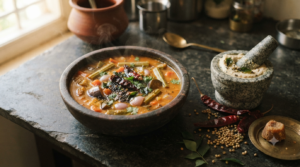
Authentic Kannada Brahmin style sambar, thickened with wet-ground coconut masala and finished with a small lump of jaggery.
This guide corrects that, because the coconut masala is the whole point. You will get exact quantities, the fresh-masala versus stored-powder conversion almost nobody publishes, and fixes for the four things that usually go wrong.
Kannada Style Sambar Recipe at a Glance
- The Kannada name: huli. Sambar is the borrowed word, while huli is what most Karnataka households actually say at the table.
- The defining masala: spices roasted fresh, then ground with grated coconut into a wet paste rather than stirred in as dry powder.
- The sweet note: a marble-sized lump of jaggery, added near the end.
- Satvik by default: no onion and no garlic, since this is temple and festival food.
- Time: roughly 50 minutes, of which about 20 minutes is hands-on.
- Serves: four, with rice, or alongside idli, dosa and vada.
What Makes This Kannada Style Sambar Recipe Different
This Kannada style sambar recipe is a tamarind-soured toor dal stew thickened with a freshly ground paste of roasted spices and grated coconut, finished with jaggery and a mustard-seed tempering. The coconut is what separates it from its Tamil cousin. It gives the sambar body, a faint sweetness and a paler, softer colour.
Tamil Nadu sambar leans on dry sambar powder and tamarind alone. Karnataka’s version grinds the masala wet, so the texture is thicker and the flavour rounder. Add jaggery and the sourness stops being sharp.
The no-onion, no-garlic rule is not a health choice here. It comes from satvik cooking, the style used for temple prasada and festival meals across Karnataka. Because these households cook huli almost daily, the recipe stayed simple and repeatable.
Huli, Saaru and the Names You Will Hear
In coastal Karnataka you may hear the dish called koddel. In the Malnad belt people say huli-saaru. Saaru on its own usually means the thinner rasam-like preparation, while huli is the thicker one with vegetables.
Knowing the vocabulary matters when you follow any Kannada style sambar recipe from a family notebook. If a Kannada recipe asks for huli pudi, it means sambar powder. If it asks for huli masala, it means the wet coconut paste, and the two are not interchangeable by volume.
Kannada Style Sambar Recipe: Masala, Bol and Podi Huli
Karnataka homes do not make one sambar. They make three, and the choice depends on how much time the cook has that morning. Most blogs publish only one and call it the authentic one, which is where the confusion starts.
| Version | Masala method | When it is made |
|---|---|---|
| Masala huli | Spices roasted and ground fresh with coconut | Festivals, guests, Sunday lunch |
| Bol huli | Fresh ground spices, no coconut | When coconut is unavailable or the meal is light |
| Podi huli | Stored huli pudi stirred in dry | Weekday cooking, when time is short |
The Kannada style sambar recipe below is masala huli, the full version. Still, the troubleshooting and conversion sections apply to all three.
Recipe Card
| Prep time | 15 minutes |
| Cook time | 35 minutes |
| Total time | 50 minutes |
| Servings | 4 |
| Cuisine | Karnataka, South Indian |
| Difficulty | Medium |
Ingredients for This Kannada Style Sambar Recipe
Dal and vegetables
- ½ cup toor dal (split pigeon peas), rinsed until the water runs clear
- 1½ cups water for cooking the dal
- ¼ tsp turmeric powder
- 1 medium tomato, chopped
- ½ cup brinjal, cubed
- ½ cup carrot or ash gourd, chopped
- ¼ cup drumstick pieces, optional but traditional
- Small lemon-sized ball of tamarind, soaked in ½ cup warm water (or 2 tsp thick tamarind paste)
- 1 tsp salt, adjusted to taste
The coconut masala (the part that matters)
- ½ cup fresh grated coconut, or ⅓ cup frozen coconut, thawed
- 2 tbsp coriander seeds
- 1 tbsp chana dal
- 1 tsp urad dal
- 5–6 dried Byadagi chillies for colour, plus 1–2 hotter chillies if you want heat
- ½ tsp cumin seeds
- ¼ tsp fenugreek seeds, no more
- ¼ tsp asafoetida
- ½ tsp oil for roasting
Tempering and finish
- 2 tsp coconut oil, or ghee
- 1 tsp mustard seeds
- 2 dried red chillies, broken
- 8–10 curry leaves
- Pinch of asafoetida
- 1 tsp grated jaggery, roughly a marble-sized lump
Byadagi chillies are the Karnataka default because they stain the sambar deep red without much heat. The Byadagi chilli is grown around Byadgi town in Haveri district and carries a Geographical Indication tag. If you cannot find them, Kashmiri chillies behave similarly.
Kannada Style Sambar Recipe: Step by Step
Step 1: Cook the Dal (15 minutes)
Rinse the toor dal until the water runs clear. Pressure cook it with 1½ cups water, the turmeric and a few drops of oil for three to four whistles. Let the pressure drop on its own, which takes about 10 minutes.
Mash the dal thoroughly with a ladle while it is still hot. It should pour, not hold its shape. Undermashed dal is the most common reason sambar tastes watery.
Step 2: Roast and Grind the Masala (10 minutes)
Heat ½ tsp oil in a small pan on low flame. Add the chana dal and urad dal first, because lentils take longest, and roast until they turn golden. Then add the coriander seeds, cumin and fenugreek.
Roast for another two minutes, until the coriander smells nutty. Add the chillies and asafoetida last, then switch off the heat after 30 seconds. Now add the grated coconut off the flame and stir once, since roasting coconut turns the masala bitter.
Let everything cool for five minutes. Grind to a smooth paste with about ¼ cup water. Smooth matters here, because a grainy paste never dissolves properly into the stew.
Step 3: Cook the Vegetables (10 minutes)
Put the brinjal, carrot, drumstick and tomato in a wide pan with ½ cup water and a pinch of salt. Cover and simmer for six to eight minutes. Stop while the vegetables still hold their shape, as they will keep cooking in the sambar.
Step 4: Bring It Together (8 minutes)
Squeeze the soaked tamarind and strain the pulp into the vegetables. Boil for three minutes so the raw tamarind smell burns off. This step is not optional, though many recipes skip it.
Add the mashed dal and the ground coconut masala. Pour in another ½ cup water if the sambar looks thick, then add the salt. Simmer on low for five minutes.
Stir in the jaggery last and let it dissolve. Do not boil hard after the coconut goes in, because a rolling boil splits the paste and dulls the aroma.
Step 5: Temper and Rest (3 minutes)
Heat the coconut oil in a small pan until it shimmers. Add mustard seeds and wait for them to pop. Then add the broken chillies, asafoetida and curry leaves, and count to ten.
Pour the tempering over the sambar and cover the pan immediately. Leave it covered for at least five minutes before serving, so the aromas settle into the stew.
Step 6: Serve
That is the full Kannada style sambar recipe. Ladle it over hot rice with a spoon of ghee. It also works with idli, dosa and vada, although the consistency is thicker than the thin hotel sambar served with tiffin. For that thinner version, our Udupi idli sambar recipe is the closer match.
Fresh Masala or Stored Huli Pudi: How Much to Use
This is where most home cooks overshoot. Fresh wet masala and stored dry powder are not the same strength, so swapping them spoon for spoon makes the sambar either bitter or bland.
| What you are using | Quantity for 4 servings | When to add it |
|---|---|---|
| Fresh coconut masala paste | All of it, about ¾ cup | After the tamarind has boiled |
| Homemade huli pudi (dry) | 2–3 tsp, plus ⅓ cup coconut ground separately | With the dal, then simmer 5 minutes |
| Shop-bought sambar powder | 2 tsp only | With the dal, taste before adding more |
Dry powders are concentrated and often already salted, so start low. Our Kannada Brahmin style sambar powder recipe gives the stored-blend version if you would rather grind a batch once a month.
Where a Kannada Style Sambar Recipe Goes Wrong
Sambar fails in predictable ways. Each of these faults has a fix you can apply mid-cook, so nothing has to be thrown away.
- Bitter aftertaste: too much fenugreek, or roasted coconut. Stir in a little extra jaggery and a spoon of fresh coconut paste to soften it.
- Sharp, raw sourness: the tamarind never boiled. Simmer uncovered for five more minutes before you judge the salt.
- Thin and watery: the dal was undermashed, or the masala was ground coarse. Blend a ladle of the sambar smooth and stir it back in.
- Split or curdled look: it boiled hard after the coconut went in. It is still safe to eat, though the texture will not fully recover.
- Flat, no aroma: the tempering went in too early or the pan stayed uncovered. Make a fresh 30-second tempering and pour it over.
If the sambar tastes correct but dull, salt is usually the answer before more chilli. Taste after the jaggery dissolves, never before, since jaggery changes how the salt reads.
Pro Tips for This Kannada Style Sambar Recipe
- Grind the coconut with a splash of the tamarind water instead of plain water. The acid keeps the paste from tasting flat.
- Use coconut oil for the tempering when you want the coastal Karnataka character. Ghee gives a rounder, more festive result.
- Keep the fenugreek at a quarter teaspoon. It is the single easiest ingredient to overdo, and there is no way to remove the bitterness afterwards.
- Sambar genuinely improves overnight, because the coconut and spices keep melding. Cook it a few hours before a meal if you can.
- Add drumstick early rather than late, since it needs longer than brinjal and releases flavour into the base.
Vegetables That Work, and Two That Do Not
A Kannada style sambar recipe rotates vegetables by season rather than following a fixed list. Ash gourd, cucumber, pumpkin, ridge gourd, beans, brinjal and drumstick are all standard. Yellow pumpkin is especially common because its sweetness pairs with the jaggery.
Two vegetables cause trouble. Okra turns the sambar slimy unless you fry it separately first. Potato absorbs liquid and flattens the tang, although some families still use it for a heavier meal. If you want a single-vegetable version, our drumstick sambar recipe follows the same base.
Diet, Allergy and Safety Notes
One allergen catches people out. Most compounded asafoetida sold in India is bound with wheat flour, so it is not gluten-free even though the resin itself is. Anyone cooking for coeliac disease should check the pack for a wheat declaration, which Indian manufacturers must list under the Food Safety and Standards Authority of India labelling rules, or buy a gluten-free labelled brand.
The recipe is otherwise vegan if you temper in coconut oil rather than ghee. It is naturally nut-free, and the coconut is the only common allergen in the masala.
On the pressure cooker: always let it depressurise naturally after cooking dal. Forcing the valve on a starchy load can spray hot dal. Nutrition figures below are general estimates, not dietary or medical advice, so anyone managing diabetes or kidney disease should ask a qualified professional about portion sizes.
Nutrition Per Serving (Estimate)
One serving is roughly one bowl, about 200 to 220 ml. These are calculated estimates for a home batch made with toor dal, mixed vegetables and half a cup of coconut, so your figures will shift with the oil and coconut you actually use.
| Nutrient | Per serving |
|---|---|
| Calories | 180–230 kcal |
| Carbohydrates | 24–29 g |
| Protein | 7–9 g |
| Fat | 7–10 g |
| Fibre | 6–8 g |
The coconut pushes fat and calories above a plain Tamil-style sambar, while protein and fibre stay much the same. Toor dal supplies most of that protein, and you can read more about the pigeon pea used as toor dal if the nutrition side interests you.
Storing and Reheating This Kannada Style Sambar Recipe
Refrigerate leftovers in an airtight container for up to three days. Coconut shortens the shelf life compared with a powder-based sambar, so do not stretch it to a week.
Reheat gently on the stove with a splash of water, because microwaving tends to separate the coconut. Freezing works for up to a month, although the texture loosens slightly after thawing. Thaw overnight in the fridge, then reheat once only.
Kannada Style Sambar Recipe: The Short Version
If you take three things from this page, take these. Grind the coconut into the masala rather than adding powder, keep the jaggery in, and boil the tamarind before anything else joins the pan. Those three moves are what make a Kannada style sambar recipe taste like Karnataka rather than a generic South Indian stew.
Everything else, from the vegetable choice to the tempering fat, is a family preference you can adjust freely. Start with the fresh masala version once, then switch to stored huli pudi on weekdays.
Frequently Asked Questions
Is this Kannada style sambar recipe the same as Udupi sambar?
They are closely related but not identical. Udupi sambar is a coastal subset that leans harder on coconut oil and jaggery, and it is often built around pumpkin. This Kannada style sambar recipe covers the broader Brahmin household version cooked across Karnataka, and inland kitchens use less coconut oil.
Why is coconut added to Karnataka sambar?
Coconut thickens the stew and softens the tamarind sourness without needing extra dal. It also reflects what grows locally, since coastal and Malnad Karnataka have coconut in daily supply. The result is heavier and less sharp than Tamil Nadu sambar.
Can I make this sambar without a pressure cooker?
Yes. Soak the toor dal for 30 minutes first, then simmer it in a heavy pot with three cups of water for about 40 minutes. Keep topping up hot water and mash well at the end. The dal must be fully soft before you proceed.
Is jaggery essential in a Kannada style sambar recipe?
It is traditional and most Karnataka cooks consider it non-negotiable, though the quantity is small enough to be adjustable. A single teaspoon balances the tamarind rather than sweetening the dish. Skip it and the sambar reads noticeably sharper.
What is huli pudi?
Huli pudi is the Kannada name for sambar powder, a stored blend of roasted lentils, coriander, chillies and fenugreek. Some Karnataka blends also include dried coconut. It is used for quick weekday sambar rather than the fresh-ground festival version.
Can I use desiccated coconut instead of fresh?
You can, but soak two tablespoons in warm water for 10 minutes first. Desiccated coconut grinds coarse when dry and will leave a gritty masala. Frozen grated coconut is a much closer substitute if you can get it.
Why does my sambar taste bitter?
Bitterness almost always traces back to fenugreek seeds or over-roasted coconut. Fenugreek should stay at a quarter teaspoon, and coconut must never touch a hot dry pan. Extra jaggery masks mild bitterness, but badly burnt masala cannot be rescued.
What is the difference between Kannada and Tamil sambar powder?
Karnataka blends usually carry more coriander, Byadagi chillies for colour, and sometimes dried coconut. Tamil blends run hotter and rely on toor dal in the powder itself. That is why the same quantity of each gives very different results in the pot.
Can I make it with no onion and no garlic?
It already is. This Kannada style sambar recipe is satvik by tradition, so neither onion nor garlic appears at any stage. That also makes it suitable for festival meals, vrata days and temple-style cooking, which is why it pairs naturally with dishes like Karnataka style bisi bele bath.