Sambar Recipe with Jaggery: The Authentic Udupi Method
A good sambar recipe with jaggery uses far less jaggery than most home cooks expect. One or two teaspoons is the whole story. The sweetness is there to round off tamarind, not to be tasted on its own. Add a tablespoon and the pot turns cloying, which is the commonest mistake with this style.
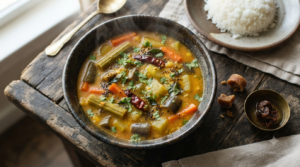
Udupi-style sambar finished with a teaspoon of jaggery, served hot with steamed rice.
Below you get exact quantities, the six-step Udupi method, and a fix for every way sambar goes wrong. There is also an honest look at what jaggery really does for your health.
Sambar Recipe with Jaggery at a Glance
- Jaggery quantity: 1–2 teaspoons (roughly 5–10 g) for four servings, never more.
- What it does: softens the sharp edge of tamarind so the sambar tastes rounded.
- Where it belongs: standard in Udupi and coastal Karnataka homes, while most Tamil Nadu versions skip it.
- Order of adding: tamarind first, jaggery after, so you can taste before you commit.
- Total time: about 1 hour 10 minutes, including 20 minutes of prep.
- Health reality: jaggery is not a low-sugar substitute, although the amount here is tiny.
| Detail | Value |
|---|---|
| Prep time | 20 minutes |
| Cook time | 50 minutes |
| Total time | 1 hour 10 minutes |
| Servings | 4 |
| Cuisine | South Indian, Udupi and Karnataka style |
| Difficulty | Medium |
Why Jaggery Goes Into Sambar at All
Jaggery goes into sambar to balance tamarind. Tamarind brings a sharp, acidic sourness. A small amount of jaggery softens that edge without adding any noticeable sweetness. The result tastes fuller and more layered, so Udupi and coastal Karnataka cooks treat it as essential rather than optional.
Think of it the way a baker thinks of salt in a dessert. You are not adding sugar to make something sweet. You are adding one flavour to correct another. Because tamarind strength varies between batches, every sambar recipe with jaggery also gains a built-in safety net.
The habit is regional, not universal. Udupi kitchens, Mangalorean households and many Karnataka temple kitchens add it as standard. A classic Tamil Nadu sambar without onion and garlic usually leaves it out entirely. Neither version is wrong, since they simply aim at two different flavour targets.
How Much Jaggery Should You Actually Add?
A sambar recipe with jaggery scaled for four people needs 1 to 2 teaspoons, roughly 5 to 10 grams. That is enough to blunt the tamarind while keeping the pot savoury. If you can clearly taste sweetness at the end, you have overshot, because the jaggery should register only as depth.
Start at the lower end. Stir in one teaspoon, simmer for two minutes, then taste before deciding on the second. Sourness also fades as the sambar simmers. A pot that seems too sharp early often settles on its own.
Quantity depends on your tamarind too. Thick, dark, freshly soaked pulp needs the full two teaspoons, while a mild store-bought paste may need barely one. Because these variables shift each time, treat the measurement as a starting point rather than a rule.
Ingredients for This Sambar Recipe with Jaggery
Everything here is standard South Indian pantry stock. The one ingredient worth buying carefully is the jaggery itself, since colour and purity vary a great deal between brands.
- Toor dal (split pigeon peas) – 1 cup (200 g).
- Water – 4 cups, adjusted for consistency.
- Mixed vegetables – 2 cups of carrot, drumstick, bottle gourd and brinjal.
- Tamarind pulp – ¼ cup, from 2 tbsp tamarind soaked in warm water.
- Jaggery – 1–2 tsp (5–10 g), grated or powdered.
- Sambar powder – 2 tbsp.
- Turmeric powder – ½ tsp.
- Red chilli powder – ½ tsp, optional.
- Salt – 1½ tsp, adjusted to taste.
- Oil – 2 tbsp, and coconut oil is traditional here.
- Mustard seeds – 1 tsp.
- Cumin seeds – ½ tsp.
- Fenugreek (methi) seeds – ¼ tsp.
- Asafoetida (hing) – a pinch.
- Dry red chillies – 2.
- Curry leaves – 10 to 12.
- Green chillies – 1 or 2, slit lengthwise.
- Fresh coriander leaves – 2 tbsp, chopped, for garnish.
Choose dark, unpolished jaggery blocks over bright golden ones. Darker jaggery is generally the less processed product. It also carries more of the molasses notes that suit a savoury pot.
Step-by-Step Sambar Recipe with Jaggery
1. Cook the dal (15–20 minutes)
Rinse the toor dal under running water until the water runs clear. Soak it for about 10 minutes, since soaked dal cooks softer and faster. Transfer it to a pressure cooker with 2 cups water, ½ tsp turmeric and a pinch of salt.
Pressure cook for 3 to 4 whistles until the dal turns completely mushy. Once the pressure drops, mash it lightly with the back of a ladle and set it aside.
2. Cook the vegetables (10–15 minutes)
Heat 1 tablespoon of oil in a large pot over medium flame. Add the chopped carrot, drumstick, bottle gourd and brinjal, then stir-fry for 3 to 4 minutes. Pour in about 1½ cups water with ½ tsp turmeric and salt.
Cover and simmer for 8 to 10 minutes until the vegetables are almost tender. Keep the lid slightly ajar so the pot does not boil over.
3. Add tamarind and spices (5 minutes)
Stir the tamarind pulp into the vegetables and simmer for 3 to 4 minutes. This step matters more than it looks, because raw tamarind tastes flat until it has cooked through. Then whisk in the sambar powder and chilli powder, breaking up any lumps as you go.
4. Combine the dal and the jaggery (7–10 minutes)
Pour the mashed dal into the simmering vegetables and stir gently so the pieces stay intact. Add water if you want a thinner gravy. Now add the jaggery, stir it through, and simmer for 7 to 10 minutes until the sambar thickens slightly.
This is where a sambar recipe with jaggery is won or lost, so taste now rather than at the very end. If sourness still dominates, add the second teaspoon and give it two more minutes.
5. Temper (3–5 minutes)
Heat the remaining tablespoon of oil in a small pan. Add mustard seeds and wait until they pop. Then add cumin seeds, fenugreek seeds, dry red chillies, curry leaves, asafoetida and slit green chillies. Fry for about a minute until fragrant, then pour the tempering over the sambar and stir gently.
6. Garnish and serve
Scatter chopped coriander leaves over the top. Serve hot with steamed rice, idli, dosa or vada. A spoon of ghee over the rice is optional, though most Karnataka households treat it as standard.
How to Fix Sambar That Tastes Wrong
A sambar recipe with jaggery is forgiving, and almost every problem has a rescue. Work through the table below before you decide a pot is beyond saving.
| Problem | Likely cause | Fix |
|---|---|---|
| Too sour | Strong tamarind pulp | Add ½ tsp jaggery, simmer 2 minutes, taste again |
| Tastes sweet | Jaggery overdose | Add more tamarind extract and salt, then simmer |
| Raw, powdery taste | Sambar powder added late | Simmer another 8 to 10 minutes on low heat |
| Too thin | Excess water or under-mashed dal | Simmer uncovered, or mash in more cooked dal |
| Slightly bitter | Burnt fenugreek in the tadka | Discard that tempering, redo it on lower heat |
| Flat and dull | Under-salted, or stale tempering | Correct the salt first, then add a fresh tadka |
One caution on rescues. Sweetening only works up to a point. A pot that started with far too much tamarind is better diluted with extra cooked dal than pushed further with jaggery.
How to Buy Jaggery That Is Actually Pure
Jaggery is a commonly adulterated product in India. Additives are used to make it look cleaner and brighter than it naturally is. The Food Safety and Standards Authority of India (FSSAI) runs a consumer-awareness programme with simple home tests for exactly this reason.
The easiest check needs only water. Drop a small piece into a glass of clean water and leave it for a few minutes. Pure jaggery dissolves without leaving residue, whereas particles settling at the bottom suggest chalk powder or similar fillers.
Two more habits help at the shop. Look for a valid FSSAI licence number on the pack. Also be wary of unusually bright, glossy, pale jaggery, since natural jaggery runs golden brown to dark brown. Current standards and consumer guidance sit on the FSSAI website.
Nutrition Facts and the Jaggery Health Myth
Jaggery is not a low-sugar alternative to sugar. Published Indian studies place the glycaemic index of cane jaggery at roughly 84, against about 65 for table sugar. Gram for gram, it therefore raises blood glucose at least as fast as the sugar it supposedly replaces.
That correction matters, because the opposite claim circulates on most recipe sites. Jaggery does contain trace iron and other minerals that refined sugar lacks. However, those quantities are far too small to justify eating more of it. No credible nutrition body treats jaggery as a diabetes-friendly food.
Here is the reassuring part. Two teaspoons split across four servings works out to roughly 2 to 3 grams of added sugar per plate. In the context of a full meal, that is negligible.
So this sambar recipe with jaggery is not the problem. The myth about jaggery everywhere else is.
| Per serving (approximate) | Amount |
|---|---|
| Calories | ~170 kcal |
| Carbohydrates | 28–32 g |
| Protein | 7–9 g |
| Fat | 4–6 g |
| Fibre | 6–8 g |
| Added sugar from jaggery | 2–3 g |
These figures are estimates for a standard dal-and-vegetable sambar, not laboratory values. They shift with your oil quantity and vegetable mix. For reference values on Indian foods, the ICMR–National Institute of Nutrition publishes the Indian Food Composition Tables.
Health note: this is general information, not medical or dietary advice. If you live with diabetes or prediabetes, treat jaggery exactly as you would treat sugar. Follow the guidance of your doctor or dietitian on how it fits your daily carbohydrate allowance.
Pro Tips for a Better Sambar Recipe with Jaggery
- Grate or powder the jaggery first, because a solid lump dissolves unevenly and leaves a sweet pocket in the pot.
- Always add jaggery after the tamarind has simmered, so you are correcting a sourness you have already tasted.
- Cook the dal until it is genuinely mushy, since undercooked dal leaves the sambar watery and grainy.
- Let the pressure release naturally when you have time, because the residual heat softens the dal further.
- Use fresh curry leaves in the tempering, as dried leaves lose most of the aroma.
- Coconut oil pushes the flavour towards the coastal Karnataka original, while any neutral oil works fine otherwise.
- Add drumsticks a few minutes after the harder vegetables, because they turn stringy when overcooked.
Substitutions, Storage and Make-Ahead
Ingredient swaps
- Dal: toor dal is traditional, though a handful of masoor dal makes the sambar creamier.
- Sweetener: palm jaggery works and tastes smokier, while brown sugar is an acceptable last resort.
- Vegan: the recipe is already vegan, so simply skip the ghee at the table.
- No cooker: simmer the dal in a covered pot for 30 to 40 minutes with extra water.
Storing and reheating
- Refrigerator: cool it fully, then store in an airtight container for up to 3 days.
- Freezer: up to 1 month, although the vegetables soften noticeably after thawing.
- Reheating: warm it gently and add a fresh tempering, because the top notes fade first.
- Make-ahead: cook the dal a day early, which cuts the active time to about 25 minutes.
What to Serve It With
Rice is the default pairing. A ladle of this sambar recipe with jaggery over hot rice, with a spoon of ghee, is the standard Karnataka lunch. It also works with idli, dosa and vada, although tiffin usually calls for a thinner consistency.
For a fuller South Indian spread, a dry vegetable poriyal and a rasam round out the plate. If you want one-pot comfort instead, the Karnataka style bisi bele bath covers similar flavour ground in a single vessel.
Before You Cook
The jaggery is the smallest ingredient here and the one that decides the result. Measure it, add it late, and taste before adding more. If the pot tastes sweet, you have made a different dish, so pull the quantity back next time.
Keep the health framing honest as well. Jaggery in sambar is a seasoning, not a health food. For a faster weeknight version, the sambar with readymade sambar powder method skips the grinding. The Kerala style sambar with coconut takes the same base in a richer direction.
Sambar Recipe with Jaggery: Common Questions
Can I make sambar without jaggery?
Yes, and most Tamil Nadu sambar recipes do exactly that. Without jaggery the sambar tastes sharper and more tamarind-forward, which many people prefer. If you skip it, use slightly less tamarind so the pot does not turn harsh.
How much jaggery goes into sambar for four people?
One to two teaspoons, or about 5 to 10 grams. Start with one, simmer briefly, then taste before adding the second. Anything approaching a tablespoon will make the sambar noticeably sweet.
Why does my sambar taste sweet instead of tangy?
You have added too much jaggery, or your tamarind was weaker than usual. Correct it with a little more tamarind extract and a pinch of salt, then simmer for five minutes. Balance returns quickly once the acidity rises.
Is jaggery healthier than sugar in sambar?
Not meaningfully. Cane jaggery has a glycaemic index of roughly 84 against about 65 for table sugar, so it is not a low-sugar swap. The trace minerals are real but far too small to matter at these quantities. Use jaggery for flavour, not for health claims.
Can people with diabetes eat this sambar?
The jaggery adds only 2 to 3 grams of sugar per serving, which is minor. Even so, anyone managing diabetes should count it as sugar rather than as a free ingredient. Ask your doctor or dietitian how it fits your daily carbohydrate allowance.
Is this sambar recipe with jaggery vegan?
Yes. Every ingredient listed is plant-based, and the tempering uses oil rather than ghee. Just skip the optional spoon of ghee at the table, and serve it with rice or dosa for a fully vegan meal.
Can I make sambar without a pressure cooker?
Yes. Simmer the toor dal in a covered pot with extra water for 30 to 40 minutes until it collapses. Mash it well before adding it to the vegetables, since pot-cooked dal needs more help to reach the right texture.
Which vegetables work best in this sambar?
Drumstick, carrot, bottle gourd, brinjal and pearl onions are the traditional choices. Pumpkin, ash gourd and potato also work well. Add the harder vegetables first and the softer ones later, so nothing turns to mush.
When exactly should the jaggery go in?
Add it after the tamarind has simmered and the dal has gone in, roughly seven to ten minutes before you finish. Adding it earlier means guessing at a sourness that has not developed yet, so the correction lands wide.
What is the difference between Udupi and Tamil Nadu sambar?
Udupi sambar carries a hint of jaggery and often freshly ground coconut, which gives it a milder, rounder taste. Tamil Nadu sambar leans sharper and relies more on tamarind. Both use similar vegetables, and the recorded history of the dish shows how many regional versions grew up side by side.