Brahmin Bisi Bele Bath Recipe: No Onion, No Garlic
Brahmin bisi bele bath is at its best when the rice and dal turn creamy, the tamarind stays bright, and the masala tastes warm rather than harsh. This version follows an onion-free and garlic-free Brahmin-style approach, with a fresh roasted spice blend, mixed vegetables, jaggery and a ghee tempering. It keeps the dish traditional in spirit without pretending that every Karnataka Brahmin household cooks it in exactly the same way.
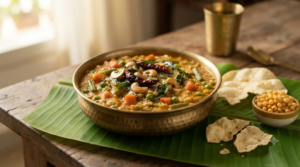
Brahmin bisi bele bath made without onion or garlic, finished with ghee, cashews, mustard seeds and curry leaves.
Karnataka Tourism describes bisi bele bath as a popular Karnataka rice-and-lentil dish built around rice, dal, vegetables, a special masala and a hot tempering. That basic framework is consistent across many home versions. However, the details vary by family, so this recipe states its choices clearly instead of calling one variation the only “authentic” method.
Brahmin Bisi Bele Bath at a Glance
This Brahmin bisi bele bath makes six moderate servings and takes about 75 minutes from start to finish. The cooking is not difficult, but the order matters. Cook the rice and dal very soft, keep the vegetables tender rather than mushy, simmer the tamarind before the final mix, and add the tempering only at the end.
| Detail | Guide | What to look for |
|---|---|---|
| Prep time | 25 minutes | Spices measured, vegetables chopped |
| Cook time | 50 minutes | Rice and dal soft, masala fully cooked |
| Servings | 6 | Main-meal portions |
| Texture | Semi-thick and spoonable | Looser than khichdi, thicker than sambar rice |
| Style | Vegetarian, no onion, no garlic | Fresh masala and ghee finish |
- Use Sona Masuri or another everyday medium-grain rice because it softens without becoming pasty too quickly.
- Cook toor dal until it mashes easily, since a firm dal gives a grainy finish.
- Use tamarind and jaggery as balancing ingredients, not as competing dominant flavours.
- Add hot water near the end because bisi bele bath thickens quickly as it rests.
- Serve it hot with papad, potato chips, banana chips or khara boondi for contrast.
What Makes Brahmin Bisi Bele Bath Different?
The Brahmin-style label here means this version uses no onion and no garlic. It also avoids tomato, so the sourness comes from tamarind alone. That choice creates a cleaner sweet-sour profile and keeps the roasted spice blend at the centre of the dish.
There is no single Brahmin bisi bele bath formula used by every community or family. Some households add tomato, some use different vegetables, and some temper with peanuts instead of cashews. Therefore, treat “Brahmin style” as a household cooking tradition with variations, not a rigid universal standard.
The older version of this page called itself Brahmin style but instructed readers to fry onion. That contradicted the search intent of readers looking for an onion-free version. This refresh fixes that mismatch and gives the page a clearer purpose beside Bhimas Cook’s broader Karnataka bisi bele bath articles.
Brahmin Bisi Bele Bath Ingredients and Ratios
The most dependable starting ratio is 1 cup rice to ¾ cup toor dal for six servings. That gives enough lentil body without making the dish taste like plain dal rice. Keep all the ingredients measured before roasting the masala because the small spices can burn quickly.
For the rice, dal and vegetables
- 1 cup Sona Masuri rice
- ¾ cup toor dal
- ½ tsp turmeric powder
- 2 cups mixed vegetables: carrot, French beans, green peas and chayote or kohlrabi
- 20 g seedless tamarind, soaked in ½ cup warm water, or 2 tbsp thick unsweetened tamarind pulp
- 1½ tbsp grated jaggery, then more only if needed
- 1½ tsp salt to start, adjusted at the end
- Hot water as needed for the final consistency
For the homemade bisi bele bath masala
- 2 tbsp coriander seeds
- 1 tbsp chana dal
- 2 tsp urad dal
- 1 tsp cumin seeds
- ¼ tsp fenugreek seeds
- ½ tsp black peppercorns
- 7 to 8 Byadagi dried red chillies
- 1 inch cinnamon
- 4 cloves
- 2 green cardamom pods
- 3 tbsp dried coconut or copra
- 8 curry leaves
- ¼ tsp asafoetida
If you already have a fresh spice blend, use about 3 tbsp and adjust after simmering. Bhimas Cook also has a separate bisibelebath powder recipe for readers who want to make a larger batch. Store-bought powder works too, although salt and chilli levels vary by brand.
For the final tempering
- 2 tbsp ghee
- 1 tsp mustard seeds
- 10 to 12 cashews, halved
- 2 dried red chillies, broken
- 10 curry leaves
- 1 pinch asafoetida
For a nut-free version, leave out the cashews rather than replacing them with another nut. For a vegan version, use coconut oil or a neutral oil instead of ghee. The aroma changes, yet the rice, dal, tamarind and masala still give the dish its main character.
How to Make Brahmin Bisi Bele Bath Step by Step
Cook the components separately first, then combine them. This takes a little longer than a one-pot shortcut, but it gives much better control over texture. The rice and dal can become soft while the vegetables still keep enough shape to be recognisable.
- Cook the rice. Rinse the rice well. Cook it with about 2½ cups water until very soft. The grains should crush easily between two fingers, since firm rice will not blend properly later.
- Cook the dal. Rinse the toor dal and cook it with turmeric and about 2½ cups water until completely soft. Mash it smooth after the pressure settles or after the dal finishes simmering.
- Cook the vegetables. Simmer the chopped vegetables with about 1½ cups water and a pinch of salt until just tender. Keep the cooking liquid because it carries flavour and helps loosen the final pot.
- Extract the tamarind. Squeeze the soaked tamarind well and strain it. Keep about ½ cup extract ready, adding a little more water if it is unusually thick.
Finish the Brahmin Bisi Bele Bath
- Roast the masala. On low heat, roast coriander, chana dal, urad dal, cumin and fenugreek until the dals turn golden. Add pepper, chillies, cinnamon, cloves, cardamom, curry leaves and coconut last. Cool completely, then grind to a fine powder.
- Cook the sour-sweet base. Add the tamarind extract to the vegetable pot and simmer for 5 to 7 minutes. Add jaggery and salt, then stir until dissolved. This step softens the raw tamarind edge before the rice goes in.
- Combine everything. Add the mashed dal, cooked rice and 3 tbsp homemade masala. Stir gently, then add 1 to 2 cups hot water in stages. Simmer on low heat for 10 minutes, stirring often so the bottom does not catch.
- Temper at the end. Heat the ghee, crackle the mustard seeds, then fry cashews until pale gold. Add red chillies, curry leaves and asafoetida. Pour the tempering over the hot bath, cover for 2 minutes, then mix once before serving.
How to Get the Right Bisi Bele Bath Texture
A good Brahmin bisi bele bath should fall slowly from a serving spoon, not sit in a stiff mound. It should also be thicker than sambar rice. This matters because rice and dal keep absorbing liquid after the flame goes off, so a pot that looks perfect on the stove can become too thick ten minutes later.
Keep a kettle of hot water nearby. Add only ¼ cup at a time, stir well, and wait a minute before adding more. Cold water can dull the simmer and make the texture uneven, while hot water blends in quickly.
Do not chase a restaurant-style glossy look by adding too much ghee. The creamy body should come mainly from well-cooked rice and dal. Ghee belongs at the finish, where a smaller amount gives more aroma.
Common Problems and How to Fix Them
Most failed pots come down to four things: undercooked dal, burnt spice powder, raw tamarind or the wrong final consistency. Fortunately, three of those problems can still be corrected before serving. Burnt masala is the exception because its bitterness spreads through the whole dish.
| Problem | Likely cause | Best fix |
|---|---|---|
| Too thick | Rice absorbed more water while resting | Add hot water in ¼-cup steps |
| Too sour | Tamarind was strong or added in excess | Add a little jaggery and more cooked dal |
| Flat flavour | Masala too mild or tempering skipped | Add a small fresh ghee-hing tempering |
| Bitter finish | Fenugreek, coconut or chillies burnt | Do not mask it; use a fresh spice batch |
| Grainy texture | Dal was not cooked soft enough | Whisk the dal separately before mixing |
If the pot is slightly bland, add salt first before reaching for more masala. Salt often makes the existing tamarind and spice flavours clearer. If it still needs depth, simmer 1 tsp extra masala with a little hot water for two minutes, then stir it in.
What the Old Recipe Got Wrong About “Authentic” Bisi Bele Bath
Bisi bele bath is unquestionably associated with Karnataka. The Karnataka Tourism dish page describes rice, lentils, vegetables, masala, ghee, cashews, asafoetida and curry leaves as common elements. Its current South Karnataka food trail also presents the dish as a comforting rice-and-lentil speciality.
The often-repeated claim that the recipe was a secret of the Mysore Palace is much harder to treat as settled fact. It appears widely in secondary sources, but official Karnataka Tourism pages do not establish that story as a documented origin. Therefore, this refresh keeps the Karnataka identity while avoiding a confident palace-history claim that the old page could not properly support.
Another correction concerns rice. The old page called Sona Masuri “long-grained rice,” which is misleading. It is better described simply as a common South Indian rice that works well here because it softens and blends readily.
Serving Ideas for Brahmin Bisi Bele Bath
This Brahmin bisi bele bath needs something crisp more than it needs another gravy. Papad, potato chips, banana chips or khara boondi give the soft rice-and-dal base the contrast it lacks. A spoon of plain curd also works if you want a cooling side.
For a fully onion-free meal, skip onion raita and choose plain curd or cucumber raita without onion. If you prefer a lighter grain base, Bhimas Cook’s millet bisi bele bath uses the same general flavour idea with a different staple.
If you enjoy Karnataka’s onion-free temple-style flavour profiles, the Udupi temple sambar recipe is another useful comparison. It relies on tamarind, coconut, jaggery and hing rather than onion or garlic, although the masala and final consistency are different.
Storage, Reheating and Food Safety
Cool leftovers promptly and refrigerate them in shallow, covered containers. The USDA advises refrigerating cooked leftovers within two hours and using most refrigerated leftovers within three to four days. That guidance is more useful than simply saying the dish “keeps for three days” without explaining safe cooling.
When reheating, add a splash of hot water because the rice and dal will have tightened. Heat the portion until it is steaming throughout. If you use a food thermometer, the USDA’s leftovers guidance uses 74°C (165°F) as the reheating target.
Freezing is possible, but the texture usually suffers after thawing. Rice can become softer and vegetables can lose structure. For best eating quality, make a smaller batch rather than relying on frozen leftovers.
Is Brahmin Bisi Bele Bath Gluten-Free?
The rice, dal, vegetables, tamarind and jaggery are naturally gluten-free, but the complete dish is not automatically safe for a strict gluten-free diet. Compounded asafoetida often contains wheat flour, and packaged spice mixes can have their own allergen or cross-contact warnings. Therefore, check the hing and masala labels before serving someone who must avoid gluten.
Cashews are another ingredient to flag for anyone with a nut allergy. Leave them out completely if needed, and use a clean tempering pan. The core flavour still comes from mustard, curry leaves, red chilli, hing and ghee or oil.
Before You Serve
The most important decision is consistency. Stop cooking while the bisi bele bath is still slightly looser than you want on the plate, because it thickens fast during the resting time. Then taste for salt, tamarind and jaggery in that order.
Use the Brahmin-style label carefully as well. This page gives one onion-free and garlic-free household approach, not a rule for every Karnataka Brahmin kitchen. That distinction makes the recipe more accurate and also keeps it meaningfully different from the site’s broader bisi bele bath variations.
Brahmin Bisi Bele Bath FAQ
Is Brahmin-style bisi bele bath always made without onion and garlic?
Many Brahmin-style and sattvic versions avoid onion and garlic, but household practices vary. This recipe deliberately leaves both out because that is the clearest intent behind a Brahmin-style search. Some families may also avoid tomato, while others use it freely in everyday cooking.
Can I Make Brahmin Bisi Bele Bath With Readymade Powder?
Yes. Use about 2½ to 3 tbsp readymade powder for this quantity, then taste after simmering. Brand formulas differ in chilli, salt and spice strength, so add extra powder only after the rice, dal and vegetables have cooked together for several minutes.
Which rice is best for bisi bele bath?
Sona Masuri is a practical choice because it cooks soft and blends well with dal. You do not need a premium long-grain rice for this dish. In fact, very separate, fluffy grains work against the creamy, spoonable texture that bisi bele bath needs.
Why does bisi bele bath become very thick after cooking?
Rice and toor dal continue absorbing water after the heat is switched off, so the mixture tightens quickly. Keep the finished pot slightly loose and hold back some hot water for serving. Add a splash while reheating as well, because chilled leftovers become much thicker.
Is bisi bele bath the same as sambar rice?
No. Both combine rice, lentils, vegetables and souring ingredients, but bisi bele bath uses its own aromatic masala with warm spices such as cinnamon and cloves. Sambar rice usually relies on a sambar-style spice profile, so the finished aroma and flavour are noticeably different.
Can I make bisi bele bath ahead for a lunch box?
Yes, but pack it a little looser than you would serve it at home because it thickens as it cools. Keep papad, chips or boondi separate so they stay crisp. For food safety, cool and refrigerate promptly if the meal will not be eaten soon after cooking.
Can I make the recipe vegan?
Yes. Replace ghee with coconut oil or a neutral cooking oil and leave the rest of the method unchanged. The flavour will be less buttery, but the tamarind, jaggery, roasted masala and curry-leaf tempering still create the essential balance.
Can I make bisi bele bath without vegetables?
You can, although the result will be simpler and less varied in texture. Rice, toor dal, tamarind, jaggery and the masala will still produce a recognisable dish. If you omit vegetables, reduce the final water slightly and adjust the salt after simmering.