Chiroti Rava Poli Recipe With Jaggery: Soft Rava Holige
Chiroti Rava Poli Recipe works best as a stuffed rava holige: a soft outer dough wrapped around a cooked semolina-and-jaggery filling. The key is keeping the filling firm enough to roll while the dough stays softer and more elastic. This method gives a tender poli with a warm caramel note instead of a dense sweet roti.
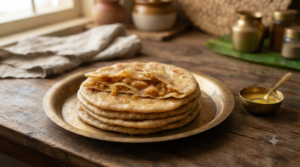
Soft rava holige filled with cooked semolina and jaggery, served warm with a small spoon of ghee.
The earlier version of this page mixed jaggery syrup directly into semolina and treated that mixture as the dough. That produces a different style of sweet flatbread, but it is not the stuffed rava holige most cooks expect from this name. The refreshed method separates the wrapper and filling so the poli rolls thin without cracking.
Chiroti Rava Poli Recipe at a Glance
- Yield: about 12 medium polis
- Prep time: about 25 minutes
- Dough rest: 30 minutes
- Cook time: about 35 minutes
- Total time: about 1 hour 30 minutes
- Texture: soft outer layer with a smooth, lightly grainy rava-jaggery centre
- Best served: warm with a little ghee
This Chiroti Rava Poli Recipe is closer to Karnataka-style rava holige than to paal poli. Paal poli uses fried puris soaked in sweetened milk, while rava holige uses a cooked sweet filling sealed inside dough and cooked on a tawa. Keeping those two methods separate avoids one of the most common recipe mix-ups online.
What Is Chiroti Rava and Why Use It?
Chiroti rava is very fine semolina, so it hydrates faster and cooks more smoothly than coarse sooji. In this recipe, that fine grain helps the jaggery filling become soft enough to spread without turning pasty. Coarse rava can work, but the filling feels rougher and usually needs a little more cooking time.
Fine semolina also appears in many South Indian festive sweets and doughs. If you enjoy this ingredient with jaggery, try our rava laddu with jaggery. The technique is different, yet the same roasted semolina and caramel-like sweetness come through.
Ingredients for Soft Rava Holige
Measure the filling before you start because jaggery and rava thicken quickly once heated. Use a heavy pan if possible, since it spreads heat more evenly and reduces scorching. These quantities make roughly twelve medium polis.
For the Outer Dough
- 1 1/2 cups whole wheat flour (atta)
- 1/2 teaspoon salt
- 1/2 teaspoon turmeric powder, optional
- 1 teaspoon ghee
- 1 teaspoon neutral oil
- About 1/2 to 3/4 cup water, added gradually
For the Rava-Jaggery Filling
- 1 cup fine semolina or chiroti rava
- 1 cup grated jaggery
- 3 cups water
- 2 tablespoons ghee
- 1/2 teaspoon cardamom powder
- A small pinch of salt, optional
Jaggery quality varies, so strain the melted mixture if you see grit or fibre. The Food Safety and Standards Authority of India defines cane jaggery as a sugarcane product with set quality requirements, including limits on extraneous matter. Buying clean, food-grade jaggery makes the filling smoother and easier to roll.
How to Make Chiroti Rava Poli Recipe Step by Step
The process has three control points: a soft dough, a dry-but-pliable filling, and gentle rolling. If those three are right, the polis stay thin and the stuffing does not burst. Read the full method once before heating the pan because the filling firms as it cools.
Step 1: Make and Rest the Dough
Mix the wheat flour, salt, turmeric and ghee in a bowl. Add water little by little until you get a soft dough that feels looser than chapati dough. Knead for five to six minutes, then rub the oil over the surface.
Cover the dough and rest it for 30 minutes. Resting matters because the flour absorbs water and the gluten relaxes, so the wrapper stretches around the filling more easily. If the dough feels stiff after resting, knead in one or two teaspoons of water.
Step 2: Cook the Chiroti Rava
Heat one tablespoon ghee in a heavy pan on medium-low heat. Add the chiroti rava and roast for three to four minutes while stirring, until it smells nutty but stays pale. Roasting first improves flavour and helps the grains stay separate.
Bring the three cups of water to a boil in another pan. Lower the heat, then add the roasted rava gradually while stirring to prevent lumps. Cook until the semolina absorbs most of the water and looks thick.
Step 3: Add Jaggery and Finish the Filling
Add the grated jaggery once the rava has softened. The mixture will loosen as the jaggery melts, so keep cooking on low heat and stir often. Add cardamom and the remaining tablespoon of ghee when the mixture begins to thicken again.
The filling is ready when it leaves the sides of the pan and can hold a soft ball after cooling for a minute. Do not cook until dry and crumbly, because a brittle filling tears the wrapper. Transfer it to a plate and cool completely before shaping.
Step 4: Portion the Dough and Filling
Divide the cooled filling into 12 equal balls. Divide the dough into 12 slightly smaller balls, since the outer layer should stay thin. Keep both covered while you work so their surfaces do not dry out.
Flatten one dough ball into a small disc using lightly oiled fingers. Place a filling ball in the centre, then bring the dough edges up and pinch them closed. Turn the sealed side down before rolling.
Step 5: Roll Without Tearing
Lightly oil the rolling surface or use a sheet of baking paper. Press the stuffed ball gently with your fingers, then roll from the centre outward. Aim for a circle about 15 to 18 cm wide rather than forcing it paper-thin on the first try.
If the filling starts to show through, stop rolling and patch the spot with a tiny piece of dough. Flour dusting can make the wrapper dry, so oil works better for this soft style. A light hand also keeps the filling evenly spread.
Step 6: Cook on a Medium-Hot Tawa
Heat a tawa over medium heat until a drop of water sizzles and evaporates quickly. Lay the rolled poli on the pan and cook until small pale bubbles appear, usually about 30 to 45 seconds. Flip it, then cook the second side until light brown spots form.
Flip once more if needed and brush with a small amount of ghee. Avoid very high heat because jaggery near the surface can scorch before the wrapper cooks. Stack the finished polis loosely under a clean cloth so steam keeps them soft.
Why This Method Works Better Than Mixing Jaggery Into the Dough
A good Chiroti Rava Poli Recipe needs contrast between a flexible wrapper and a sweet filling. When jaggery goes straight into a semolina dough, the sugar competes for moisture and can make the mixture sticky when warm but firm after cooling. That makes thin rolling much harder.
Separating the two parts solves the problem. The wheat dough supplies stretch, while the cooked rava-jaggery centre supplies sweetness and body. The result behaves more like holige or poli, which is why it can be rolled, filled and cooked evenly.
This distinction also separates rava holige from classic dal-filled bobbatlu. Our bobbatlu with jaggery uses chana dal for the filling, while this recipe uses semolina instead. Both share the same basic stuffed-flatbread technique.
Chiroti Rava Poli Recipe Troubleshooting
Most failures come from moisture balance rather than the ingredient list. A filling that is too wet leaks, while a filling that is too dry cracks. The wrapper should also stay softer than ordinary roti dough because it must stretch around a large centre.
| Problem | Likely cause | Fix |
|---|---|---|
| Poli tears while rolling | Dough is stiff or filling is dry | Knead a little water into dough; soften filling with 1-2 teaspoons warm water |
| Filling leaks out | Filling is too wet | Return it to the pan and cook until it holds a ball |
| Poli turns hard | High heat or overcooking | Use medium heat and remove once both sides show light brown spots |
| Rava filling feels gritty | Semolina is coarse or undercooked | Use chiroti rava and cook it fully before adding jaggery |
| Jaggery tastes burnt | Heat was too high | Cook the sweet filling on low heat after adding jaggery |
Small Technique Changes That Make a Big Difference
For this Chiroti Rava Poli Recipe, match the dough and filling temperatures before stuffing. Cold filling inside warm dough can make the centre firm, while hot filling weakens the wrapper. Room-temperature components roll more predictably and give you cleaner edges.
Keep the filling ball slightly larger than the dough ball because a good poli should taste of filling, not bread. Still, beginners can start with equal portions for the first two pieces. Once the dough stops tearing, increase the filling on the remaining batch.
Do not chase a perfectly round shape. Even thickness matters more, because thin edges burn while a thick centre stays doughy. If you want another jaggery sweet that rewards careful heat control, our wheat flour gavvalu with jaggery uses a different shaping method but the same low-and-slow approach to syrup.
Serving, Make-Ahead and Storage
Serve this Chiroti Rava Poli Recipe warm with a small spoon of ghee. Milk is optional, and the poli does not need to be soaked because this is not paal poli. For a festive plate, pair it with a savoury dish rather than adding extra syrup on top.
You can cook the filling a day ahead and refrigerate it once cool. Bring it back to room temperature before stuffing, since cold filling is harder to spread. The dough is best made the same day because it stays more elastic.
For food safety, refrigerate cooked leftovers within two hours if you are not eating them promptly. The U.S. Department of Agriculture advises using most refrigerated cooked leftovers within three to four days. Store the polis in a covered container and reheat briefly on a tawa rather than microwaving them until tough.
See the USDA guidance on leftovers and food safety for general storage guidance. For jaggery quality standards in India, refer to the FSSAI product standards.
Can You Make This Chiroti Rava Poli Recipe With Maida?
Yes. Replace the whole wheat flour with the same volume of maida if you want a softer, more elastic outer layer. Maida usually rolls thinner, while atta gives a slightly nuttier flavour and a sturdier bite.
If you use maida, add water more slowly because absorption differs by brand. Rest the dough at least 30 minutes and keep it well oiled. The filling method stays exactly the same.
Can You Use Sugar Instead of Jaggery?
You can, but the flavour changes noticeably. Jaggery gives a deeper caramel note and slightly softer filling, while white sugar tastes cleaner and can set firmer after cooling. If you substitute sugar, start with less water and judge the filling by texture rather than by a fixed cooking time.
Do not assume jaggery makes the sweet low-sugar or suitable for unrestricted eating. It is still a concentrated sweetener, so portion size matters. The main reason to choose it here is flavour and tradition, not a health claim.
Before You Start Your Batch
The refreshed Chiroti Rava Poli Recipe is built around one practical rule: cook the rava and jaggery as a filling, then wrap it in a separate soft dough. That structure gives the sweet its proper stuffed-flatbread character. Keep the filling pliable, rest the dough, and use medium heat for the best texture.
Your first poli is the test piece, so use it to adjust the batch. If it tears, soften the dough; if filling escapes, cook the filling a little longer. Small corrections at that stage save the remaining eleven pieces.
Frequently Asked Questions
Is Chiroti Rava Poli Recipe the same as rava holige?
Yes, this version is essentially a rava holige or rava obbattu made with a semolina-jaggery filling. Names vary by region, but the core method is a sweet filling sealed inside dough and cooked on a tawa.
Can I make the filling only with chiroti rava and jaggery?
Yes. Fine semolina, jaggery, water, ghee and cardamom are enough for the filling. Cook it until it forms a soft mass that holds its shape after cooling, because loose filling will leak during rolling.
Why does my poli crack at the edges?
The outer dough is probably too dry or has not rested long enough. Add a teaspoon of water, knead briefly, and rest it another 10 minutes. Also keep unused dough covered while you roll each piece.
Can I use coarse sooji instead of chiroti rava?
Yes, although the filling will be more textured. Coarse sooji also takes longer to soften, so cook it fully before adding jaggery. If the grains still feel firm, add a little hot water and continue cooking.
Why does the filling become loose after adding jaggery?
Jaggery melts and releases moisture as it heats, so the mixture naturally loosens for a few minutes. Keep the heat low and continue stirring. It will thicken again as excess water evaporates.
Can I prepare rava holige a day ahead?
Yes. Cook the polis, cool them, then refrigerate in a covered container if holding them overnight. Reheat each one briefly on a tawa with a little ghee before serving.
Is this the same as paal poli?
No. Paal poli usually uses fried puris soaked in sweetened milk, while this Chiroti Rava Poli Recipe uses a stuffed rava-jaggery filling and tawa cooking. The two sweets share the word poli but use different techniques.
What should I do if the filling is too dry?
Knead one or two teaspoons of warm water into the cooled filling and test again. Add only a little at a time, since an overly wet filling is harder to fix. It should roll into a smooth ball without crumbling.