Javvarisi Paruppu Payasam: Easy Creamy South Indian Recipe
Javvarisi paruppu payasam combines roasted moong dal, soft sago pearls, jaggery, milk, cardamom and ghee into a creamy South Indian dessert. The best version is not just sweet; it has a nutty dal aroma, translucent javvarisi and a pourable texture that stays pleasant after cooling. This method also fixes two problems that spoil many batches: unevenly cooked sago and milk splitting after jaggery.
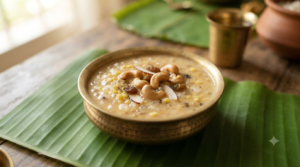
Creamy javvarisi paruppu payasam finished with translucent sago pearls, roasted cashews, raisins and cardamom.
The recipe below keeps the familiar dairy-milk style of the original post, while using a safer order for jaggery and milk. “Hotel style” here means rich, smooth and ladleable rather than a single standard restaurant formula. Different hotels and homes use different ratios, so texture and heat control matter more than any secret ingredient.
Javvarisi Paruppu Payasam at a Glance
- Prep time: about 20 to 30 minutes if regular sago needs soaking
- Cook time: about 30 minutes
- Servings: 5 to 6 dessert portions
- Main ingredients: pasi paruppu, javvarisi, jaggery, milk, cardamom and ghee
- Texture: creamy and pourable with soft dal and fully translucent sago
- Key technique: cook the dal and sago until tender before adding jaggery, then add warm milk off the heat
- Best serving: warm or at room temperature; chilled payasam becomes noticeably thicker
The main visual cue is the javvarisi. The pearls should look translucent through the centre, without a hard white dot. The dal should be soft enough to press between two fingers, yet it should not dissolve into a completely smooth paste.
Ingredients for Javvarisi Paruppu Payasam
These quantities give a rich payasam without making it overly dense. Jaggery varies in sweetness, so start with the listed amount and adjust only after tasting the cooked dal-sago base.
| Ingredient | Quantity | Why it matters |
|---|---|---|
| Yellow moong dal / pasi paruppu | 1/2 cup | Gives body and a nutty base |
| Javvarisi / sago | 1/3 cup | Adds soft, translucent pearls |
| Jaggery | 3/4 cup, grated or powdered | Sweetens and adds caramel notes |
| Full-fat milk | 3 cups, boiled | Creates the creamy finish |
| Water | About 3 cups | Cooks the dal and sago |
| Ghee | 2 tbsp | Roasts the dal and garnish |
| Cashews | 10 to 12 | Adds crunch |
| Raisins | 10 to 12 | Adds soft sweetness |
| Cardamom powder | 1/2 tsp | Adds the classic aroma |
| Salt | 1 small pinch | Balances sweetness |
If your jaggery contains visible grit, dissolve it with 1/4 cup water and strain it before use. That small step prevents sandy bits in the finished dessert. If the jaggery is very dark or strongly flavoured, you may prefer slightly less than 3/4 cup.
Which javvarisi should you use?
Regular medium sago often benefits from a short soak because the pearls cook more evenly. Rinse it, soak for 20 to 30 minutes, then drain. Small nylon or quick-cooking sago may need less soaking, so follow the packet guidance and rely on the translucent-centre test rather than the clock alone.
Do not judge doneness by softness on the outside. A pearl can feel tender yet still keep an opaque centre. That white core means the starch inside needs a little more water and cooking time.
How to Make Javvarisi Paruppu Payasam
The most reliable method is to cook the moong dal and sago until fully tender, combine them with jaggery, then take the pan off the heat before adding milk. This sequence gives you more control because jaggery and dairy milk can split when combined at high heat. It also lets you correct the consistency before the final milk goes in.
- Rinse and soak the sago. Rinse 1/3 cup javvarisi briefly. Soak regular sago in water for 20 to 30 minutes, then drain. Skip or shorten this step only if your packet says the variety is quick-cooking.
- Roast the dal. Heat 1 teaspoon ghee in a heavy pan over low to medium heat. Add 1/2 cup moong dal and roast for 3 to 4 minutes, until it smells nutty and turns lightly golden. Do not brown it deeply because burnt dal will make the whole payasam bitter.
- Cook the dal. Add about 1 1/2 cups water. Cover and simmer until the dal is soft, adding a little hot water if needed. A pressure cooker also works; cook until tender rather than chasing a fixed whistle count, since cooker sizes differ.
- Cook the javvarisi. In a second pan, bring about 1 1/2 cups water to a gentle boil. Add the drained sago and cook on low to medium heat while stirring often. Stop when the pearls look translucent through the centre.
Finish the Javvarisi Paruppu Payasam
Once both main ingredients are tender, the remaining steps move quickly. Keep the heat gentle because the jaggery only needs to dissolve and blend; it does not need a long boil.
- Combine both. Add the cooked sago to the soft dal and mix gently. The mixture should be loose enough to move when stirred. If it looks stiff, add a small splash of hot water now.
- Add the jaggery. Stir in 3/4 cup jaggery, or add strained jaggery syrup if your jaggery has impurities. Simmer on low heat for 2 to 3 minutes, just until the sweetness blends through the dal and sago.
- Switch off the heat. Remove the pan from the flame and let it stand for about 5 minutes. Meanwhile, keep 3 cups boiled milk warm rather than actively boiling.
- Add milk gradually. Pour the warm milk into the jaggery-dal mixture in two or three additions while stirring. Add the cardamom and a tiny pinch of salt. Do not return the finished payasam to a hard boil.
- Finish with ghee-roasted garnish. Heat the remaining ghee, fry the cashews until golden, then add raisins and remove them once they puff. Pour the ghee, nuts and raisins over the payasam and stir once.
At this point, the javvarisi paruppu payasam should fall from a ladle in a thick stream. Keep it slightly looser than your final target because both dal and sago continue absorbing liquid as the dessert rests.
What Makes This Version “Hotel Style”?
There is no single hotel-standard formula for paruppu payasam. In practical terms, a hotel-style bowl usually feels richer and smoother than a thin home kheer, while still remaining pourable. This version gets there through roasted dal, full-fat milk, controlled sweetness and a fresh ghee-cardamom finish.
A generous hot-ghee finish is not a universal hotel rule. A measured ghee finish is enough to carry the aroma without making the dessert greasy, while roasted cashews and raisins add the familiar final texture.
For javvarisi paruppu payasam, the balance matters more than richness alone. Too much sago turns the dessert gluey after cooling, while too much milk can hide the roasted dal flavour. The 1/2 cup dal to 1/3 cup sago ratio keeps both textures visible.
Javvarisi Paruppu Payasam Troubleshooting
| Problem | Likely cause | Fix |
|---|---|---|
| White centre in sago | Pearls are undercooked | Add hot water and cook until translucent |
| Payasam becomes gluey | Too much sago or too little liquid | Loosen with warm milk before serving |
| Milk splits after jaggery | Jaggery met very hot milk | Combine off the heat with warm milk |
| Dal tastes raw | Dal was not roasted or cooked enough | Roast lightly and cook until fully soft |
| Payasam tastes burnt | Starch caught on the pan | Use a heavy pan and stir the base often |
| Too sweet | Jaggery was stronger than expected | Add warm milk, then adjust cardamom |
Why does milk sometimes curdle after jaggery?
Milk is more likely to split when jaggery enters while the dairy base is still boiling. Jaggery composition varies, so one batch may behave differently from another. The safest home method is simple: finish the jaggery stage first, switch off the heat, wait briefly, then stir in boiled warm milk.
This same off-heat approach appears in many established South Indian jaggery-payasam methods. If you want an even more forgiving option, use coconut milk and stir the thick coconut milk in after the flame is off.
Why does the payasam turn thick after cooling?
Sago and cooked dal continue holding water as they rest, so the texture tightens naturally. That is why a perfect serving consistency in the pan can become heavy an hour later. Keep the fresh batch slightly loose, then add a splash of warm milk when reheating.
Two Useful Variations
Coconut milk version
Replace the dairy milk with coconut milk if you want a dairy-free finish. Cook the dal and sago in water first, then add jaggery and switch off the heat. Stir in thick coconut milk only at the end and avoid prolonged boiling, since gentle heat preserves its fresh flavour.
If coconut milk is the style you prefer, Bhimas Cook also has a dedicated moong dal payasam with coconut milk. That recipe keeps the focus on dal rather than the dal-and-sago combination here.
Pressure-cooker shortcut
You can pressure-cook the roasted dal and soaked sago together when speed matters. However, separate cooking gives better control because different sago sizes soften at different rates. If you combine them in one cooker, use enough water and check that the pearls are fully translucent before adding jaggery.
For a different texture, the sago and vermicelli payasam uses semiya instead of dal. If you need a coconut-free dal dessert, compare the parippu payasam without coconut milk.
Serving and Storage Tips for Javvarisi Paruppu Payasam
Serve javvarisi paruppu payasam warm for the softest, most pourable texture. It also tastes good at room temperature. Chilled payasam becomes much thicker, so stir in a little milk before serving if the texture feels stiff.
Because this javvarisi paruppu payasam contains milk, cool leftovers promptly and refrigerate them in a covered container. The Food Safety and Standards Authority of India advises storing leftover cooked food cold below 5°C when it is not eaten immediately. The USDA Food Safety and Inspection Service also advises refrigerating perishable cooked food within two hours and using most cooked leftovers within three to four days.
For best dessert quality, aim to finish this payasam within two to three days because sago keeps thickening in the refrigerator. Reheat only the portion you need over low heat and add a splash of milk. If it smells sour, looks unusually separated or has been left out too long, discard it.
Common Javvarisi Paruppu Payasam Mistakes
- Adding all the milk early: it makes jaggery handling harder and increases the chance of splitting later.
- Using the timer instead of checking sago: pearl size varies, so translucency is the better test.
- Over-roasting moong dal: deep browning makes the dessert bitter rather than pleasantly nutty.
- Reducing until thick on the stove: the payasam keeps thickening after cooking, so stop while it still looks slightly loose.
- Adding jaggery without straining gritty batches: visible sediment can spoil the smooth texture.
- Boiling again after milk goes in: gentle warming is safer than a hard final boil.
The easiest way to remember javvarisi paruppu payasam is texture first, timing second. Cook the dal until soft, cook the javvarisi until translucent, dissolve the jaggery completely, then finish with milk away from aggressive heat.
Before You Serve
Javvarisi paruppu payasam works best when every element keeps its own character. The dal should taste roasted, the sago should feel soft but distinct, and the jaggery should add depth without hiding the cardamom. Keep the mixture a little loose, add the milk off the heat, and garnish only at the end.
Those small choices make javvarisi paruppu payasam easier to repeat than chasing an exact “hotel” formula. Once you know the visual cues, you can adjust sweetness or milk to suit your family without losing the core texture.
Frequently Asked Questions
Can I make javvarisi paruppu payasam without milk?
Yes. Use coconut milk for a dairy-free version, or use extra water and finish with a smaller amount of thick coconut milk. Add the thick coconut milk after switching off the heat, because a long boil can dull its fresh flavour and make the texture heavier.
Do I have to soak javvarisi before cooking?
Not always. Regular medium sago often cooks more evenly after a 20 to 30 minute soak, while some nylon or quick-cooking varieties need little or none. Follow the packet guidance and cook until every pearl looks translucent through the centre.
Can I cook moong dal and sago together?
Yes, especially in a pressure cooker, but the result depends on pearl size. Separate cooking gives more control because dal and sago do not always soften at the same speed. If you cook them together, check the sago centre before moving to the jaggery stage.
Why did my milk split after I added jaggery?
The mixture was probably too hot when jaggery and dairy milk met. Finish the jaggery stage first, switch off the flame, wait a few minutes, then stir in boiled warm milk. Avoid a hard boil after combining them.
Can I use sugar instead of jaggery?
Yes, but the flavour will be lighter and less caramel-like. Sugar also behaves differently with milk, so curdling is less of a concern. Start with less sugar than the jaggery quantity, taste, then increase gradually.
Why is my payasam much thicker the next day?
Sago and dal keep absorbing liquid as they cool. Refrigeration makes that thickening even more noticeable. Warm the portion gently with a little milk until it returns to a ladleable consistency.
How long can I refrigerate this payasam?
For best texture, use it within two to three days when refrigerated promptly in a covered container. General food-safety guidance allows many cooked leftovers for up to three to four days under proper refrigeration. Discard the dessert sooner if it develops an off smell, sour taste or signs of spoilage.
Can I make it a day ahead for a festival meal?
Yes. Make it slightly looser than usual, cool it promptly, then refrigerate it covered. Reheat gently the next day with a small amount of milk and add fresh ghee-roasted cashews and raisins just before serving for the best aroma.