Chiroti Recipe with Rice Flour: Crisp Layered Sweet
Chiroti Recipe with Rice Flour is best made as a thin, layered fried pastry, not as a thick flatbread soaked in milk. The key is to knead fine chiroti rava into a smooth dough, spread a light rice-flour-and-fat paste between very thin sheets, roll them into a log, cut the spirals, and fry them gently. This produces the crisp, flaky structure associated with chiroti.
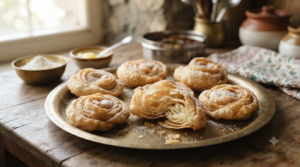
Crisp layered chiroti finished with cardamom sugar, showing the flaky texture created with rice flour and ghee.
Karnataka Tourism describes chiroti as a flaky layered sweet pastry, while its culinary material also identifies chiroti or peni as a crisp layered puri dusted with fine sugar. That makes the structure very different from stuffed poli such as holige or bobbatlu. If you want a soft stuffed flatbread, use this bobbatlu recipe instead.
Chiroti Recipe with Rice Flour at a Glance
- Main dough: fine chiroti rava, softened fat, salt, and water
- Layering paste: rice flour mixed with softened butter or ghee
- Texture: crisp outside with thin, separated flaky layers
- Finish: powdered sugar and cardamom
- Optional serving: warm badam milk on the side or poured just before eating
- Method: roll thin sheets, layer, roll into a log, slice, flatten, and deep-fry
The important correction in this Chiroti Recipe with Rice Flour is simple: rice flour works best as part of the layer-separating paste. Two established chiroti methods currently available online use the same basic approach. One mixes rice flour with butter into a creamy paste, while another uses the same paste between multiple thin semolina sheets before rolling and frying.
Ingredients for Chiroti Recipe with Rice Flour
This Chiroti Recipe with Rice Flour follows the well-established semolina-and-rice-flour lamination method. The water amount may vary slightly because fine semolina absorbs moisture differently by brand and storage conditions. Add it gradually rather than pouring it in at once.
For the dough
- 2 cups chiroti rava or very fine semolina
- 2 tablespoons softened unsalted butter or ghee
- 1/4 teaspoon salt
- About 3/4 cup water, added gradually
- Plain flour or rice flour for very light dusting, only as needed
For the rice flour layering paste
- 1/4 cup softened unsalted butter or ghee
- 2 tablespoons rice flour
For frying and finishing
- Neutral cooking oil, enough for deep-frying
- Powdered sugar, as needed for dusting
- 1/2 teaspoon cardamom powder, or to taste
Use very fine semolina rather than coarse upma rava because the dough needs to roll into thin sheets. If you are comparing packet labels, the site’s guide to different rava types explains how grain size changes texture and water absorption.
Why Chiroti Recipe with Rice Flour Creates Better Layers
Rice flour helps the thin dough sheets stay separate during lamination because it does not form the same elastic gluten network as wheat flour. Mixed with soft butter or ghee, it becomes an even paste that coats each sheet. During frying, those coated layers separate more readily instead of merging into one dense disc.
The paste should be creamy and thin enough to spread. If it is stiff, soften the fat slightly and beat it again. For a reliable Chiroti Recipe with Rice Flour, keep this paste smooth and water-free so the laminated sheets separate cleanly during frying.
| Rice flour use | Effect | Recommendation |
|---|---|---|
| Large amount in main dough | Can make dough brittle and harder to laminate | Avoid for this method |
| Light dusting | Helps prevent sticking while rolling | Use sparingly |
| Mixed with butter or ghee | Separates sheets and supports flaky layers | Use for lamination |
How to Make Chiroti Recipe with Rice Flour Step by Step
In this Chiroti Recipe with Rice Flour, technique matters more than speed. Keep the dough covered whenever you are not working with it, because exposed fine semolina dries at the edges. Roll each sheet as thinly and evenly as you can without tearing it.
1. Make the fine semolina dough
Put the chiroti rava and salt in a wide bowl. Add 2 tablespoons softened butter or ghee, then rub it through the rava until the grains feel evenly coated. Pour in water little by little and knead until the dough becomes smooth and pliable.
Continue kneading for about 5 to 8 minutes, which matches the timing used in an established chiroti method. Cover the bowl and rest the dough for about 15 minutes. Fine semolina continues to absorb moisture while it rests, so knead it briefly once more before rolling.
2. Prepare the rice flour paste
Mix the softened butter or ghee with the rice flour until the mixture looks smooth and creamy. Scrape the sides of the bowl so no dry flour remains. The paste should spread in a thin film rather than sit in thick lumps.
Keep this mixture at room temperature while you roll the dough. If the room is cool and the fat firms up, stir it again before spreading. A thin, even coat is enough to separate the layers.
3. Roll several very thin sheets
Divide the dough into five roughly equal portions. Keep four portions covered while you roll the first. Dust the board lightly only if the dough sticks, then roll the dough as thinly as possible without making holes.
Roll the remaining portions to a similar size. Perfect circles are not important because the sheets will be stacked and rolled into a log. Even thickness matters more, since thick patches stay doughy while thin patches turn crisp.
4. Layer the sheets with rice flour paste
Place one sheet on the board and spread a very thin layer of the rice flour paste over the surface. Lay the second sheet on top, then spread another thin coat. Continue until all five sheets are stacked.
Do not use more paste simply to make the sweet richer. Too much fat between the sheets can squeeze out while rolling and may cause excessive foaming in the oil. The paste is there to separate layers, so a light coating works better than a thick one.
5. Roll, cut, and shape the spirals
Starting from one side, roll the stacked sheets into a firm log. Keep the roll reasonably tight so the layers form a clear spiral. Then cut the log into pieces about 2 to 2.5 cm wide.
Turn one piece cut-side up and press it gently with your palm. Roll it only enough to form a small disc while keeping the spiral visible. Heavy pressure can fuse the layers you just created, so use a light hand.
6. Fry on steady medium heat
Heat enough oil for the shaped pieces to float freely. The oil should be medium hot rather than smoking. Test with a tiny piece of dough: it should rise steadily with bubbles, not darken immediately.
Fry only a few pieces at a time. Gently turn them as the layers open and the surface becomes pale golden. Remove them before they turn deep brown, because over-frying makes the delicate pastry hard and can mute the layered texture.
The Food Safety and Standards Authority of India advises against repeated use of frying oil. Its current RUCO guidance sets a 25% Total Polar Compounds limit beyond which used vegetable oil must not be used for food. At home, discard oil that has become dark, thick, foamy, or has an off smell rather than repeatedly topping it up.
How to Finish and Serve Chiroti Recipe with Rice Flour
Let the fried pieces drain for several minutes, then dust them with powdered sugar mixed with cardamom. The sugar should sit on the crisp surface rather than dissolve into a wet coating. For the cleanest texture, add it while the chiroti is warm but no longer dripping with oil.
Milk is optional, not mandatory for this version. Karnataka food references describe chiroti both as a sugar-dusted layered pastry and in milk-serving contexts. If you enjoy the richer style, serve warm milk or kesar badam milk separately and pour it over an individual serving just before eating.
Keeping the pastry and milk apart until serving gives you control over texture. Eat it immediately after pouring for a crisp-soft contrast, or let it sit briefly if you prefer a softer bite. Avoid soaking the entire batch in advance unless that soft texture is specifically what you want.
Chiroti Recipe with Rice Flour: Common Problems and Fixes
Most chiroti problems come from one of four things: dry dough, thick sheets, excessive layering paste, or the wrong oil temperature. Watch the first two pieces closely because they tell you how to adjust the rest of the batch.
| Problem | Likely cause | What to do |
|---|---|---|
| Dough cracks while rolling | Dough is dry or under-rested | Knead in a little water and rest again |
| Layers are not visible | Sheets were too thick or pressed too hard | Roll thinner and flatten spirals gently |
| Pastry turns hard | Oil is too hot or frying is too long | Lower the heat and stop at pale gold |
| Pastry absorbs too much oil | Oil is too cool | Let the oil recover before the next batch |
| Fat leaks from the layers | Layering paste is too thick | Spread a thinner film |
| Sugar becomes wet | Pastry is coated while too hot | Drain and cool briefly before dusting |
Why did my chiroti puff like a poori?
A large hollow puff usually means the laminated disc was too thick or the layers fused during shaping. Chiroti should develop many fine flakes rather than one empty pocket. Roll the first sheets thinner and use less pressure after cutting the log.
Why are my chiroti layers dense?
Dense layers usually point to thick dough sheets, too little rice-flour paste, or a loose log. Spread the paste evenly to the edges and roll the stack firmly. Also keep the frying heat steady so the pastry has time to open before browning.
What “Hotel Style” Should Mean Here
There is no single official hotel formula for the Chiroti Recipe with Rice Flour. On this page, “hotel style” should describe a crisp, evenly fried, neatly layered result rather than imply a secret restaurant recipe. The repeatable factors are thin rolling, light lamination, steady frying heat, and a dry finish.
That distinction matters because richness alone does not create better chiroti. Adding extra ghee, milk, or sugar cannot fix thick layers. Technique gives the pastry its structure, while the finishing sugar and optional milk provide sweetness.
This also makes the recipe easier to prepare for guests. Fry the pastry first and keep it dry. Add sugar before serving, then offer milk separately for anyone who wants it.
Chiroti, Poli, Bobbatlu, and Paal Poli Are Not the Same
Karnataka Tourism currently identifies chiroti as a flaky layered sweet pastry. Its published culinary material also describes chiroti or peni as a crisp flaky layered puri dusted with fine sugar. By contrast, holige and related poli styles are sweet flatbreads with filling.
Bobbatlu, holige, obbattu, and puran poli normally involve a sweet filling enclosed in dough and cooked on a tawa. Chiroti gets its character from laminated sheets and deep-frying. That difference in construction is more useful than relying on regional naming alone.
Paal poli is another separate preparation because milk soaking is central to the serving style. Chiroti can certainly be enjoyed with milk, but that does not make every chiroti a paal poli. Keeping these techniques separate prevents the common mistake of turning a flaky pastry recipe into a soft milk-soaked disc.
Chiroti Recipe with Rice Flour: Storage and Food-Safety Notes
For the best texture, serve chiroti fresh after it has cooled enough to become crisp. If you need to hold the dry pastries, cool them fully before placing them in an airtight container. Trapping steam while they are warm will soften the layers.
Keep milk or badam milk separate from the pastry. The Food Safety and Standards Authority of India advises prompt refrigeration of perishable foods and recommends storing advance-prepared or leftover foods cold below 5°C. Its Food Safety at Home guidance also advises keeping cooked food cold below 5°C when it cannot be eaten immediately.
Do not leave a dairy-soaked batch at room temperature for long periods. If you want to make the sweet ahead, store the dry fried chiroti and chilled milk separately, then combine them at serving time.
Chiroti Recipe with Rice Flour: Final Checklist
- Use fine chiroti rava, not coarse upma rava.
- Knead until smooth, then allow the semolina to rest and hydrate.
- Mix rice flour with butter or ghee for the layering paste.
- Roll each sheet thin before stacking.
- Spread only a light film of the paste.
- Roll the layered stack firmly, then cut visible spirals.
- Flatten gently so the layers do not fuse.
- Fry on steady medium heat and stop at pale gold.
- Dust with cardamom sugar after draining.
- Serve milk separately if you want a softer finish.
The strongest version of this Chiroti Recipe with Rice Flour is built around lamination, not soaking. Get the thin sheets and rice-flour paste right, and the pastry develops the crisp flakes that define chiroti. Sugar, cardamom, and milk can then be adjusted to taste without changing the core method.
Frequently Asked Questions
What is chiroti rava?
Chiroti rava is a very fine grade of semolina used for smooth doughs and delicate sweets. It is finer than the coarse rava commonly used for upma. Because brands vary, add water gradually and judge the dough by softness rather than relying on one fixed liquid amount.
Why does Chiroti Recipe with Rice Flour use a layering paste?
Rice flour is mixed with softened butter or ghee and spread between thin dough sheets. That paste helps keep the sheets distinct while they are rolled and fried. The result is a more visible flaky structure than you usually get from mixing a large amount of rice flour into the dough.
Can I use regular rava instead of chiroti rava?
Very fine regular semolina can work, but coarse upma rava is harder to roll into thin sheets. If the grains are noticeably coarse, the pastry will usually feel rougher and may crack more easily. Fine chiroti rava is the better choice for this laminated method.
Can I make chiroti without rice flour?
You can make related layered pastries with other flour-and-fat pastes, but this page specifically uses rice flour because it gives clean separation between layers. If you omit it, the finished pastry may still be crisp, yet the flakes may be less distinct.
Should chiroti be soaked in milk?
No. Milk is an optional accompaniment for this crisp chiroti method, not a required soaking step. Serve it on the side or pour it over one portion immediately before eating if you prefer a softer, richer texture.
What is the difference between chiroti and bobbatlu?
Chiroti is made from laminated dough that is cut, shaped, and deep-fried. Bobbatlu is a stuffed sweet flatbread, usually filled with cooked dal and jaggery, then cooked on a tawa. Their ingredients can overlap, but the structure and cooking methods are different.
Why does my chiroti become oily?
The most common cause is oil that is not hot enough when the pastry goes in. Fry small batches and let the oil return to steady medium heat between batches. Very thick discs can also absorb more oil because they need longer to cook through.
Can I prepare Chiroti Recipe with Rice Flour ahead of time?
Yes, but keep the fried pastry dry until serving. Cool it completely before storing it airtight, and keep any milk accompaniment refrigerated separately. Add powdered sugar near serving time if humid weather tends to make it dissolve.
Can I bake chiroti instead of deep-frying it?
You can bake a laminated semolina pastry, but the texture will not be the same as traditional fried chiroti. Deep-frying rapidly expands and crisps the thin layers. A baked version should be treated as an adaptation rather than an exact substitute.