Gavvalu Recipe with Wheat Flour: Crisp Andhra Sweet Shells
A gavvalu recipe with wheat flour behaves nothing like the maida version most guides copy, and that single difference decides whether your shells turn out crisp or leathery. Atta drinks more water, browns faster, and needs a slower fry. Get those three things right and you will pull out ridged little shells that hold jaggery syrup in every groove. Below you will find the exact measurements, the syrup test that most blogs describe wrongly, and the fixes for shells that turn soft by evening.
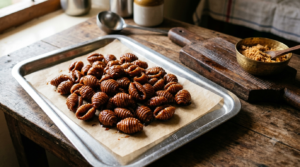
Whole wheat gavvalu shells coated in one-string jaggery syrup, cooling on a tray before storing.
Gavvalu Recipe with Wheat Flour at a Glance
- Flour: whole wheat atta, no maida at all
- Sweetener: jaggery syrup cooked to one-string stage
- Yield: roughly 48 to 55 shells, or 8 servings
- Total time: about 1 hour 5 minutes, including resting
- Shelf life: 7 to 10 days in a dry, airtight jar
- Tool: a gavvalu peeta if you own one, otherwise a fork
| Stage | Time | Notes |
|---|---|---|
| Prep and rest | 20 mins | Dough must rest before shaping |
| Shaping | 15 mins | Faster with two people |
| Frying | 20 mins | Low-medium heat, 4 to 5 batches |
| Syrup and coating | 10 mins | Work quickly once syrup is ready |
| Difficulty | Medium | Syrup stage is the only tricky part |
Wheat Flour or Maida: What Actually Changes
Traditional Andhra gavvalu use maida. The Wikipedia entry on sweet shells lists maida with water or milk as the classic base. So a wheat version is a genuine adaptation, not the original, and it does not behave identically.
Bran is the reason. Whole wheat carries bran and germ, which cut through gluten strands as you knead. Because of that, atta dough tears more easily and the finished shell snaps rather than shatters.
Any gavvalu recipe with wheat flour therefore needs two adjustments. Use a little more water, and drop the frying temperature.
Wheat also browns sooner. Since atta holds more natural sugars and bran particles, the shells colour while the centre is still doughy. That is why the fry must run cooler and longer than any maida recipe tells you.
| Factor | Whole wheat atta | Maida |
|---|---|---|
| Water needed | Higher, about 1 cup | Lower, about ¾ cup |
| Frying heat | 160–165°C, low-medium | 170–175°C, medium |
| Fry time per batch | 6–8 minutes | 3–4 minutes |
| Texture | Nutty, firm snap | Light, flaky shatter |
| Colour | Deep brown | Pale gold |
If you want the pale, flaky, festival-stall texture instead, our maida gavvalu with jaggery syrup covers that version properly.
Ingredients for Gavvalu Recipe with Wheat Flour
These quantities make about 8 servings. Measure the flour by weight when you can, because cup sizes vary widely across Indian kitchens.
- Whole wheat flour (atta) — 2 cups, roughly 240 g
- Fine semolina (chiroti rava) — 2 tbsp, for crispness
- Hot ghee — 3 tbsp, about 40 g, heated until it shimmers
- Salt — a generous pinch
- Warm water — ¾ to 1 cup, added slowly
- Oil for deep frying — 3 to 4 cups, though little is absorbed
- Jaggery, grated — 1 cup, about 200 g
- Water for syrup — ½ cup
- Cardamom powder — ½ tsp
The semolina is the one addition worth insisting on. Rava grains stay coarse after frying, so they interrupt the dense wheat structure and keep the bite crisp for days.
Choose dark, sticky jaggery rather than the pale hard blocks. Cheap jaggery often carries grit and sets unevenly, which leaves a gritty film on the shells.
How to Make Gavvalu Recipe with Wheat Flour Step by Step
Step 1: Make the dough (10 minutes)
Combine the atta, semolina, and salt in a wide bowl. Heat the ghee until it shimmers, then pour it straight over the flour. Rub it in with your fingertips until the mix resembles damp breadcrumbs.
Now test it. Squeeze a fistful, and it should hold its shape briefly before crumbling. If it will not hold, add another teaspoon of ghee.
Step 2: Knead and rest (15 minutes)
Add warm water two tablespoons at a time while mixing. Stop as soon as the dough gathers into a firm, non-sticky mass. Knead for three minutes until smooth.
The dough should feel stiffer than chapati dough, though it must not crack. Cover it with a damp cloth and rest it for 15 minutes, since resting lets the bran hydrate fully.
Step 3: Shape the shells (15 minutes)
Pinch marble-sized portions and roll them smooth between your palms. Press each ball onto a wooden gavvalu peeta, then drag it downward so the ridges print and the edges curl.
No peeta at hand? A fork works well, although a clean new comb gives finer lines. Keep the shaped shells under a cloth while you work, because exposed wheat dough dries and cracks quickly.
Step 4: Fry low and slow (20 minutes)
Heat oil in a heavy pan to roughly 160–165°C. Drop in a scrap of dough as a test. It should rise steadily after two or three seconds without browning immediately.
Slide in 10 to 12 shells and fry for 6 to 8 minutes, turning gently. They are done when the bubbling almost stops and the colour turns deep golden. Drain them on a rack rather than tissue, so trapped steam escapes.
Step 5: Cook the jaggery syrup (8 minutes)
Melt the jaggery with half a cup of water on medium heat. Strain it once through a fine sieve if the jaggery looks dusty. Return it to the pan and boil until it reaches one-string consistency.
Step 6: Coat and cool (10 minutes)
Take the pan off the heat, stir in the cardamom, and tip in the fried shells. Toss fast for about a minute so every ridge picks up syrup. Spread them on a greased tray in a single layer, then let them cool for at least 30 minutes before storing.
Getting the Jaggery Syrup Right
This is where most gavvalu fail, and it is also where competing recipes contradict themselves. Several tell you to stop at a “thick but pourable” stage. That syrup never sets, so the shells stay tacky and go soggy within a day.
A gavvalu recipe with wheat flour is especially unforgiving here, since the denser shell absorbs less syrup. You want one-string consistency instead. Dip a spoon, cool a drop between thumb and forefinger, then pull them apart. A single unbroken thread should form before it snaps.
Jaggery makes this harder to judge than sugar, because its colour hides the change. So rely on the thread test, not on the shade. If the syrup crosses into two threads it will harden like candy, and the fix is simple: stir in a tablespoon of hot water off the heat.
Timing matters as much as the stage. Coat while the syrup is hot and the shells are warm, since a cooled syrup slides off instead of clinging.
Why Wheat Gavvalu Turn Soft or Hard
| Problem | Likely cause | Fix |
|---|---|---|
| Soft by evening | Syrup under-cooked | Boil to one-string stage |
| Rock hard | Syrup past two strings | Add hot water, reheat gently |
| Doughy centre | Oil too hot | Drop to 160°C, fry longer |
| Oily shells | Oil too cool | Reheat before each batch |
| Cracked edges | Dough too dry | Knead in a spoon of warm water |
| Gritty coating | Impure jaggery | Strain the melted syrup |
One pattern repeats in home kitchens. People fry wheat shells at maida temperatures and then blame the flour when the centres stay raw. Lower the flame instead, because atta simply needs the extra minutes.
Pro Tips for Gavvalu Recipe with Wheat Flour
- Rest twice. Rest the dough, then rest the shaped shells for five minutes so their surface dries slightly and holds ridges better.
- Fry a tester. Cook one shell fully and taste it before committing a whole batch to that oil temperature.
- Work in pairs. One person shapes while the other fries, since fresh shells fry far better than ones left sitting.
- Skip the tissue. Cooling on a wire rack keeps the underside crisp, whereas paper traps steam.
- Coat in batches. Add half the shells, toss, then add the rest, because a crowded pan coats unevenly.
Substitutions and Storage
For a lighter shell, swap half a cup of atta for maida. The result sits midway between the two textures, though it loses the nutty depth.
Coconut oil replaces ghee for a vegan batch, and it fries cleanly. If jaggery is unavailable, our sugar syrup gavvalu version uses the same shaping method with a plain sugar syrup.
Store a batch from this gavvalu recipe with wheat flour in a dry glass jar for 7 to 10 days. Humidity is the real enemy here, so never seal them while even slightly warm. If they soften anyway, spread them on a tray and warm them at 120°C for 5 minutes.
Prefer a savoury batch instead? The same dough method appears in our karam gavvalu with wheat flour, which skips the syrup entirely.
Nutrition in Gavvalu Recipe with Wheat Flour
The figures below are calculated from standard food composition values for the listed quantities, divided into 8 servings of roughly 6 shells each. They are estimates, not laboratory measurements, and oil absorption varies with your frying temperature.
| Nutrient | Per serving (approx.) |
|---|---|
| Energy | 295 kcal |
| Carbohydrates | 46 g |
| of which sugars | 24 g |
| Fat | 11 g |
| Protein | 4 g |
| Fibre | 3 g |
One point deserves correcting, because many recipe pages repeat it. Jaggery is often sold as a detoxifying health food, yet it remains a free sugar in nutritional terms.
The World Health Organization advises keeping free sugars under 10% of daily energy, which works out to about 50 g for a 2,000-calorie diet. A single serving here supplies roughly 24 g. So treat these as a festive sweet, and anyone managing diabetes should speak to their doctor before adding them.
Sankranti and Diwali in Andhra Kitchens
Gavvalu belong to the pre-festival week rather than the festival day itself. Families in coastal Andhra shape them days ahead, because the shells keep well and free up the stove later.
The shaping usually happens as a group task on a veranda floor. Older women handle the peeta while children roll balls, and the wheat version has grown common in households cutting back on maida.
Small variations mark each family. Some fold in a pinch of nutmeg, while others stir sesame seeds into the dough for a faint crunch. Our wider Sankranti sweets and snacks guide places gavvalu alongside the other dishes cooked that week.
Serving and Gifting
Serve gavvalu at room temperature with filter coffee or strong tea. The bitterness cuts the jaggery cleanly, so the pairing works better than milk-based drinks.
They travel well too, which makes them a practical gift. Pack them in a dry jar with a paper liner, although you should wait a full day after coating so the syrup sets completely.
Before You Start Cooking
Three things decide the outcome of any gavvalu recipe with wheat flour. Keep the dough stiff, fry cooler and longer than a maida recipe suggests, and stop the syrup at exactly one string.
Read the syrup section once more before you light the stove, since that stage moves fast and cannot be undone easily. Everything else forgives a small mistake. If this is your first batch, halve the quantities and treat it as a practice run before the festival week.
Gavvalu Recipe with Wheat Flour: Common Questions
Can I make gavvalu with wheat flour without any maida?
Yes, and this recipe uses no maida at all. Whole wheat alone produces a firmer, nuttier shell with a deeper colour. Add two tablespoons of fine semolina, because that keeps the texture crisp rather than dense.
Why are my wheat gavvalu hard instead of crisp?
Overcooked syrup causes this almost every time. Once jaggery syrup passes one-string consistency it sets like toffee around each shell. Reheat the coated batch gently with a spoon of hot water, then toss and cool again.
Can I make gavvalu without a wooden mould?
Yes. Press the dough ball against the back of a fork and drag it down to print the ridges. A clean new comb gives finer, closer lines, while a bamboo mat also works.
How long do wheat flour gavvalu stay fresh?
They keep 7 to 10 days in an airtight jar at room temperature. Wheat shells soften slightly faster than maida ones because of their bran content. Store them somewhere dry, and never refrigerate them.
Is a gavvalu recipe with wheat flour healthier than the maida version?
It adds fibre and a little more protein, so it is marginally better nutritionally. Both versions remain deep-fried sweets coated in sugar, however. The flour swap does not change that, and portion size matters far more.
Can I bake or air-fry gavvalu instead of deep frying?
You can air-fry them at 180°C for 12 to 15 minutes, though the texture turns harder and drier. Deep frying puffs the ridges and creates the layered snap. Air-frying suits a lower-oil batch if you accept that trade-off.
What is the difference between teepi gavvalu and karam gavvalu?
Teepi gavvalu are the sweet version coated in jaggery or sugar syrup. Karam gavvalu skip the syrup and get tossed in chilli and salt instead. Both start from the same shaped shells.
Why did my dough crack while shaping?
Dry dough is the usual reason, since wheat absorbs water for several minutes after kneading. Rest the dough longer, then knead in a teaspoon of warm water. Keep unused portions covered while you shape.