Putharekulu Recipe at Home: Andhra Paper Sweet, Step by Step
A putharekulu recipe at home needs two things to agree: the number of rice sheets and the amount of filling. If you prepare 16 to 20 usable sheets and use two for each sweet, you can assemble 8 to 10 rolls, not 16 to 20. Making those delicate sheets is the difficult part. This putharekulu recipe at home therefore separates the documented village technique from an untested home-pan trial.
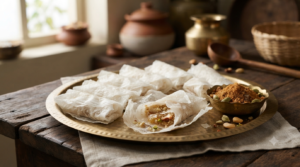
Traditional Andhra putharekulu made with delicate rice sheets, ghee, powdered sugar or jaggery, and optional nuts.
Recipe status: The suggested home-pan steps and filling weights below are an untested adaptation, not a proven recipe or a guaranteed yield. The filling table gives a measured starting plan, while the number of usable sheets depends on practice, equipment and batch size.
Putharekulu Recipe at Home: Quick Facts
- What it is: Thin Andhra rice sheets layered with ghee and powdered sugar or jaggery.
- Assembly yield: 16–20 usable sheets make 8–10 rolls when each roll uses two sheets.
- Sheet yield from rice: Not established by a measured home trial.
- Method status: Traditional clay-pot process documented; flat-pan adaptation untested.
- Allergens: Ghee contains milk-derived ingredients; optional cashews, almonds and pistachios are tree nuts.
- Best approach: Make a few test sheets, then scale the filling only after counting usable sheets.
What Putharekulu Actually Is
Putharekulu is a folded Andhra sweet made from very thin rice sheets, fat and a dry sweet filling. The Telugu word reku means sheet. You may also see the spelling pootharekulu, while a single sweet is often called a poothareku.
Its best-known centre is Atreyapuram in Andhra Pradesh’s Godavari region. Makers there rely on a skilled cloth swipe over a heated, inverted clay pot. The sheet sets rapidly, after which they lift it and add ghee, jaggery or sugar. That craft takes practice, so a normal frying pan should not be described as an equivalent method without testing.
The GI tag worth knowing about
India’s Geographical Indications Registry lists Atreyapuram Pootharekulu as registered under application 804. Its certificate date is 14 June 2023. The protected regional name is not proof that a homemade roll follows the registered makers’ process.
Bhimas Cook is an independent home-cooking website, not a member of the registered makers’ association. You can check the record directly on the Intellectual Property India GI register.
Ingredients for a Putharekulu Recipe at Home
For a putharekulu recipe at home, this is a planning list for 8–10 small rolls, provided you already have 16–20 usable sheets. It is not a claim that two cups of rice will reliably produce that number. Weigh the filling when possible, since spoon measures vary greatly.
| Ingredient | Starting amount | Use |
|---|---|---|
| Thin cooked rice sheets | 16–20 usable sheets | Two per roll |
| Powdered sugar or dry, finely powdered jaggery | 80–120 g | About 10–12 g per roll |
| Ghee | 40–60 g | About 5–6 g per roll |
| Cardamom powder | About ¼ tsp | Divide across filling |
| Finely chopped dry nuts, optional | Up to 20 g | About 1–2 g per roll |
Untested quantities: These are modest starting allocations, not amounts confirmed by a weighed trial. For eight rolls, begin near the lower end. For ten, use the upper end if needed, but do not add extra filling simply to empty the bowl.
If you plan to make sheets from scratch, the previous version used two cups of raw rice, about 400 g, with water for soaking and grinding. That quantity can remain a trial-batter starting point. However, neither the number nor the size of sheets produced from it has been verified.
Which rice should you use?
Traditional accounts describe a locally preferred coarse rice, including a variety called Bondalu. For a home experiment, ordinary raw rice is a reasonable trial ingredient, but a particular supermarket variety cannot be guaranteed to make intact films. Start small before buying rice solely for this technique.
Packaged rice flour does contain starch. Therefore, the old claim that milling removes the free starch is incorrect. A flour-based trial may behave differently because particle size, water and heating matter. No tested rice-flour substitution ratio is available for this version.
How Are Traditional Putharekulu Sheets Made?
For this putharekulu recipe at home, it helps to know that traditional Atreyapuram makers grind soaked rice with water into a thin batter. They dip a cloth into that batter, swipe it over a hot inverted clay pot and lift the delicate film once it forms. Reports documenting working makers describe this process without requiring a separate three-to-four-hour starch-settling stage.
Thus, the older article’s statement that settled starch is essential should not guide this refresh. It may be an experimental variation, but it is not an established rule. Sheet quality depends on batter fineness, water, surface heat and the maker’s motion. Those conditions are difficult to reproduce on a flat pan.
Three Sheet-Making Options for a Putharekulu Recipe at Home
| Option | Evidence | Practical note |
|---|---|---|
| Traditional inverted clay pot | Documented artisan technique | Requires training and a purpose-built setup |
| Ordinary flat pan | Untested home adaptation here | Trial results may be uneven or unsuccessful |
| Shop-bought plain sheets | Depends on actual product available | Check ingredients, storage and maker instructions |
The original article also recommended stretching muslin over a steaming pot. This refresh does not recommend that improvised setup, since loose cloth and escaping steam create avoidable burn risks. Do not invert an unsuitable pot or improvise an open-fire arrangement in a domestic kitchen.
Step-by-Step Putharekulu Recipe at Home
Untested home-pan trial: These steps offer a controlled way to experiment, not a promise of authentic sheets. If the film stays wet, sticks firmly or cannot lift safely, stop. No fixed pan temperature or six-to-ten-second cooking time has been validated for this kitchen method.
Step 1: Soak the rice safely
Rinse raw rice with clean water. If soaking for several hours, use a covered food-safe container in the refrigerator, rather than leaving it overnight in a warm kitchen. Drain it before grinding, and discard any rice with an unusual smell or visible spoilage.
The exact soak duration needed for this home setup has not been tested. Artisan descriptions use shorter soaking times than the old six-to-eight-hour instruction, so do not treat that older duration as a rule.
Step 2: Grind a thin batter
Grind the drained rice with drinking-quality water, adding a little at a time. Aim for a smooth, thin batter that can leave a fine film on a cloth. Use a clean sieve if coarse grains remain, but avoid assuming that straining or settling is mandatory.
Prepare only the batter you can use promptly. If there is a delay, cover it and keep it refrigerated. Do not hold wet rice batter on the counter for a three-to-four-hour settling period.
Step 3: Prepare the pan and tools
Use a stable, food-safe pan within its manufacturer’s heat limits. Start with gentle heat and keep it well below the point where oil smokes or a non-stick coating overheats. A flat pan has different heat flow from a traditional clay pot, so no universal flame setting applies.
Keep clean cotton, long-handled food-safe utensils and a tray ready. Avoid loose clothing, synthetic cloth and bare-finger contact with the hot pan. Children should stay away from the work area.
Step 4: Try one thin sheet
Using a small, clean cotton pad held safely away from your fingers, trial a very light batter swipe. Let the film cook fully rather than timing it by a fixed number of seconds. Try lifting only when the edge releases without force, using a suitable non-scratching tool.
If the sheet sticks, tears or looks wet, do not serve it as a finished wrapper. Recheck the batter and heat, then attempt a fresh test. The method may fail on a flat pan even when you follow the steps carefully.
Step 5: Count usable sheets
Set aside only sheets that have cooked through and remain intact enough to fold. Count them before dividing the filling. For example, 12 usable sheets give six two-sheet rolls, while 18 give nine rolls. Broken scraps do not count as complete sheets.
Keep the sheet-making area clean, and avoid stacking warm, damp films into a sealed box. If you cannot form safe, workable sheets, use properly labelled, ready-made plain sheets intended for this sweet, if available.
Step 6: Fill and roll
Place two usable sheets together. Brush on roughly 5–6 g of just-melted, not hot, ghee, then spread about 10–12 g of powdered sugar or jaggery. Add a little cardamom and, if suitable for your guests, 1–2 g of chopped nuts.
Fold the sides in and roll gently without pressing the film into crumbs. Use a kitchen scale for the first piece, since a large spoonful can overwhelm a thin sheet. Work with clean, dry utensils and fill only as many as you plan to serve.
Putharekulu Recipe at Home: Sheet-to-Roll Yield
A putharekulu recipe at home cannot promise 18 rolls from 18 sheets when each roll needs two. The calculation is simple: usable sheets divided by two equals complete rolls. It is a folding calculation, not a prediction of how much rice batter will work.
| Usable sheets | Sheets per roll | Finished rolls |
|---|---|---|
| 10 | 2 | 5 |
| 16 | 2 | 8 |
| 18 | 2 | 9 |
| 20 | 2 | 10 |
One-sheet versions also exist as a folding choice, but their weight and texture differ. Do not silently switch the recipe to one sheet just to preserve the old 18-roll claim. Record the actual sheet count for your own batch.
Sugar or Bellam: Which Filling Should You Choose?
Both sugar and bellam, the Telugu word for jaggery, appear in traditional putharekulu. Finely powder either one before filling, since hard lumps can puncture the rice film. Use dry, clean utensils and do not add syrup or water to the filling.
Jaggery brings a stronger flavour, while fine sugar gives a lighter sweetness. Either filling may absorb moisture after assembly, but an exact crispness period has not been established here. If using nuts, chop them finely so their edges do not tear the sheets.
Putharekulu Recipe at Home: Why Rice Sheets Tear
| Problem | Possible cause | Safer next step |
|---|---|---|
| Film tears as you lift | Too thin, too wet or attached to pan | Try a smaller test with adjusted batter |
| Film scorches or smells burnt | Surface too hot | Stop, cool pan and reduce heat |
| Opaque, thick sheet | Heavy batter application | Trial a thinner single swipe |
| Roll crumbles | Sheet brittle or overfilled | Use less filling; do not wet a cooked sheet |
Do not dab a cracked roll with a wet cloth. Adding water after cooking changes moisture and can shorten safe holding. Nor should you keep reheating a damaged non-stick pan to force a film to release.
Putharekulu Recipe at Home: Storage and Safety
For this putharekulu recipe at home, the old room-temperature claims of four days for sugar rolls and two to three days for jaggery rolls are not validated shelf lives. This homemade adaptation has no water-activity test, shelf-life study or documented storage trial. For that reason, make it close to serving and treat any leftovers cautiously.
For a conservative home plan, serve soon after making. Chill leftover rolls promptly in a clean, covered container at 4°C or below, ideally within one hour. Never leave perishable food out beyond two hours, or one hour if the air exceeds 32°C. As an extra-cautious choice for this untested rice-sheet preparation, use refrigerated leftovers within 24 hours rather than claiming they remain safe for days.
Cold storage may soften the crisp layers, yet texture loss is not a reason to skip temperature control. If the batch stayed warm too long, discard it instead of reheating or tasting it. See Bhimas Cook’s practical guide to cooling and storing homemade sweets for more context.
For rice-handling guidance, consult the UK government’s rice food-safety advice and FoodSafety.gov’s cooling and refrigeration rules. Their general guidance does not certify this particular sweet’s shelf life.
Milk, nuts and gluten cross-contact
Traditional ghee comes from milk, so this recipe contains a milk-derived ingredient. Optional cashews, almonds and pistachios introduce tree nuts. Do not call a nut-free version allergy-safe unless the ingredients, equipment and preparation area also avoid cross-contact.
The rice-based sheet has no wheat ingredient by design. However, gluten-free safety depends on the actual rice, other ingredients and shared kitchen equipment. People with coeliac disease or serious food allergies should check every label and avoid uncertain cross-contact. The Food Safety and Standards Authority of India (FSSAI) label guide explains what to check.
Putharekulu Recipe at Home: Cost and Nutrition
A putharekulu recipe at home lets you choose the filling, but it is not automatically cheaper than buying a box. Cost depends on how many intact sheets you make, how much ghee you use and how many attempts fail. Compare your actual receipts and final roll count instead of using a guessed price per piece.
The old table’s 115–130 calories per roll was also inconsistent with its much larger listed filling quantities. This refresh removes that unsupported estimate. To calculate a meaningful serving value, weigh the ingredients you actually used, account for leftovers and divide by your real number of rolls.
Before Your First Batch
Before starting a putharekulu recipe at home, decide whether you want to make sheets or simply assemble the sweet. The traditional craft is hard to reproduce on a normal pan, so a failed first trial does not prove your rice was wrong. Keep notes on the pan, batter and number of intact sheets instead of chasing an untested time or yield.
For a festive menu, you can pair your rolls with Bhimas Cook’s Sankranti sweets collection. The site’s jaggery laddu recipe is another option when you already have bellam. Above all, use the actual sheet count to portion the filling, and serve the finished sweet fresh.
Putharekulu Recipe at Home: Common Questions
Can I make putharekulu without a special clay pot?
You can try a flat-pan adaptation, but Bhimas Cook has not tested it to a reliable result. The documented traditional method uses a purpose-built heated clay pot. Do not expect the same heat control or texture from an ordinary tawa.
How many rolls do 20 rice sheets make?
Twenty intact sheets make ten rolls when you use two per roll. If some sheets tear, the yield falls. Count the usable pieces before you measure the filling so the quantities stay consistent.
How much sugar and ghee go in one roll?
For this untested small-roll plan, start with 10–12 g powdered sugar and 5–6 g ghee per two-sheet roll. Those amounts are planning estimates, not verified traditional weights. Adjust only after checking the size and strength of your sheets.
Do I have to settle rice starch for four hours?
No. Published accounts of Atreyapuram makers describe a thin ground-rice batter applied directly with a cloth. A separate long settling stage is not established as essential. Avoid leaving wet rice batter at room temperature while testing that idea.
Can I use shop-bought rice flour instead of rice?
Rice flour still contains starch, contrary to the old explanation. However, this home method has no tested flour-to-water ratio. If you experiment, use a small batch and do not promise that it will produce traditional translucent sheets.
Should homemade putharekulu go in the refrigerator?
For this untested homemade version, refrigerate leftovers promptly rather than relying on an unverified multi-day room-temperature claim. The sheets may soften in the fridge. That texture change does not override food-safety precautions.
Is putharekulu safe for people with milk or nut allergies?
Not automatically. Ghee is milk-derived, while common dry-fruit fillings contain tree nuts. Even when nuts are omitted, shared utensils and ingredient traces can matter. Check every ingredient and cross-contact risk before serving.
Is this sweet gluten-free?
Rice sheets do not require wheat flour, but that alone cannot certify the finished sweet as gluten-free. Check added ingredients and shared equipment, especially when cooking for someone with coeliac disease. Avoid an assurance you cannot verify.