Kitchen Scale Tare: Zero a Bowl and Weigh in Stages
Kitchen scale tare lets you weigh flour, sugar or ghee without counting the bowl. Set an empty bowl on the scale, press TARE or ZERO, and add your first ingredient. Press the button again before the next ingredient, so each new reading starts at zero. The method saves washing up, but it does not raise the scale’s weight limit.
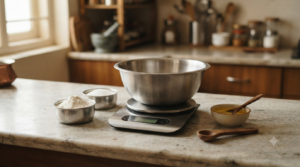
A mixing bowl on a digital kitchen scale shows how to zero the bowl before weighing flour, sugar and other ingredients.
That last detail matters when you use a heavy steel mixing bowl. A display reading of zero does not mean the scale carries no weight. Here is how to use the function, read the units and avoid the mistakes that spoil a careful batch.
Kitchen scale tare at a glance
- What it does: Removes the bowl or existing contents from the displayed reading.
- First step: Set the bowl on a stable scale, then press TARE or ZERO.
- For another ingredient: Tare again while the first ingredient stays in the bowl.
- Best everyday unit: Grams (g), when your recipe gives weights in grams.
- Important limit: Bowl plus every ingredient must stay within the model’s capacity.
KitchenAid describes both bowl zeroing and consecutive ingredient weighing in its kitchen scale instructions. OXO and Escali describe the same basic method, although buttons and available units differ between models.
What does the tare button actually do?
The tare button changes the display’s starting point. When you press it with an empty bowl on the platform, the scale treats that bowl as zero for the next reading. You can then add flour or another ingredient and see its weight alone, without mental subtraction.
Pressing tare does not remove weight from the sensor. Instead, it subtracts the weight already on the platform from the number you see. That difference explains why kitchen scale tare works for both one ingredient and a batch built in stages.
Some scales say TARE, while others say ZERO. A few models zero automatically when you switch them on with an empty bowl in place. Check your particular manual before relying on automatic behaviour, since not every control works alike.
How to use kitchen scale tare with an empty bowl
Place the scale on a firm, level worktop before you start. Then centre an empty, dry bowl on its platform and use the tare control. The screen should return to zero in your chosen unit, even though the bowl is still there.
- Start with the platform clear. Switch on the scale and wait for a stable reading. If your model starts with the bowl already on it, follow its auto-tare instructions.
- Choose grams. Press UNIT or MODE, if needed, until the screen shows g. Use the unit that matches your recipe.
- Place the empty bowl. Centre it without pressing on the worktop or touching another object.
- Press TARE or ZERO. Wait until the display settles at 0 g before adding food.
- Add the ingredient slowly. Watch the reading rise to your target. Use a spoon near the final few grams.
- Lift the bowl only when ready. Transfer it to the counter for mixing or kneading, rather than pushing down on the scale.
OXO’s ingredient-measuring guide recommends zeroing the bowl and adding ingredients directly. It also notes that a pull-out display can help when a wide bowl blocks the screen.
Kitchen scale tare for weighing several ingredients
Kitchen scale tare also helps when a recipe calls for several weighed ingredients in one bowl. After the first addition, press tare with everything still on the scale. The display returns to zero, so the next ingredient gets a separate reading.
Imagine a practice mix with 150 g atta, 40 g sugar and 20 g ghee. These are measurement examples, not a tested recipe or suggested ingredient ratio. Follow the real recipe for amounts and the order of mixing.
| Stage | What you add | Display target | What happens next |
|---|---|---|---|
| 1 | Empty bowl | 0 g after tare | Begin weighing |
| 2 | Atta | 150 g | Press tare again |
| 3 | Sugar | 40 g | Press tare again |
| 4 | Ghee | 20 g | Stop or follow recipe |
The bowl now holds 210 g of ingredients, yet the last reading shows only the 20 g of ghee. That is not a calculation error. It reflects the last reset, not the entire bowl’s contents.
This technique suits separate ingredients that the recipe already asks you to combine. It is less suitable when an ingredient needs whisking, cooking or testing before the next addition. For dough work, use the measurements in Bhimas Cook’s whole wheat shankarpali trial as a clear example of why gram amounts are useful. That site’s formula remains explicitly untested.
When should you press tare again?
Press tare only after you have finished weighing one ingredient and before adding the next. If you reset halfway through a pour, the scale forgets the earlier amount for display purposes. The food stays in the bowl, so your recipe total can quietly go wrong.
Keep a written list of ingredients beside the scale when the recipe has many stages. Tick each item off after adding it. Otherwise, repeated zero readings can make it hard to remember whether the sugar or salt has already gone in.
Also check the bowl before resetting. If you have added too much flour, remove the excess while the display still shows that flour’s weight. Taring too early makes the correction harder because the scale no longer shows the original overshoot.
Grams, ounces and millilitres: which unit should you use?
Use grams for any recipe written in grams and ounces for one written in weight ounces. Millilitres and fluid ounces describe volume, not mass. Some scales offer liquid modes, but their estimates depend on the model and the liquid involved.
| Display | Measures | Useful for |
|---|---|---|
| g | Weight in grams | Atta, besan, sugar, ghee |
| kg | Weight in kilograms | Large food batches |
| oz / lb | Weight in imperial units | Recipes specifying weight ounces or pounds |
| ml / fl oz | Volume estimate on supported scales | Liquids covered by the model’s instructions |
OXO lists grams, kilograms, pounds and ounces on its Everyday Glass Food Scale, with a liquid-unit option also listed. Not every digital scale offers all these settings, so read the labels on yours.
A recipe calling for 100 g of oil means 100 g by weight. Do not simply enter 100 ml and assume the same amount, since oil and water have different densities. Kitchen scale tare cannot tell you how many millilitres equal a given number of grams. If your recipe states millilitres, use a suitable measuring jug or follow the liquid mode specified by your scale’s maker.
Does kitchen scale tare change the maximum capacity?
No. Kitchen scale tare resets the number you see, not the maximum load the sensors can carry. A bowl and every ingredient already inside it still count toward capacity. If their combined mass exceeds your model’s limit, you must use a lighter vessel or divide the batch.
For example, Escali lists the Primo scale at 5,000 g capacity with 1 g display steps. A 900 g bowl holding 4,300 g of ingredients weighs 5,200 g in total. That is above a 5,000 g limit, even if the screen was reset to zero several times.
Escali’s scale selection guide and KitchenAid’s help page both stress the total load. Do not treat a zero display as permission to add unlimited ingredients. A lighter bowl or two smaller batches gives the scale room to operate within its rating.
Capacity and resolution are different specifications
Capacity tells you the heaviest total load the scale is rated to handle. Resolution, also called an increment or display step, tells you the smallest change the screen can show. A scale may handle a large mixing bowl but still be unsuitable for tiny spice quantities.
Escali’s Primo is one manufacturer example: its published capacity is 5,000 g and its display advances in 1 g steps. That makes sense for flour or sugar, but not for a measured fraction of a gram. A higher-resolution scale may suit very small quantities better.
Kitchen scale tare does not improve the smallest step your scale can display. That distinction matters in Indian kitchens. A gram-scale display works well for larger amounts of atta, rice and besan. Small amounts of cardamom, yeast or other potent ingredients may need a suitable measuring spoon or a finer-resolution scale, depending on the recipe.
Why does the scale show a negative number after you lift the bowl?
A negative reading after removing a tared bowl can be normal. The scale still remembers the weight you subtracted earlier. When you lift the bowl, the platform becomes lighter than its saved zero point, so the display may show a minus figure.
To begin a fresh measurement, clear the platform and press ZERO or TARE again. Then confirm the screen reads zero before placing a new container on top. If your model behaves differently, use its own reset instructions.
After kitchen scale tare, a negative number by itself is not proof of a faulty scale. Persistent wandering readings, however, deserve a closer look. Start by checking the surface, whether anything touches the bowl, the batteries and the manufacturer’s troubleshooting steps.
What to do when kitchen scale tare does not work
When kitchen scale tare seems broken, the cause may be an unstable reading, excess load or an unexpected unit. First remove the bowl and check whether the empty scale settles at zero. Then restart your measurement with a stable worktop and a lighter container.
- Display will not settle: Move the scale away from a rocking board, a draught or a vibrating appliance. Keep the bowl clear of nearby objects.
- Wrong number appears: Check whether the display says g, oz, lb or another unit before resetting.
- Tare button seems inactive: Check the model manual, battery condition and any error message. Some scales need a steady reading before reset.
- Overload appears: Remove weight immediately and compare the full load with the scale’s stated capacity.
- Screen goes dark: Battery-powered models can switch off automatically. Check the ingredients already added before restarting.
- Readings drift repeatedly: Clean and dry the platform, then follow the maker’s testing or service advice. Never guess a calibration procedure.
KitchenAid confirms that auto-off times differ by product, while Escali publishes model-specific limits and display increments. These details matter more than generic advice that assumes all kitchen scales behave the same way.
What beginners get wrong with the tare function
A common mistake is mixing ingredients while the bowl remains on the scale. The downward force from stirring can stress the platform or upset the reading. Lift the bowl onto the counter first, then return it when another weight measurement is needed.
Another mistake is changing units halfway through a recipe without noticing. While a scale can switch its display, it cannot decide whether your recipe meant weight ounces or fluid ounces. Write the unit beside each amount and check the screen before pouring.
Large bowls can also hide the display or touch the counter, causing a false reading. Choose a smaller bowl or a scale with a visible display. To make small repeatable batches, the weighing approach also helps when following Bhimas Cook’s almond flour nankhatai trial. That proposed formula, too, is not kitchen-tested.
Using tare for spice mixes, dough and portioning
For spice blends, tare a small dish and add each larger ingredient by weight. However, check whether your scale can register the smallest quantities accurately. Bhimas Cook’s bisi bele bath powder guide illustrates why repeatable gram measurements matter for a mix.
For dough, weigh the separate ingredients before you knead. Once the dough comes together, remove the mixing bowl and work on a suitable surface. If you need equally sized pieces, weigh the dough itself or use the known empty-bowl weight to find the total.
Portioning works much the same way. Place a plate or storage box on the scale, tare it and add food to the planned weight. Start again with each new empty container, since a different plate may weigh more or less.
Can you weigh food without a separate bowl?
Yes, if the food suits the platform and the manufacturer allows direct contact. You can zero an empty scale and place a dry item directly on it. However, a clean plate, sheet or small bowl often makes food handling neater.
For messy ingredients, choose a suitable container and tare it. Keep hot pans and wet or sticky surfaces away unless the manual specifically allows them. KitchenAid advises wiping its scales with a damp cloth and avoiding immersion unless the product instructions permit it.
The point of tare is to simplify the arithmetic, not to remove the need for safe handling. A stable container protects the scale while also keeping the ingredient in one place.
Kitchen scale tare: the simplest habit to keep
Kitchen scale tare is easiest to remember as bowl, zero, add, zero again. Use grams when your recipe gives grams, and watch the display before every new ingredient. Most importantly, count the hidden weight of the bowl and earlier additions against the scale’s rated capacity.
A reliable scale saves effort only when you use it within its limits. If a reading looks wrong, stop before adding more food. Clear the platform, check the unit and start the measurement again.
Frequently asked questions
What does tare mean on a kitchen scale?
Tare means setting the current load as the display’s zero reference. You can place an empty bowl on the scale, press tare and then weigh only the food you add. The bowl’s physical weight still counts toward the maximum load.
Should I put the bowl on before pressing tare?
Yes, for the usual manual-tare method. Set the empty bowl on the scale and press TARE or ZERO before you add food. Some models support auto-tare when they start with the bowl in place, so check the manual.
Can I tare the scale between every ingredient?
Yes. Tare after reaching one ingredient’s target and before starting the next. Keep the bowl and existing ingredients on the platform when you press the button. This gives the new ingredient its own reading.
Does pressing tare erase the weight of earlier food?
It erases that amount from the displayed measurement, not from the bowl. The sensor still supports the earlier food, so it contributes to the total physical load. Keep a checklist if you may forget which ingredients are already inside.
Why does my scale display minus grams?
A negative value can appear after you remove a container that the scale previously tared. Clear the platform and reset the scale for a new measurement. If the number keeps changing with nothing on the platform, follow the manufacturer’s troubleshooting advice.
Are 1 g steps accurate enough for baking?
One-gram display steps suit many everyday flour, sugar and fat measurements. However, a display step is not a promise of exact measurement accuracy. Tiny amounts may call for a finer-resolution scale or another method specified by the recipe.
Can I use the millilitre setting for ghee or oil?
Use caution because liquid volume and weight are not interchangeable for every food. A scale’s millilitre setting may use a model-specific conversion. For oil or ghee, prefer the recipe’s stated weight or use a volume measure when the recipe calls for millilitres.
Does tare let a 5 kg scale weigh more than 5 kg?
No. The scale’s capacity still covers the bowl and the full amount of food on it. Taring changes only the display’s reference point. Use lighter containers or smaller batches when the combined weight approaches the rated limit.