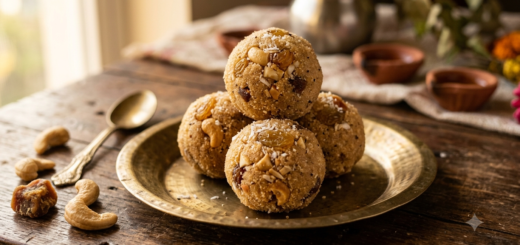
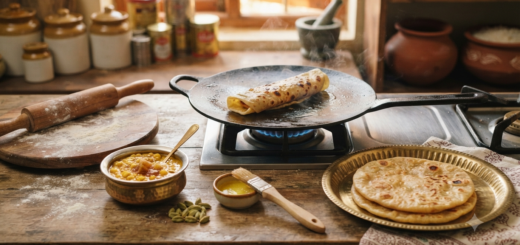
Rava Poli Recipe: Soft Semolina Sweet Flatbread Guide
Rava poli recipe works best when the semolina becomes a thick, mouldable sweet filling instead of a loose syrup or a dry outer dough. This refreshed method uses a soft wheat-maida cover and a cooked rava-jaggery poornam, so the poli rolls evenly, cooks without raw patches, and stays tender instead of cracking.
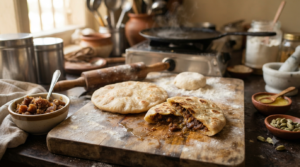
Soft rava poli with a cooked semolina-jaggery filling, rolled thin and finished on a hot tawa with ghee.
The most important correction is simple: plain sugar syrup cannot be portioned into filling balls. For a stuffed rava poli, cook the semolina with the sweetener until the mixture leaves the pan and can hold its shape after cooling.
Rava Poli Recipe at a Glance
| Detail | Guide | Why it matters |
|---|---|---|
| Yield | 8 medium poli | Easy family-size batch |
| Prep | About 25 minutes | Includes dough and filling prep |
| Rest/cool | About 30 minutes | Prevents tearing while rolling |
| Cook | About 15 minutes | Use steady medium heat |
| Sweetener | Jaggery | Gives deeper flavour and a firm filling |
| Best rava | Fine semolina | Creates a smoother poornam |
This is not an “instant” sweet in the strict sense because both dough and filling benefit from resting. However, the hands-on work is straightforward, and the filling needs no pressure-cooked dal.
What Is Rava Poli?
Rava poli is a sweet stuffed flatbread with a semolina-based filling. In different regions, related versions may be called sanjyachi poli, sujichi poli, sajjaka holige, or rava puran poli. The exact spice mix and flour covering vary, but the key technique is the same: cook the rava filling until firm enough to stuff and roll.
This makes it different from classic chana-dal puran poli. If you want the dal version, see BhimasCook’s puran poli with jaggery or the more detailed bobbatlu recipe.
Ingredients for This Rava Poli Recipe
For this rava poli recipe, keep the covering soft and the filling firm. That contrast is what makes stuffing easy. Fine rava gives the smoothest result, while coarse semolina needs more liquid and a longer rest.
| Part | Ingredient | Quantity |
|---|---|---|
| Cover | Whole wheat flour | 1 cup |
| Cover | All-purpose flour | 1/2 cup |
| Cover | Salt | 1/4 teaspoon |
| Cover | Oil | 1 1/2 tablespoons |
| Cover | Water | About 1/2 cup, added gradually |
| Filling | Fine semolina or rava | 1 cup |
| Filling | Grated jaggery | 1 cup |
| Filling | Water | 1 1/2 cups |
| Filling | Ghee | 1 tablespoon |
| Filling | Cardamom powder | 1/2 teaspoon |
| Cooking | Ghee or oil | As needed |
If your jaggery contains visible grit, dissolve it in the measured water and strain it before cooking. That small step prevents hard particles from tearing the covering later.
Rava Poli Recipe: Step-by-Step Method
1. Make a soft, rested dough
Mix the wheat flour, maida, and salt. Add the oil, then rub it through the flour. Pour in water little by little until you get a soft dough that feels slightly looser than chapati dough.
Knead for 6 to 8 minutes, then cover and rest for 30 minutes. The rest matters because the gluten relaxes, so the covering stretches around the filling instead of springing back.
2. Roast the rava lightly
Heat a heavy pan on low to medium heat and add the ghee. Add the rava, then roast for 3 to 4 minutes while stirring. Stop when it smells nutty and feels hot; it does not need a deep brown colour.
Roasting helps the grains stay separate at first. It also gives the filling a fuller flavour, yet over-roasting can make the poornam dry and sandy.
3. Cook the jaggery and semolina filling
In a second pan, warm the 1 1/2 cups water with jaggery until the jaggery dissolves. Strain it if needed, then return the liquid to the pan and bring it to a gentle simmer.
Add the roasted rava slowly while stirring continuously. The mixture thickens quickly, so keep the heat low. Add cardamom, then cook until the mass pulls away from the pan and no watery syrup remains.
4. Cool until the filling can hold a ball
Transfer the filling to a plate and spread it slightly so steam can escape. Let it cool until comfortable to handle. Then knead it briefly with greased fingers and divide it into eight equal balls.
This is the real doneness test. If a portion slumps flat, the filling is still too wet. Return it to low heat for a few minutes, then cool it again before stuffing.
5. Stuff and roll gently
Divide the rested dough into eight balls. Flatten one piece into a small disc, place a rava filling ball in the centre, and bring the dough edges over it. Pinch the seam closed without trapping a thick lump of dough on top.
Dust very lightly with flour and roll to about 5 to 6 inches. Use gentle, even pressure because aggressive rolling pushes the filling through the edges.
6. Cook on a medium-hot tawa
Heat a tawa over medium heat. Place the rolled poli on it and wait until small bubbles and pale brown spots appear. Flip, brush with a little ghee, and cook the second side until evenly spotted.
Flip once more only if needed. Long cooking dries the cover, while very high heat browns it before the centre warms through. Stack finished poli under a clean cloth so they stay soft.
Rava Poli Recipe Ratio That Prevents Leaks
The safest working rule is a soft cover and a firm filling, with roughly equal-sized dough and filling portions. If either side is out of balance, rolling becomes difficult. Too much dough gives a thick, bread-like poli, while too much wet filling bursts through the surface.
Do not chase an exact gram-for-gram ratio unless your flour and rava are weighed consistently. Instead, test one poli first. If the filling pushes out, reduce each filling ball slightly or cook the remaining poornam a little longer.
- Dough feels stiff: knead in 1 to 2 teaspoons of water, then rest it again.
- Dough feels sticky: grease your hands rather than adding lots of dry flour.
- Filling feels wet: cook it on low heat until it forms one mass.
- Filling feels crumbly: knead it while warm with a teaspoon of hot water or ghee.
Why the Old Sugar-Syrup Method Fails
A loose sugar syrup can sweeten food, but it cannot behave like poornam. Stuffed poli needs a filling with enough body to stay in the centre while you seal and roll the dough. Otherwise, liquid leaks through the seam and burns on the tawa.
That is why established rava-poli methods cook semolina into the sweet liquid rather than stuffing syrup by itself. The rava absorbs water and thickens, which turns the sweetener into a workable filling instead of a runny centre.
Common Rava Poli Recipe Problems and Fixes
| Problem | Likely cause | Fix |
|---|---|---|
| Poli cracks while rolling | Dough too dry or under-rested | Add a little water and rest again |
| Filling leaks | Poornam too wet | Cook longer, then cool fully |
| Rava filling is grainy | Rava too coarse or undercooked | Use fine rava and cook with enough liquid |
| Poli turns hard | Too much dry flour or overcooking | Use minimal dusting and medium heat |
| Raw flour taste | Tawa too hot | Lower heat and give each side time |
If your first piece fails, do not roll the whole batch. In this rava poli recipe, correct the dough or filling after that test piece. This single habit prevents eight identical mistakes.
Jaggery, Sugar, or Condensed Milk?
Jaggery is the best fit for this version because it gives depth and thickens into a cohesive rava filling. White sugar also works, but the flavour is lighter and the filling may need careful cooking so it does not become sticky.
Condensed milk creates a richer, milkier sweet and changes the recipe’s character. If that is what you want, use the separate condensed-milk poli recipe rather than adding it casually to this jaggery ratio.
Whole Wheat, Maida, or Both for the Cover?
A 2:1 mix of wheat flour to maida gives a useful middle ground. Wheat adds flavour and structure, while maida gives enough stretch for easier rolling. An all-wheat covering works, although it tends to feel firmer and should be rested well.
An all-maida cover rolls very thin and soft, but it is less forgiving if the filling is wet. For a first attempt, the mixed-flour cover is easier because it combines strength with flexibility.
How to Serve Rava Poli
Serve rava poli warm with a light smear of ghee. Warm milk on the side is another traditional pairing in homes that enjoy a softer, richer sweet. You can also serve it plain because the jaggery-cardamom filling carries enough flavour on its own.
Avoid soaking this version in milk unless you specifically want a paal-poli style dessert. Soaking changes the texture and turns a soft stuffed flatbread into a different dish.
Storage and Food-Safety Notes
Rava poli tastes best on the day you cook it. If you need to prepare ahead, cool the poli before covering them so trapped steam does not make the surface soggy. Reheat on a dry or lightly greased tawa until warm.
For food safety, the Food Safety and Standards Authority of India advises keeping prepared food cold when it is made in advance and reheating stored cooked food thoroughly. See FSSAI’s Food Safety at Home guidance. FoodSafety.gov also advises prompt refrigeration of leftovers in its cold-storage guidance.
Semolina is a wheat product, so this recipe is not gluten-free. People with coeliac disease or a medically required gluten-free diet should avoid semolina and wheat flour; the Celiac Disease Foundation lists semolina among wheat ingredients that contain gluten.
What Makes This Rava Poli Recipe More Reliable?
This version focuses on the two variables that decide success: moisture and rest. The filling must be dry enough to form a ball, while the covering must be soft enough to stretch. Most failed poli recipes lose control of one of those two points.
It also separates rava poli from unrelated semolina sweets. The result is a clear stuffed-flatbread method with a repeatable filling test, a test-poli checkpoint, and practical fixes before the rest of the batch is rolled.
Before You Start Rolling
Make the filling first if your kitchen is warm, because it needs time to cool. Keep the dough covered while you work, and roll one test poli before dividing all the filling. Those small choices make the process calmer and reduce waste.
The key lesson is simple: a successful rava poli recipe depends less on speed than on texture. Get a soft cover, a firm poornam, and steady tawa heat, and the rest becomes much easier.
Frequently Asked Questions
Is rava poli the same as puran poli?
No. Classic puran poli usually uses a cooked lentil filling, often chana dal with jaggery. Rava poli replaces that dal-based poornam with a semolina filling, so it has a softer grain and a different flavour.
Can I make this rava poli recipe with only wheat flour?
Yes. Use whole wheat flour for the full covering, but keep the dough soft and give it a longer rest. Whole wheat is less stretchy than maida, so roll gently and avoid a very large filling ball on your first batch.
Can I use sugar instead of jaggery?
Yes, sugar can replace jaggery, but the flavour becomes lighter. Start with the same volume, then cook the filling until it forms a soft mass. The final texture matters more than the exact minute count.
Why does my rava filling stay loose?
It usually has too much liquid or has not cooked long enough. Keep it on low heat and stir until the mixture pulls away from the pan. Then cool it fully before deciding whether it still needs more cooking.
Why does my poli tear while rolling?
Tearing usually means the cover is too dry, the filling is too wet, or you are using too much pressure. Soften the dough, firm the filling, and roll from the centre outward with a light hand.
Can I prepare the filling a day ahead?
Yes, provided you cool and refrigerate it promptly. Bring it closer to room temperature before shaping, since very cold filling can feel stiff and may crack the covering while you roll.
Does rava poli contain gluten?
Yes. Semolina comes from wheat, and this covering also uses wheat flour and maida. Therefore, the standard recipe is not suitable for a gluten-free diet.
How do I reheat rava poli without making it hard?
Warm it briefly on a medium tawa, then cover it for a minute after heating. A very small smear of ghee can restore softness, while microwaving for too long can make the edges chewy.