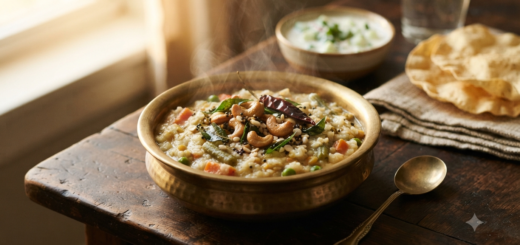
Hotel Style Sambar Sadam Recipe: Soft, Tangy and Foolproof
Hotel style sambar sadam is soft and spoon-coating, not fluffy and separate-grained. That single texture difference is why most home versions never taste like the plate served at Saravana Bhavan or Adyar Ananda Bhavan. Hotel kitchens deliberately cook the rice well past the point a home cook usually stops.
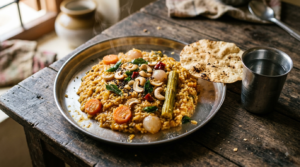
Hotel style sambar sadam has a soft, slightly flowing texture — never separate grains.
They also grind a fresh masala instead of leaning only on packet sambar powder. So this guide skips the generic sambar rice method you have already read ten times. Instead you get hotel style sambar sadam broken down properly: the exact water ratio, the grinding list, stage-by-stage timings, and fixes for every way this dish normally fails.
Hotel Style Sambar Sadam at a Glance
- Texture target: soft and slightly flowing, because the rice must break down rather than stay separate.
- Water ratio: 3.5 to 4 cups per 1 cup raw rice, since dal and vegetables both soak up liquid.
- The hotel secret: a freshly ground paste of coriander seeds, chana dal and coconut, added along with sambar powder.
- Total time: about 55 minutes, of which 30 minutes is unattended soaking.
- Yield: 4 generous plates, or 6 smaller lunchbox portions.
- Best fat: sesame oil (nallennai) for the base, then a spoon of ghee at the finish.
What Makes Hotel Style Sambar Sadam Different
Three things separate hotel style sambar sadam from an ordinary weeknight sambar rice: texture, a ground masala, and shallots. Everything else is negotiable. Once you fix those three, the dish tastes recognisably like the hotel version even if your vegetables differ.
The texture is meant to be soft
Plenty of recipes online promise “separate grains” for sambar sadam. That advice is simply wrong for this dish. Restaurant sambar rice is mushy on purpose, closer to a loose khichdi than to biryani, so it holds sambar flavour in every spoonful. If your rice stays firm and grainy, you have made sambar mixed into rice, not sambar sadam.
Fresh masala beats packet powder
Most hotels do not rely on sambar powder alone. They roast coriander seeds, chana dal and dried chillies, then grind them with coconut into a paste. That paste is where the rounded, slightly sweet aroma comes from. Packet powder still goes in, yet the ground masala carries the flavour.
Shallots, not big onions
Small onions hold their shape while everything else softens, and they turn sweet as they cook. Big onions dissolve and make the dish flat. Drumstick plays a similar role, because it keeps giving flavour to the liquid long after the other vegetables have gone soft.
Recipe Card
| Prep time | 30 minutes, mostly soaking |
| Cook time | 25 minutes |
| Total time | 55 minutes |
| Servings | 4 generous plates |
| Cuisine | Tamil Nadu, South Indian |
| Difficulty | Easy once the ratio is right |
Ingredients for Hotel Style Sambar Sadam
Rice and dal
- Raw rice (sona masoori or ponni) – 1 cup (200 g)
- Toor dal – 1/2 cup (100 g), rinsed until the water runs clear
- Water – 3.5 cups for cooking, plus extra hot water to loosen later
- Turmeric powder – 1/2 tsp
- Sesame oil – 1 tsp, added so the cooker does not froth over
Freshly ground hotel masala
- Coriander seeds – 1 tbsp
- Chana dal – 1 tbsp, because it thickens the gravy as well as flavouring it
- Dried red chillies – 3, adjusted to taste
- Grated coconut – 3 tbsp, fresh or frozen
- Black peppercorns – 1/2 tsp
Vegetables and gravy
- Shallots – 10 to 12, peeled and left whole
- Drumstick – 1, cut into 2-inch pieces and added early since it softens slowly
- Carrot – 1 medium, cut into thick rounds
- Brinjal – 1 small, cubed just before cooking so it does not brown
- Potato – 1 small, cubed (optional, though it makes the dish heartier)
- Tomato – 1 medium, chopped
- Tamarind – a lemon-sized ball, soaked in 1/2 cup hot water
- Sambar powder – 1.5 tbsp
- Salt – 1.5 tsp, adjusted after the rice goes in
Tempering
- Sesame oil – 2 tbsp
- Ghee – 1 tbsp, added at the very end for aroma
- Mustard seeds – 1 tsp
- Fenugreek seeds – 1/4 tsp, used sparingly because they turn bitter fast
- Curry leaves – 1 sprig
- Asafoetida – a generous pinch
- Cashews – 10, fried until pale gold
Hotel Style Sambar Sadam: Step-by-Step Method
1. Soak rice and dal (30 minutes)
Rinse the rice and toor dal together, then soak them in fresh water for 30 minutes. Soaking matters here because it lets the grains swell before pressure cooking, so they collapse evenly into that soft hotel texture. Use hot water if you are short on time and want to cut the soak to 15 minutes.
2. Roast and grind the masala (8 minutes)
While the rice soaks, dry-roast the coriander seeds, chana dal, peppercorns and red chillies on low heat. Stop when the chana dal turns golden and smells nutty, usually after 4 to 5 minutes. Add the coconut and roast another minute, then cool everything completely. Grind to a smooth paste with a little water.
3. Extract the tamarind (10 minutes)
Soak the tamarind in half a cup of hot water while the masala cools. Squeeze it well, then strain out the fibres. Weak tamarind water is the most common reason a batch tastes flat, so press the pulp properly rather than dunking it once.
4. Pressure cook the rice and dal (15 minutes)
Drain the soaked rice and dal, then transfer them to a pressure cooker with 3.5 cups water, turmeric and a teaspoon of sesame oil. Cook for 4 to 5 whistles on medium heat. Let the pressure drop naturally, because a forced release firms up the grains. Mash lightly with the back of a ladle once opened.
5. Cook the vegetables (10 minutes)
Heat 1 tablespoon sesame oil in a wide pan and add the shallots. Sauté for 2 minutes until they turn glassy at the edges. Add drumstick and carrot first, since both need longer, then follow with potato, brinjal and tomato. Cook for 5 minutes with a splash of water and a lid on.
6. Build the gravy (8 minutes)
Pour in the tamarind extract, the ground masala paste and the sambar powder. Add half a cup of water, then simmer until the raw tamarind smell disappears. This takes roughly 5 minutes, and you will see the surface turn glossy as the oil separates. Season with salt at this stage rather than later.
7. Fold in the rice and dal (4 minutes)
Add the cooked rice and dal to the gravy in two batches, folding gently each time. Loosen with hot water until the mixture moves slowly when you tilt the pan. Cold water makes it lumpy, so keep a kettle nearby. Simmer for 3 minutes so the rice absorbs the sambar.
8. Finish with tempering (3 minutes)
Heat the sesame oil and ghee in a small pan, then crackle the mustard seeds. Add fenugreek seeds, curry leaves, asafoetida and cashews, and fry for under a minute. Pour it over the rice while it is still sizzling. Rest the dish for 5 minutes before serving, since the flavour settles as it sits.
How to Get the Hotel Style Sambar Sadam Texture Right
The right consistency is loose enough to spread slowly on a plate but not soupy. Aim for the way a thick porridge behaves when you tilt the spoon. Remember that sambar sadam thickens noticeably as it cools, so it should look slightly too loose in the pan.
| Rice type | Water per 1 cup rice | Result |
|---|---|---|
| Sona masoori | 3.5 cups | Soft, ideal hotel texture |
| Ponni raw rice | 4 cups | Very soft, best for elders and children |
| Basmati | 3 cups | Stays grainy, so it is not recommended |
| Brown rice | 4.5 cups | Chewy, needs a 60-minute soak first |
Sona masoori at 3.5 cups is the safest starting point for hotel style sambar sadam, and you can always thin the dish afterwards. Going the other way is far harder, because you cannot un-cook rice that has already turned to paste.
What Goes Wrong and How to Fix It
Hotel style sambar sadam fails in predictable ways, yet almost every failure is recoverable while the pan is still on the stove. Work through this table before you decide a batch is ruined.
| Problem | Why it happened | Fix |
|---|---|---|
| Too thick or pasty | Rice absorbed everything as it sat | Stir in hot water, a quarter cup at a time |
| Watery and thin | Too much water, or weak dal | Simmer uncovered for 5 minutes |
| Flat, no tang | Tamarind under-extracted | Add fresh extract, then boil 3 minutes |
| Bitter aftertaste | Fenugreek seeds burnt | Make a fresh tempering and discard the old |
| Vegetables mushy | All added at once | Next time stagger by cooking time |
| Raw spice smell | Masala not simmered enough | Cook 4 more minutes before adding rice |
One failure cannot be fixed. If the rice has broken into a uniform paste with no structure at all, no amount of water will bring texture back. Serve it as a thick sambar bath with extra papad, and cut the water by half a cup next time.
One-Pot Hotel Style Sambar Sadam in a Pressure Cooker
You can cook hotel style sambar sadam in a single pot when time is short. Add the soaked rice, dal, chopped vegetables, tamarind extract, ground masala, sambar powder, salt and 4.5 cups water to the cooker at once. Cook for 4 whistles, then let the pressure fall naturally.
The trade-off is real, though. Vegetables cooked this way lose definition and the drumstick often disintegrates. Hotels cook the components separately for exactly this reason, so treat the one-pot route as a weeknight compromise rather than the better method.
Sambar Sadam and Bisi Bele Bath Are Not the Same
People swap these two names constantly, although they are distinct dishes from different states. The confusion is understandable, since both combine rice, lentils, vegetables and tamarind in one pot. The spicing is where they separate.
| Feature | Sambar sadam | Bisi bele bath |
|---|---|---|
| Origin | Tamil Nadu | Karnataka |
| Signature spices | Coriander seeds, pepper | Cinnamon, clove, marathi moggu |
| Onion used | Shallots | Regular onions |
| Typical vegetables | Drumstick, brinjal, okra | Beans, peas, avarekalu |
| Cooking style | Often cooked separately | Almost always single pot |
If you want the Karnataka version with its warm-spice profile, our Karnataka style bisi bele bath recipe uses the traditional spice blend rather than sambar powder. Cook both once, and the difference becomes obvious immediately.
Chef Notes, Substitutions and Make-Ahead
Once the base method works, hotel style sambar sadam adapts easily to whatever is in the kitchen. These swaps all keep the texture and the tang intact.
- No coconut at home? Use 1 tbsp roasted gram (pottukadalai) instead, since it thickens similarly.
- Vegan version: skip the ghee and finish with an extra teaspoon of sesame oil.
- Seasonal swaps such as pumpkin, ridge gourd or okra all work, though okra should be fried separately first.
- For a lunchbox, keep the mixture slightly looser, because it firms up by midday.
- Doubling the recipe works, yet increase tamarind by only half, or the dish turns sharp.
- Make the ground masala a day ahead and refrigerate it, so weeknight cooking drops to 25 minutes.
Storing and Reheating Hotel Style Sambar Sadam Safely
Hotel style sambar sadam is a cooked rice dish, so it needs more care than most other leftovers. Bacillus cereus spores survive boiling, and they produce heat-stable toxins if cooked rice sits at room temperature for too long. Reheating does not destroy those toxins once they form.
So cool the dish quickly in a shallow container and refrigerate within two hours of cooking. Store for up to two days, and reheat only once, until piping hot throughout. The United States Department of Agriculture guidance on Bacillus cereus explains the cooling window in detail.
Reheat with a splash of hot water and a stir, because the dish tightens considerably in the fridge. Freezing works for up to a month, although the vegetables soften further after thawing.
Nutrition Per Serving (Approximate)
Published figures vary widely, mainly because serving sizes differ. A large 450 g plate of hotel style sambar sadam works out to roughly 430 kcal, while a standard 200 to 250 g bowl lands nearer 220 to 300 kcal. Treat the table below as indicative rather than exact.
| Nutrient | Per 450 g plate |
|---|---|
| Calories | Around 430 kcal |
| Carbohydrates | About 73 g |
| Protein | About 13 g |
| Fat | About 10 g |
| Fibre | 6 to 8 g |
Toor dal contributes most of the protein and fibre here, and you can check baseline values on the USDA FoodData Central database. Swapping to brown rice raises fibre noticeably. These numbers are general information only, so anyone managing diabetes, blood pressure or kidney health should follow their own dietitian.
What to Serve With Hotel Style Sambar Sadam
Hotels almost always pair hotel style sambar sadam with something crisp, because the rice itself is soft throughout. Appalam is the classic partner. Potato fry, vazhakkai varuval or a simple beans poriyal all work equally well.
A spoon of thick curd cools the tang, while a wedge of lime lifts it. Skip heavy gravies entirely, since two soft dishes on one plate feel monotonous. For a full tiffin spread instead, our hotel sambar recipe for pongal covers the thinner sambar that restaurants serve alongside breakfast.
Where the Dish Comes From
Hotel style sambar sadam belongs to the Tamil family of kalandha sadam, or mixed rices, which also includes puliyodarai and thakkali sadam. Temple kitchens and wedding cooks made large batches of it long before hotels put it on a menu, mainly because one pot could feed many people. The dish is closely related to sambar itself, though here the rice cooks into the gravy rather than sitting beside it.
The restaurant version arrived later, refined by Tamil Nadu vegetarian chains that standardised the soft texture and the ground masala. That is why the hotel plate tastes consistent across cities. It was engineered to be repeatable.
Before You Start Cooking
Get three things right and the rest follows: soak the rice, keep the water at 3.5 cups per cup of rice, and grind the masala fresh. Those steps take barely ten extra minutes, yet they account for most of the gap between hotel style sambar sadam and an ordinary home plate.
Keep hot water on hand for adjusting consistency, and finish with ghee off the heat. If your first batch comes out thick, thin it and note the correction, because this recipe rewards small adjustments more than big changes. Try our Tamilnadu style sambar for idli next if you enjoy this spice profile.
Frequently Asked Questions
Why is my hotel style sambar sadam not soft?
You almost certainly used too little water or skipped soaking. Hotel style sambar sadam needs 3.5 to 4 cups of water per cup of raw rice, plus 4 to 5 whistles. Also let the pressure release naturally, because a quick release firms the grains up again.
Can I make sambar sadam without a pressure cooker?
Yes, though it takes longer. Cook the soaked rice and dal in a heavy pot with 5 cups of water for about 35 minutes, stirring now and then. Add hot water whenever the surface looks dry. The texture comes out just as soft if you keep the heat low.
Which rice is best for sambar sadam?
Sona masoori is the standard choice in Tamil Nadu hotels, since it softens evenly without turning gluey. Ponni raw rice is an equally good alternative. Avoid basmati, because its long grains stay separate and give exactly the wrong texture.
Do I need to grind masala, or is sambar powder enough?
Sambar powder alone gives a decent everyday dish, yet it will not taste like a restaurant plate. The freshly ground coriander, chana dal and coconut paste is what creates the rounded aroma. Grinding adds roughly eight minutes, and it is the single highest-return step in this recipe.
Why does my sambar sadam turn thick after some time?
Rice keeps absorbing liquid as it cools, so thickening is normal rather than a mistake. Add hot water and stir gently before serving. Never use cold water, because it makes the mixture lumpy and dulls the flavour.
Can I skip tamarind in hotel style sambar sadam?
Tamarind provides the tang that defines the dish, so skipping it changes the result entirely. If tamarind is unavailable, use 2 tablespoons of tamarind paste or a similar quantity of tomato puree with a squeeze of lime. The flavour will be milder, though still pleasant.
Is hotel style sambar sadam good for a lunchbox?
Hotel style sambar sadam travels very well, which is why it is a school and office staple across Tamil Nadu. Pack it slightly looser than you would serve it, since it firms up over a few hours. Add papad separately so it stays crisp until lunchtime.
How many vegetables should I add?
Three or four are plenty, and drumstick plus shallots should be two of them. Overloading the pan dilutes the sambar flavour and turns everything mushy. Cut them into thick pieces, because thin cuts disappear during cooking.
How long does sambar sadam keep in the fridge?
Two days is the practical limit for cooked rice dishes when refrigerated promptly. Cool it in a shallow container and chill it within two hours of cooking. Reheat once until steaming hot, and discard anything left after that.
What is the difference between sambar sadam and sambar rice?
They are the same dish under two names, since sadam simply means rice in Tamil. Some cooks use sambar rice for the quicker version made by mixing leftover sambar into plain rice. Hotel style sambar sadam always means the version cooked together from the start, with the rice finishing inside the gravy.