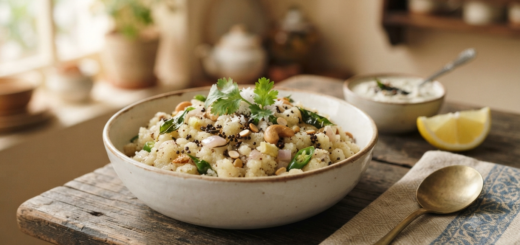
Hotel Sambar for Pongal: The Real Tiffin-Centre Method
This hotel sambar for pongal is built the way tiffin centres actually cook it, so the sambar comes out thin, mildly sour, and light enough to soak straight into hot ven pongal. Most home versions fail here because they borrow a rice-sambar formula: too much tamarind, too thick, too many vegetables. Tiffin kitchens do the opposite. They lean on moong dal for body, cut the tamarind back, and finish the pot with a tempering poured over at the very end.
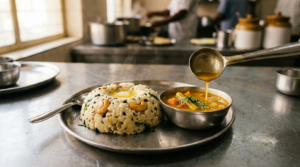
Thin, mildly sour hotel sambar for pongal, ladled fresh beside hot ven pongal.
Get those three levers right and the rest is ordinary cooking. A hotel sambar for pongal takes about 45 minutes, needs one pressure cooker and one small tadka pan, and works just as well for idli and dosa on the days you are not making pongal.
Hotel Sambar for Pongal at a Glance
Here are the numbers before you start, so you can plan around the pressure cooker.
| Detail | Value |
|---|---|
| Prep time | 15 minutes |
| Cook time | 30 minutes |
| Total time | 45 minutes |
| Servings | 4 |
| Cuisine | South Indian, Tamil Nadu tiffin style |
| Difficulty | Easy to moderate |
Four rules define a good hotel sambar for pongal, and they hold whatever vegetables you have on hand.
- The dal base is half toor and half moong, because moong gives the smooth body pongal needs.
- Tamarind stays small, roughly a marble-sized ball, since tiffin sambar is meant to be mild.
- The final consistency should pour off a ladle rather than drop in a lump.
- Tempering goes in last, after the sambar is cooked, never at the start.
What Makes Hotel Sambar for Pongal Different from Rice Sambar
Ask any tiffin-centre cook and the answer is rarely a secret masala. The differences are structural, and there are four of them.
The dal changes. Rice sambar runs on toor dal alone. Tiffin sambar adds moong dal, which breaks down completely and gives a velvety base instead of a grainy one. Some large chains use masoor dal for the same effect, because it cooks faster in volume.
The sourness drops. A rice sambar is assertively tangy so it can carry plain rice. Pongal already brings pepper, cumin and ghee to the plate, so a sharp sambar fights it. Tiffin kitchens therefore use noticeably less tamarind.
A starchy vegetable does quiet work. Pumpkin, potato or carrot cooks along with the dal and gets mashed in. It thickens the pot without flour, adds mild sweetness, and stretches the quantity, which is exactly why commercial kitchens rely on it.
The finish is aggressive. Mustard, cumin, urad dal and curry leaves are fried separately, then poured over at the end. That last-minute aroma is the single thing home cooks most often lose by tempering first.
Why Hotel Sambar for Pongal Is Thinner Than Idli Sambar
Ven pongal is already soft, wet and rich. When the sambar is thick, the two simply sit side by side on the plate and never combine. A hotel sambar for pongal is meant to seep in, and that is the whole point of the pairing.
Idli sits somewhere in the middle, because idli is dry and absorbs a slightly heavier sambar happily. Rice needs the thickest and sourest version of all. So if you have been using one pot for all three, that is likely why the pongal combination felt heavy.
Aim for a consistency close to thin buttermilk. When you lift a ladle, the sambar should fall in a steady stream rather than in blobs. It thickens as it cools, so keep it slightly looser than you think you need.
Ingredients for This Hotel Sambar for Pongal
Everything below is standard South Indian pantry stock. Quantities serve four people generously.
Lentils and base
- Toor dal (arhar) — 1/2 cup
- Yellow moong dal — 1/4 cup
- Water for cooking — 2 1/2 cups
- Turmeric powder — 1/4 teaspoon
Vegetables
- Potato — 1 medium, cubed
- Tomato — 1 medium, chopped
- Carrot — 1/2 cup, cubed
- Yellow pumpkin — 1/3 cup, cubed (optional, but it adds real body)
- Drumstick pieces — 1/2 cup (optional)
- Brinjal cubes — 1/4 cup (optional)
- Shallots — 8 to 10, peeled (skip these for a no-onion festival version)
Spices and souring
- Sambar powder — 1 tablespoon, fresh or store-bought
- Tamarind — a marble-sized ball, soaked and strained
- Jaggery — 1 teaspoon, to round off the sourness
- Salt — 1 heaped teaspoon, adjusted to taste
Tempering
- Oil or ghee — 2 tablespoons, divided
- Mustard seeds — 1 teaspoon
- Cumin seeds — 1 teaspoon
- Urad dal — 1 teaspoon
- Dried red chillies — 2, broken
- Asafoetida — 1/4 teaspoon
- Curry leaves — 1 sprig
- Green chillies — 2, slit
- Fresh coriander leaves — 1/4 cup, chopped
Hotel Sambar for Pongal: Step-by-Step Method
Read the six steps once before you begin, because the tempering timing matters more than anything else here.
1. Rinse and cook the dal (0 to 10 minutes)
Wash both dals two or three times until the water runs clear. Tip them into a pressure cooker with 2 1/2 cups water, the turmeric and a pinch of salt. Add the pumpkin cubes now if you are using them.
Cook for three to four whistles on medium heat, then let the pressure drop on its own. The lentils should be soft enough to mash against the side of the vessel.
2. Soak the tamarind (5 minutes)
While the dal cooks, soak the tamarind in 1/4 cup warm water. Squeeze it well after five minutes, then strain out the fibres. Set the extract aside.
3. Saute the vegetables (10 to 15 minutes)
Heat 1 tablespoon oil in a wide pan on medium flame. Add the shallots first and cook until they turn glassy, roughly two minutes. Then add potato and carrot and saute for another two minutes.
Add tomato, drumstick and brinjal next. Cook for three more minutes so the tomato softens and loses its raw edge.
4. Add the dal and spices (15 to 20 minutes)
Open the cooker and mash the dal lightly with a ladle. Pour it over the sauteed vegetables. Stir in the sambar powder and salt.
Now add the tamarind extract, the jaggery, and 1 to 1 1/2 cups of hot water. Bring it to a gentle boil and simmer for about 10 minutes, until the vegetables give way easily to a spoon.
5. Make the tempering (20 to 25 minutes)
Heat the remaining tablespoon of oil or ghee in a small pan. Add mustard seeds and wait for them to pop. Then add cumin, urad dal, broken red chillies, asafoetida, curry leaves and green chillies.
Fry for 30 to 40 seconds, only until the urad dal turns light gold. Burnt urad dal will make the whole pot bitter, so pull it off the heat early if in doubt.
6. Combine and rest (25 to 30 minutes)
Pour the hot tempering straight into the simmering sambar. Stir once, gently. Cook for three to four more minutes, then switch off and scatter the coriander over the top.
Cover the pot and leave it alone for ten minutes before serving. That rest is when the flavours actually settle, and it costs you nothing.
The Dal Ratio That Decides Your Texture
Which lentil you choose changes a hotel sambar for pongal more than the masala does. Use this table to match the dal to what you are serving.
| Dal combination | Resulting texture | Best served with |
|---|---|---|
| Toor dal only | Fuller, slightly grainy, holds shape | Rice, sambar sadam |
| Half toor, half moong | Smooth but still substantial | Ven pongal, idli |
| Moong dal only | Very light, thin, quick to cook | Pongal, upma, small children |
| Toor with a little masoor | Silky, cooks fast, deeper colour | Bulk cooking, dosa |
For pongal specifically, the half-and-half blend is the safest choice. Pure moong is lighter still, although it can taste flat when your sambar powder is weak.
Five Tiffin-Centre Tricks Most Home Cooks Miss
These small habits separate a decent home pot from a hotel sambar for pongal that tastes like the plate at your local mess.
- Use shallots, not big onions. Small onions hold their sweetness through simmering, while large onions turn watery and bland.
- Add a spoon of fried gram powder. Grind roasted gram (pottukadalai) to a powder and stir in a teaspoon. It thickens without dulling the flavour, which is how tiffin centres stretch a pot.
- Dilute with hot water only. Cold water shocks the dal and flattens the aroma, so keep a kettle beside you.
- Finish with half a teaspoon of ghee. Add it after switching off the flame, because the aroma then stays on top instead of cooking away.
- Be heavy-handed with coriander. A quarter cup sounds excessive until you taste the difference. Fresh coriander is doing real flavour work here, not decoration.
Troubleshooting Hotel Sambar for Pongal
Nothing here is unrecoverable. Work out which problem you have, then apply the matching fix while the pot is still warm.
| Problem | Likely cause | Fix |
|---|---|---|
| Too sour | Excess tamarind | Add jaggery and a few spoons of mashed dal |
| Too thick | Over-simmered or cooled | Stir in hot water gradually, then re-season |
| Too thin | Not enough dal or starchy veg | Mash in boiled potato or a teaspoon of fried gram powder |
| Tastes flat | Stale sambar powder | Dry-roast a teaspoon of fresh powder and stir it in |
| Bitter aftertaste | Burnt urad dal or fenugreek | Discard that tempering and make a fresh one |
| Raw tamarind smell | Not simmered long enough | Boil for five more minutes before tempering |
The bitter case is the only one worth being strict about. Once burnt fenugreek or urad dal enters the pot, no amount of jaggery will hide it.
No-Onion Version for Pongal Festival Cooking
Pongal is a festival dish as much as a breakfast, so plenty of households cook a hotel sambar for pongal without onion or garlic. That version works perfectly well, provided you compensate.
Skip the shallots entirely. Increase the tomato to two medium ones and add an extra pinch of asafoetida to the tempering, since asafoetida does the savoury work onions would have done. A little extra pumpkin also helps, because you lose some natural sweetness along with the shallots.
If you cook regularly for temple offerings or vratam days, the same logic applies to our Udupi Krishna temple sambar recipe, which is built around that restriction from the start.
Substitutions, Batch Sizes and Storage
Most swaps here are forgiving, so cook with what you have rather than skipping the dish.
- No moong dal? Use toor dal alone and mash it harder. The texture turns slightly coarser but stays perfectly good.
- No tamarind? Two extra tomatoes or a small piece of kokum will supply the sourness, although the flavour shifts noticeably.
- Richer version: stir in 2 tablespoons of thin coconut milk after switching off the heat.
- Lighter version: use rice bran or groundnut oil in place of ghee and skip the final ghee drizzle.
For a crowd, scale the dal and vegetables linearly, but increase the tamarind and salt by roughly three-quarters rather than doubling them. Sourness and salt intensify in a bigger pot, so it is easier to add more later than to rescue an over-soured batch.
Refrigerate leftovers in an airtight container and use them within three days. Reheat gently with a splash of hot water, because the sambar will have thickened overnight. It also freezes for about a month, though the vegetables soften considerably after thawing.
Hotel Sambar for Pongal: Nutrition Per Serving
These figures are approximate, calculated from standard composition values for the listed ingredients across four servings. Your actual numbers shift with oil quantity, vegetable mix and portion size.
| Nutrient | Approximate amount |
|---|---|
| Energy | 230 to 260 kcal |
| Protein | 8 to 10 g |
| Carbohydrates | 33 to 38 g |
| Fat | 7 to 9 g |
| Dietary fibre | 6 to 8 g |
Detailed composition data for Indian lentils and vegetables is published by the ICMR-National Institute of Nutrition, while international reference values sit in USDA FoodData Central. If you are managing diabetes, blood pressure or any condition needing controlled sodium or carbohydrate intake, treat these estimates as a rough guide and follow your doctor or dietitian.
What to Serve with Hotel Sambar for Pongal
The classic plate is ven pongal, a spoon of ghee, coconut chutney and a vadai. Ladle the sambar beside the pongal rather than over it, so the pongal keeps some structure while you eat.
Millet versions pair beautifully too, and our foxtail millet pongal recipe makes a lighter partner when you want the meal to sit easier. The same pot carries idli and dosa without any change, although for a dedicated version see our Tamil Nadu style sambar for idli.
Should you want the rice-side version instead, that one wants more tamarind and a thicker body altogether. Our sambar recipe for rice covers that adjustment properly, so you are not simply thinning or thickening the same pot.
Before You Cook
Three things decide whether a hotel sambar for pongal comes out right. Keep the tamarind small, keep the sambar thin, and pour the tempering in at the end rather than the beginning. Everything else is negotiable.
Start with the half toor and half moong ratio the first time, then adjust once you know how your household likes it. Pongal is a dish built on comfort, so the sambar beside it should feel the same way.
Hotel Sambar for Pongal FAQs
What dal is best for hotel sambar for pongal?
A half-and-half mix of toor dal and moong dal works best. Toor supplies flavour while moong dissolves fully, so you get a smooth pouring texture. Some restaurant kitchens use masoor dal instead of moong, because it cooks faster in large batches.
How is tiffin sambar different from rice sambar?
Tiffin sambar is thinner, milder and less sour than rice sambar. It uses moong dal alongside toor, far less tamarind, and a lighter hand with the sambar powder. Rice sambar is thicker and tangier, because plain rice needs a stronger accompaniment.
Can I make this sambar without tamarind?
Yes, although the character changes. Replace the tamarind with two extra chopped tomatoes or a small piece of kokum. Add it early enough to simmer, since raw sourness tastes harsh when it has not cooked into the dal.
Why does my sambar taste different from hotel sambar?
Usually it is one of three things: the sambar was too thick, the tempering went in first, or the sambar powder was old. Freshly roasted powder makes the biggest single difference. Aged store-bought powder loses its aroma within a few months of opening.
Should I use ghee or oil for the tempering?
Oil for the main tempering and ghee as a finishing drizzle gives you both. Ghee burns at a lower temperature, so frying mustard and urad dal in it risks a bitter edge. Adding half a teaspoon after switching off keeps the aroma intact.
How long does this sambar stay good?
Refrigerated in a sealed container, it keeps for about three days. Reheat with a splash of hot water because it thickens as it sits. For longer storage it freezes for roughly a month, although the vegetables will be softer after thawing.
Can I make hotel sambar for pongal in an instant pot?
Yes. Pressure cook the dal and pumpkin for 8 minutes on high with natural release, then use saute mode for the vegetables and the simmering stage. Make the tempering separately in a small pan, since the inner pot does not hold heat well enough for a quick tadka.
Do I need to add vegetables at all?
No. Many tiffin centres make it with only onion and tomato, and it is still excellent. Vegetables add sweetness and body, so when you skip them, stir in a teaspoon of fried gram powder to make up the missing thickness.