Udupi Idli Sambar Recipe: Soft Idlis and Hotel-Style Sambar at Home
This Udupi idli sambar recipe gives you the coconut-and-jaggery sambar poured in Karnataka’s Udupi hotels, along with the soft white idlis that sit under it. Most versions online skip the two things that actually decide whether it works. The first is the honest timeline, because this is a 14-hour dish pretending to be a 90-minute one. The second is what to do when the batter refuses to rise.
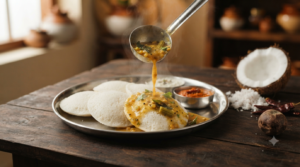
Soft steamed idlis with thin, pourable Udupi-style sambar made from freshly ground coconut masala.
Bhimas Cook is an independent home kitchen blog. What follows is a home adaptation of the Udupi hotel style, not the temple kitchen recipe of the Sri Krishna Matha at Udupi.
Udupi Idli Sambar Recipe at a Glance
Here is the whole Udupi idli sambar recipe in summary form before the detail begins.
- Active work: about 70 minutes, spread across two sessions
- Total elapsed time: 14 to 16 hours, since soaking and fermentation dominate
- Yield: 4 to 5 servings, roughly 16 to 20 small idlis with sambar
- Rice to urad dal ratio: 4:1 by volume
- Signature markers: freshly roasted masala with grated coconut, tamarind, a little jaggery, and no packaged sambar powder
- Target consistency: thin and pourable, so the sambar soaks into the idli rather than sitting on top
What Makes This Udupi Idli Sambar Recipe Different
Udupi sambar is defined by a wet masala paste ground fresh with coconut, plus a deliberate touch of jaggery and a thinner body than rice sambar. Packaged sambar powder is not used. That coconut paste, and not the chilli, is what carries the flavour, so the finished sambar tastes rounded and faintly sweet rather than sharp.
Cooks arriving from a Tamil or Andhra kitchen often find the sweetness strange at first. It is not a mistake or a modern shortcut. Jaggery balances the tamarind here, much as it does in Karnataka’s bisi bele bath.
| Style | Spice base | Coconut | Body |
|---|---|---|---|
| Udupi hotel style | Freshly roasted masala, ground wet | Yes, generous | Thin, pourable |
| Arachuvitta (Tamil) | Freshly roasted masala, ground wet | Small amount | Medium to thick |
| Powder-based everyday sambar | Ready sambar podi | Usually none | Thick |
In plain numbers, a tiffin sambar should run about as thin as buttermilk, while a rice sambar can hold a spoon upright. If you want the powder route instead, our Kannada Brahmin style sambar powder works well.
The Real Timeline Nobody Prints on the Recipe Card
The single biggest reason a first attempt at this Udupi idli sambar recipe fails is a misread clock. Recipe cards that claim 40 minutes of prep are quietly ignoring soaking and fermentation.
Urad dal needs 4 to 6 hours in water, and after grinding the batter needs 8 to 12 more hours to ferment. Plan backwards from breakfast and the whole thing becomes easy.
| When | What you do | Time needed |
|---|---|---|
| Day 1, morning | Rinse and soak rice, urad dal, fenugreek | 10 minutes, then 4 to 6 hours waiting |
| Day 1, afternoon | Grind and mix the batter, set to ferment | 25 minutes |
| Day 1, overnight | Fermentation happens on its own | 8 to 12 hours |
| Day 2, morning | Roast masala, cook sambar, steam idlis | 45 minutes |
In a Bengaluru or Chennai kitchen in summer, fermentation can finish in 7 hours. Through a north Indian winter it may stretch past 14. Judge the batter by volume, not by the clock.
Ingredients for the Udupi Idli Sambar Recipe
For the idli batter
- 2 cups idli rice, also sold as parboiled rice
- 1/2 cup whole skinned urad dal
- 1 tsp fenugreek seeds
- Salt to taste, about 1 tsp
- Water for soaking and grinding
For the sambar base
- 1/2 cup toor dal
- 1.5 cups mixed vegetables such as carrot, drumstick, brinjal and bottle gourd
- 1 medium tomato, diced
- 5 to 6 pearl onions, optional
- 1 tbsp tamarind, soaked in 1/3 cup hot water
- 1/4 tsp turmeric powder
- 1 to 2 tsp jaggery
- Salt as needed
For the Udupi sambar masala
- 3 tsp coriander seeds
- 2 tsp husked urad dal
- 1 tsp chana dal
- 1 tsp cumin seeds
- 1/4 tsp fenugreek seeds
- 3 to 4 dried red chillies, seeds removed
- 1/4 cup grated fresh coconut
For the tempering
- 2 tbsp coconut oil
- 1 tsp mustard seeds
- 2 dried red chillies
- 8 to 10 curry leaves
- A generous pinch of asafoetida
- 2 tbsp chopped coriander leaves
Note the vegetable quantity. The original half cup was too little for five servings, so this version uses 1.5 cups.
Step-by-Step Udupi Idli Sambar Recipe Method
1. Soak the grains
Rinse the idli rice until the water runs clear. Soak the rice and fenugreek seeds together in one bowl. Soak the urad dal separately in another, because the two grind very differently.
Give both at least 4 hours. Six is better, though beyond eight the dal starts to sour in warm weather.
2. Grind the batter
Drain the urad dal, saving the soaking water. Grind it first with small splashes of that water until the batter turns white, light and genuinely fluffy. Then grind the rice to a fine but faintly grainy texture, like wet semolina.
Combine both in a large vessel. Add salt, then mix with your clean hand for a full minute. The warmth and natural flora on your palm genuinely help fermentation start.
3. Ferment it
Cover loosely and leave the vessel somewhere warm. Fill the container only two-thirds full, since a good batter nearly doubles. When it has risen, smells pleasantly sour and shows small bubbles on top, it is ready.
4. Roast and grind the sambar masala
Heat a dry pan on low. Roast the coriander seeds, both dals, cumin, fenugreek and chillies until they smell nutty and the dals turn light gold. Burnt fenugreek turns the whole pot bitter, so pull the pan off early if in doubt.
Cool the spices completely. Then grind them with the grated coconut and a little water into a smooth paste.
5. Cook the dal and vegetables
Pressure cook the toor dal with turmeric and 2 cups of water for 4 to 5 whistles, until it mashes easily. Meanwhile simmer the vegetables with the tomato, optional pearl onions and salt in 2 cups of water. Stop while they still hold their shape, which takes 8 to 10 minutes.
6. Bring the sambar together
Mash the cooked dal smooth and stir it into the vegetables. Squeeze the soaked tamarind and add the strained pulp, discarding the fibre. Then stir in the ground masala paste and the jaggery, adding water until the sambar is clearly pourable.
Simmer for 10 to 12 minutes so the raw tamarind smell disappears. Do not boil hard after the coconut paste goes in, because coconut splits with aggressive heat.
7. Temper and finish
Heat the coconut oil in a small pan. Splutter the mustard seeds, then add the red chillies, curry leaves and asafoetida. Pour the whole tempering into the sambar, stir in coriander leaves and switch off the heat.
8. Steam the idlis
This last stage of the Udupi idli sambar recipe rewards a light hand. Grease the idli moulds lightly. Ladle in the fermented batter without stirring it down, since stirring knocks out the trapped air. Steam over boiling water for 12 to 15 minutes, then rest for 3 minutes before unmoulding.
Udupi Idli Sambar Recipe Troubleshooting: Why Your Batter Did Not Rise
This is the step where the Udupi idli sambar recipe most often stalls. A batter that stays flat almost always comes down to temperature, salt timing or over-grinding, not bad luck. Fermentation is microbial work, so it slows sharply below roughly 25 degrees Celsius. Fix the environment first before blaming the dal.
| Symptom | Likely cause | What to do |
|---|---|---|
| No rise at all after 12 hours | Kitchen too cold | Keep it inside the oven with only the light on, or wrap the vessel in a thick towel |
| Rose, then collapsed | Over-fermented | Use it immediately for dosa instead; refrigerate earlier next time |
| Thin and lifeless | Too much water while grinding | Add 2 tbsp fine rice flour and rest 1 hour |
| Dense, grey idlis | Urad dal ground too long and overheated | Grind in short bursts with chilled water |
| Sour smell but no bubbles | Old urad dal | Replace the dal; stock older than a year ferments poorly |
One myth worth killing: adding baking soda does not rescue a dead batter. It puffs the idli briefly, yet the texture turns spongy and the taste goes flat.
Fixing Sambar That Has Gone Wrong
Sambar is forgiving, so almost nothing needs throwing away. Too sour means excess tamarind, which a teaspoon of jaggery and a ladle of mashed dal will pull back. Too salty responds to a chunk of raw potato simmered for ten minutes, then removed.
Bitterness usually traces to burnt fenugreek and cannot be fixed, although a fresh batch of masala paste stirred in will mask it. If the sambar tastes flat, it is generally under-salted rather than under-spiced.
What Home Cooks Get Wrong With Udupi Sambar
- Grinding the coconut with the roasted spices while they are still hot, which dulls the aroma
- Boiling the sambar hard after adding coconut, so it separates and looks curdled
- Using regular raw rice for idlis instead of parboiled idli rice
- Adding the tamarind before the dal, which stops the vegetables softening properly
- Serving it as thick as rice sambar, when tiffin sambar should pour freely
- Rushing the fermentation, which is the one stage in this Udupi idli sambar recipe that cannot be hurried
Leftovers behave well too. The sambar keeps 3 days refrigerated, while fermented batter holds 2 days before it turns too sour for idli. For a lighter weekday version, our moong dal idli sambar cooks in under an hour.
Substitutions That Actually Work
Desiccated unsweetened coconut can replace fresh coconut, though soak it in warm water for ten minutes first. Idli rava substitutes for whole rice at a 2:1 ratio against urad dal, and it skips the rice grinding entirely. Skip the onions altogether for the traditional Brahmin style version.
Drumstick is the one vegetable worth chasing down, because its flavour is central to the dish. Carrot and bottle gourd alone still make a good pot, and readers who prefer a single-vegetable sambar can follow our drumstick sambar method.
Nutrition Estimate Per Serving
These are calculated estimates for roughly four idlis with a cup of sambar, not laboratory values. Published figures for idli with sambar generally land between 200 and 320 kcal per serving, and this recipe sits in the upper part of that band because of the coconut and tempering oil.
| Nutrient | Estimate |
|---|---|
| Energy | 270 to 300 kcal |
| Carbohydrate | 40 to 46 g |
| Protein | 9 to 12 g |
| Fat | 7 to 10 g |
| Fibre | 4 to 6 g |
| Sodium | 400 to 700 mg, depending on added salt |
Two health notes are worth flagging. Most Indian asafoetida is cut with wheat flour, so anyone avoiding gluten should check the label or use a compounded gluten-free brand. Sodium also climbs quickly here, since both the batter and the sambar are salted, which matters if you are managing blood pressure.
What to Serve With the Udupi Idli Sambar Recipe
Coconut chutney is the standard partner, and the combination is what most Udupi hotels put on the plate. A spoon of ghee over the idli is common at home, though it is skipped in temple kitchens. Filter coffee finishes the meal.
A full Udupi idli sambar recipe plate at home usually means idli, sambar, chutney and coffee together. The same sambar works with dosa, uttapam and plain steamed rice, although rice calls for a thicker pot. Cooks exploring the wider regional repertoire can compare it with our Mangalore style sambar or the sweeter Karnataka bisi bele bath.
Before You Start the Udupi Idli Sambar Recipe
The success of this Udupi idli sambar recipe is decided the day before, not on the morning you serve it. Soak properly, grind the urad dal light, and give fermentation the warmth it needs. Everything after that is straightforward cooking.
Roast the masala gently, keep the sambar thin, and taste for salt at the end rather than the beginning. Get those four things right and the result genuinely resembles what an Udupi hotel serves. Background on the region’s food culture is documented in the Udupi cuisine and idli entries on Wikipedia.
Udupi Idli Sambar Recipe: Questions Readers Ask
Can I make this Udupi idli sambar recipe without fermenting the batter?
Not for true idlis. Fermentation creates the airy structure and the mild tang, so unfermented batter steams into dense discs. Instant rava idli is the honest alternative when time is short, because it uses a different leavening route altogether.
Why is Udupi sambar sweet?
Jaggery is added deliberately to balance the tamarind, which is standard across coastal Karnataka. The quantity is small, so the finished sambar should taste rounded rather than sweet. Start with one teaspoon and taste before adding more.
Can I use ready-made sambar powder instead?
You can, although it stops being Udupi style. The freshly ground coconut masala is the defining element of this recipe, and powder produces a sharper, thinner-tasting sambar. If you use powder, add 2 tablespoons of ground coconut separately to compensate.
What is the correct rice to urad dal ratio?
Four parts rice to one part whole urad dal by volume is the standard for soft idlis. Some cooks go to 3:1 for a spongier result, which also ferments faster. Below 3:1 the idlis turn sticky.
How thin should tiffin sambar be?
It should pour from a ladle in a steady stream, roughly the thickness of buttermilk. Idli absorbs sambar, so a thick pot simply sits on the surface. Add hot water at the end until the consistency looks almost too loose.
Can I make the sambar in advance?
Yes, and many cooks think it improves overnight. Refrigerate it for up to 3 days, then reheat gently with a splash of water. Add a fresh tempering before serving, since the first one fades.
Why did my sambar turn bitter?
Burnt fenugreek seeds are the usual culprit, because they scorch faster than everything else in the pan. Over-roasted urad dal does the same. Roast on low heat and remove the pan while the dals are still gold rather than brown.
Can I freeze idli batter?
Fermented batter freezes for up to a month in an airtight box. Thaw it fully in the refrigerator overnight, then bring it to room temperature before steaming. Texture drops slightly, although the idlis still steam soft.
Is this Udupi idli sambar recipe suitable for diabetics?
Idli has a moderate glycaemic index and the lentils in sambar slow absorption, so it is generally considered a reasonable breakfast in controlled portions. The jaggery quantity here is small. Anyone managing diabetes should confirm portion sizes with their own doctor or dietitian.