Gutti Vankaya Fry Recipe: Authentic Andhra Stuffed Brinjal Fry
A good Gutti Vankaya Fry Recipe lives or dies on the brinjal you pick, not the masala you grind. Get a seedy, over-mature eggplant and no amount of roasted peanut stuffing will save it. Get a tender one, and the same four steps my mother has used for decades turn a ₹40 handful of baby brinjals into the dish everyone reaches for first. Below is her method, timed properly, with the fixes for every way this dish usually goes wrong.
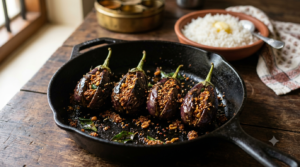
Stuffed baby brinjals slow-fried in a coarse roasted peanut, sesame and dry coconut masala, Andhra style.
Nutrition values on this page are estimates calculated from the ingredient list, not lab measurements. This recipe contains peanuts and sesame. Please read the allergen section before cooking for guests.
Gutti Vankaya Fry Recipe at a Glance
- Total time: about 50 minutes, of which roughly 30 minutes is hands-off
- Yield: 4 servings, using 8 baby brinjals (about 500 g)
- Texture: dry fry, not gravy, so the masala clings to blistered skin
- Difficulty: medium, because the stuffing step needs a light hand
- Best with: steamed rice and ghee, or jowar roti
- Key skill: low flame, covered pan, patience
What Is Gutti Vankaya Fry?
Gutti vankaya fry is an Andhra dry side dish of small brinjals slit into quarters, packed with a coarse roasted masala of peanuts, sesame, dry coconut, chana dal and red chillies, then slow-fried in a covered pan until the skins blister and the stuffing sets. It carries no gravy.
The name explains the method. Gutti means bunched or held together, since the stalk stays on so the brinjal does not fall apart. Vankaya is brinjal in Telugu. In Andhra kitchens the fry version is also called vepudu, while the gravy version is called kura or koora.
The Gutti Vankaya Fry Recipe below is firmly the dry version.
Choosing the Right Brinjals for Your Gutti Vankaya Fry Recipe
This is the step that decides everything, so give it a minute at the vegetable stall. Tender brinjals cook soft and sweet. Mature ones stay hard, taste bitter and are full of brown seeds.
Three checks work reliably. First, look at the green stalk and calyx: on a tender brinjal it covers roughly a third of the fruit. Second, press the skin gently, because it should dimple slightly and spring back. Third, weigh it in your palm, since a tender brinjal feels heavy for its size while an old one feels light and hollow.
Colour matters less than people think. Purple, striped and pale green varieties all work. Just pick eight of roughly equal size, otherwise the small ones collapse before the big ones cook through.
Gutti Vankaya Fry Recipe: Ingredients With Exact Quantities
This Gutti Vankaya Fry Recipe uses the quantities as my mother measures them. Nothing here is exotic, and every item is available at a regular kirana shop.
- Small tender brinjals — 8 nos, about 500 g
- Peanuts — 3 tbsp
- White sesame seeds — 2 tsp
- Chana dal — 3 tsp
- Urad dal — 2 tsp
- Dry red chillies — 6 nos, adjust to taste
- Grated dry coconut (kopra) — 3 tbsp
- Garlic cloves — 5 to 6 nos
- Tamarind water — 2 tbsp, from tamarind soaked in warm water
- Turmeric powder — ½ tsp
- Sambar powder or red chilli powder — 1½ tsp
- Salt — 1½ tsp, or to taste
- Cooking oil — 4 tbsp
- Mustard seeds — 1 tsp
- Curry leaves — 1 sprig
Some families add 1 tsp coriander seeds and ½ tsp cumin to the roast, and a few add a pinch of jaggery to soften the tamarind. Both are optional. This version leaves them out because the peanut and coconut already carry the flavour.
Gutti Vankaya Fry Recipe: Step-by-Step Method
Step 1 — Roast the masala base (10 to 12 minutes)
Heat a dry pan on low. Add chana dal, urad dal, peanuts and the red chillies. Stir constantly for about three minutes until the dals turn reddish and the peanuts smell toasty.
Now add the sesame seeds and dry coconut. Roast another two to three minutes until the coconut turns pale gold. Take it off the heat immediately, because coconut burns within seconds of colouring. Spread everything on a plate to cool.
Step 2 — Grind to a coarse stuffing (5 minutes)
Once the mix is properly cool, tip it into a blender with the garlic, turmeric, sambar powder, tamarind water and salt. Pulse to a coarse, crumbly paste that holds together when pressed.
Do not grind it smooth. A coarse texture is what gives the finished fry its crunch, while a fine paste turns pasty inside the brinjal.
Step 3 — Slit and stuff the brinjals (5 minutes)
Wash the brinjals and pat them completely dry. Starting from the base, cut a deep cross so you get four segments, but stop about a centimetre short of the stalk. The stalk holds the whole thing together.
Open each brinjal gently and push the masala into the slits with a small spoon or your fingers. Press it in firmly. If you have masala left over, keep it aside, since you will need it later.
Step 4 — Slow-fry until the skins blister (18 to 22 minutes)
Heat the oil in a wide, flat pan on medium. Add mustard seeds, and when they crackle, add the curry leaves. Lower the flame right down.
Place the stuffed brinjals in a single layer. Cover and cook eight minutes, turning them gently every three to four minutes with a flat spatula. Uncover, scatter the leftover masala over the top, and cook another ten to fourteen minutes until the skins wrinkle and blister. If the masala catches, sprinkle one or two tablespoons of water rather than adding more oil.
Gutti Vankaya Fry Recipe Troubleshooting
Nearly every failure with this Gutti Vankaya Fry Recipe traces back to one of five causes. Here is what goes wrong and what actually fixes it.
| Problem | Cause | Fix |
|---|---|---|
| Brinjals stay hard | Mature fruit, or flame too high | Cover the pan, drop the flame, add a splash of water |
| Bitter taste | Over-mature seedy brinjal | Salt the slit brinjals 10 minutes, rinse, pat dry |
| Stuffing falls out | Slit cut too deep or stalk removed | Stop the cut short of the stalk, press masala in firmly |
| Masala tastes raw | Dals under-roasted | Roast on low until dals turn reddish, not just warm |
| Dish turns oily | Extra oil added when masala stuck | Add water, never more oil, once frying starts |
The bitterness fix is worth spelling out. Salting draws water out of the cut surfaces and carries some bitter compounds with it. Rinse well afterwards, otherwise the dish turns salty.
Fry, Vepudu or Kura: Which One Do You Actually Want?
Three dishes share the gutti vankaya name, so people hunting for a Gutti Vankaya Fry Recipe often land on the wrong one. The difference is liquid, not spice.
| Version | Texture | Best with |
|---|---|---|
| Fry (vepudu) | Dry, masala clings to skin | Rice and ghee, curd rice |
| Kura | Thin tamarind gravy | Jowar roti, chapati |
| Masala curry | Thick onion-tomato gravy | Biryani, pulao |
If you want the dry version, stay on this page. For the Telangana gravy style, see our Gutti Vankaya Kura Telangana recipe. For the richer restaurant-style gravy, try the Gutti Vankaya masala curry.
Lighter Versions: Air Fryer, Oven and Less Oil
Four tablespoons of oil is traditional in a Gutti Vankaya Fry Recipe, though the dish still works with less. You lose some gloss but keep the flavour, because the roasted peanut and coconut do the heavy lifting.
For the oven, stuff the brinjals, brush them with 2 tbsp oil and roast at 200°C. Start checking at 25 minutes and expect 30 to 35 minutes in total, turning once. In an air fryer, use 180°C and start checking at 18 minutes. Both are done when a knife slides into the thickest part without resistance.
Timings vary a lot between ovens and air fryer models, so treat these as starting points and go by texture. A tawa version also works if you keep the flame low and turn often.
Gutti Vankaya Fry Recipe Nutrition Estimate Per Serving
Most sites publishing a Gutti Vankaya Fry Recipe give nutrition figures without showing their working. These numbers are calculated from the ingredient quantities above, divided across four servings, and rounded. Treat them as a guide.
| Nutrient | Per serving (est.) |
|---|---|
| Energy | 250 to 300 kcal |
| Protein | 5 to 6 g |
| Fat | 19 to 22 g |
| Carbohydrate | 14 to 17 g |
| Fibre | 5 to 6 g |
Most of that fat comes from the oil, the peanuts and the coconut rather than the vegetable. Brinjal itself is very light: the USDA FoodData Central entry for raw eggplant lists about 25 kcal, 0.2 g fat and 3 g fibre per 100 g, and roughly 92% water. Reduce the oil to 2 tbsp and the per-serving energy drops to around 190 to 220 kcal.
Allergens and Food Safety Notes
This dish contains two of the common allergens, so mention it when you serve guests. Peanuts are in the stuffing, and sesame seeds go in alongside them. Neither can be tasted separately once ground, which is exactly why a quiet warning matters.
Chana dal and urad dal are legumes, though they are not major allergens for most people. Swap the peanuts for roasted gram dal or cashew if you need a peanut-free version, since the texture stays close.
How to Store and Reheat Gutti Vankaya Fry Recipe Leftovers
Leftovers from this Gutti Vankaya Fry Recipe keep well, so cool them quickly and refrigerate in a shallow airtight container. Eat leftovers within two to three days. Reheat on a hot tawa for two to three minutes so the masala crisps again, because a microwave steams the skin and turns it soft.
Timing matters more than most recipe pages admit. The US Department of Agriculture Food Safety and Inspection Service warns that bacteria multiply fastest between 4°C and 60°C, doubling in as little as 20 minutes, and advises refrigerating leftovers within two hours. Above 32°C that window drops to one hour, which matters through an Indian summer. India’s Food Safety and Standards Authority (FSSAI) gives similar guidance for cooling cooked food in stages.
Do not leave the pan out on the counter overnight. Reheat thoroughly until the dish is steaming hot right through, not just warm on the surface.
What to Serve With Gutti Vankaya Fry
A dry, spicy side like this Gutti Vankaya Fry Recipe needs something plain and something wet alongside it. The classic Andhra plate is steamed rice, a spoon of ghee, this fry, and a bowl of pappu charu or rasam.
- Steamed rice with ghee, the traditional pairing
- Curd rice, which cools the chilli heat well
- Jowar or bajra roti, especially in Rayalaseema homes
- Plain chapati with a wedge of lemon
- As a side with vegetable dum biryani for a festive meal
For a full South Indian spread, our Andhra pesarattu recipe and cabbage curry with coconut sit well on the same table.
What Home Cooks Get Wrong With the Gutti Vankaya Fry Recipe
After watching this Gutti Vankaya Fry Recipe go wrong in other kitchens, the same handful of habits come up again and again.
- Grinding the masala hot. Warm ingredients release oil and turn the mix into a paste, so cool them fully first.
- Crowding the pan. Brinjals need a single layer, otherwise they steam instead of frying.
- Turning too often. Every turn knocks stuffing loose. Leave them alone for three to four minutes at a time.
- Cooking on high heat. The skin burns long before the flesh softens.
- Throwing away spare masala. Scatter it over the pan near the end, since it thickens the coating beautifully.
One more thing worth knowing: this dish tastes better after twenty minutes of resting off the heat. The stuffing settles and the flavours knit together, which is why it often tastes better at lunch than straight off the stove.
Before You Cook
Buy tender brinjals, roast the dals properly, and keep the flame low. Those three habits account for almost every good plate of this Gutti Vankaya Fry Recipe. If you are cooking it for the first time, make it with eight brinjals rather than sixteen, because a single crowded layer is the most common beginner mistake. Serve it hot with rice and ghee, and keep a little masala aside to scatter over the top.
Gutti Vankaya Fry Recipe FAQs
Can I make gutti vankaya fry less spicy?
Yes. Cut the dry red chillies from six to three, and use plain coriander powder in place of sambar powder. The peanut, coconut and tamarind carry enough flavour on their own, so the dish does not taste flat when you reduce the heat.
Why did my brinjals turn bitter?
Bitterness almost always comes from over-mature brinjals with developed seeds. Salt the slit brinjals for ten minutes, rinse them and pat dry before stuffing. Next time, choose fruit with a large green calyx and firm, glossy skin.
Can I bake gutti vankaya instead of frying it?
You can. Brush the stuffed brinjals with oil and roast at 200°C for 30 to 35 minutes, turning once. Start checking at 25 minutes, since ovens vary. The texture comes out drier than the pan version, though the flavour holds up well.
Which brinjal variety works best?
Small purple or striped varieties around 60 g each are ideal. Avoid large globe eggplants entirely, because they are seedy and will not hold a stuffing. Pick eight of similar size so they finish cooking together.
Is this recipe suitable for fasting days?
Usually not, as written. Many Hindu fasting traditions avoid brinjal altogether on Ekadashi and certain other days, and this version also uses garlic. Practices vary by family and community, so follow what your household observes.
Can I prepare the stuffing in advance?
Yes, and it helps. The roasted masala keeps in an airtight jar in the fridge for up to a week, though add the tamarind water only when you are ready to stuff. Grinding a double batch on the weekend cuts weeknight cooking to about twenty minutes.
How do I stop the stuffing from falling out?
Keep the stalk intact and stop your cut about a centimetre short of it. Press the masala in firmly rather than spooning it in loosely. Then turn the brinjals as little as possible while they fry.
Can I make it without peanuts?
Yes. Roasted gram dal, also called pottukadalai, is the closest swap and keeps the same coarse texture. Cashew or white sesame in a larger quantity also work, although the flavour turns milder and slightly sweeter.
How long does it keep?
Two to three days in the fridge in a shallow airtight container. Get it into the fridge within two hours of cooking, or within one hour if your kitchen is above 32°C. Reheat on a tawa until steaming hot right through.