Sweet Pongal Recipe With Coconut: Easy Jaggery Method
Sweet pongal recipe with coconut is a rich South Indian sweet made with soft rice, roasted moong dal, jaggery, ghee, cardamom and fresh grated coconut. The key is simple: cook the rice and dal until very soft before the jaggery goes in, then finish with coconut and ghee so the pongal stays creamy rather than grainy.
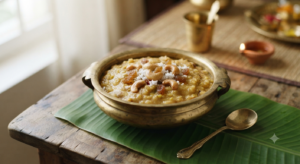
Creamy sweet pongal made with rice, moong dal, jaggery, fresh coconut, ghee and cashews.
This version uses fresh grated coconut, not coconut milk. That small distinction matters because grated coconut gives gentle chew and aroma without turning the dish into a coconut-milk pongal.
Sweet Pongal Recipe With Coconut at a Glance
- Prep time: 10 minutes
- Cook time: about 35 minutes
- Total time: about 45 minutes
- Servings: 4 generous portions
- Cooking method: stovetop pressure cooker, with Instant Pot notes below
- Main sweetener: jaggery
- Coconut used: fresh grated coconut
- Texture: soft, creamy and spoonable
Sweet pongal, also called sakkarai pongal or chakkara pongali, is closely linked with South Indian festive cooking. India’s official tourism portal also lists chakkera-pongali among the prasadams associated with Tirupati. If you are planning a larger festive menu, see our Sankranti special recipes for more dishes that pair naturally with it.
Ingredients for Sweet Pongal Recipe With Coconut
The measurements below keep the original post’s useful rice, dal and jaggery balance, but the method is corrected for cleaner flavour and texture. Dry-roast the moong dal before rinsing, since roasting wet dal is awkward and uneven.
| Ingredient | Quantity | Why it matters |
|---|---|---|
| Raw rice | 3/4 cup | Use Sona Masoori, Ponni or another short-to-medium grain rice |
| Yellow moong dal | 1/2 cup | Adds body, nuttiness and the classic soft pongal texture |
| Water | 4 cups | Creates a soft, mashable rice-dal base |
| Jaggery | 1 packed cup, about 200-220 g | Gives the traditional deep sweetness |
| Fresh grated coconut | 1/2 cup | Adds coconut aroma and a light bite |
| Ghee | 3 tablespoons | Carries aroma and gives the pongal a glossy finish |
| Cashews | 10-12 | Add crunch and a roasted note |
| Raisins | 1 tablespoon | Optional, for bursts of sweetness |
| Cardamom powder | 1/2 teaspoon | Balances jaggery and coconut |
| Salt | 1 small pinch | Sharpens the sweet flavour |
Use clean, good-quality jaggery because flavour varies widely from block to block. If your jaggery has visible grit, dissolve and strain it rather than adding it straight to the cooker.
How to Make Sweet Pongal Recipe With Coconut
This sweet pongal recipe with coconut works best when you treat the rice-dal base and jaggery syrup as two separate jobs. First make the base completely soft. Then add the sweetener and coconut, because the final mixture needs only a short simmer.
- Dry-roast the moong dal. Heat the empty pressure cooker on low to medium heat. Add the moong dal and stir for 3-4 minutes until it smells nutty. Do not brown it deeply.
- Rinse the rice and dal. Transfer the roasted dal to a bowl with the rice. Rinse both two or three times, then drain.
- Pressure-cook until very soft. Add the rice, dal, 4 cups water and a pinch of salt to the cooker. Cook for about 3-4 whistles on medium heat, then let the pressure drop naturally.
- Mash the base. Open the cooker and stir firmly with a ladle. The rice and dal should lose their separate grain shape and become thick and creamy.
- Make the jaggery syrup. While the cooker rests, add the jaggery and 1/2 cup water to a small pan. Heat gently until dissolved, then strain into a clean bowl.
Finish the Sweet Pongal Recipe With Coconut
At this point, the rice and dal are already cooked, so the sweet pongal recipe with coconut needs only gentle heat. Keep the pan moving after jaggery goes in because the sugary base catches faster than plain rice.
- Combine jaggery and cooked rice. Put the cooker back on low heat. Pour in the strained jaggery syrup and stir until the mixture looks even.
- Add fresh coconut. Stir in the grated coconut and cardamom. Simmer for 3-5 minutes, because longer cooking can mute the fresh coconut aroma.
- Finish with ghee and nuts. Heat the ghee in a small pan. Fry the cashews until golden, then add raisins if using. Pour everything over the pongal and stir once.
- Rest before serving. Switch off the heat and rest the pongal for 5 minutes. Serve warm while it is still loose and glossy.
If you prefer a method focused only on cooker timings, our pressure-cooker sweet pongal gives a separate walkthrough. Keep this page for the grated-coconut variation.
Why Add Jaggery Only After the Rice and Dal Cook?
Add jaggery after the rice and dal are fully soft because the starch base needs enough plain water to hydrate and break down first. When you sweeten too early, the mixture can take longer to soften and may stay more separate than you want.
The best cue is visual rather than timed. Before adding jaggery, you should be able to press the rice and dal into a soft paste with the back of a spoon. If you can still see firm grains, add a little hot water and cook them longer.
After the jaggery goes in, keep the flame low. A hard boil can make the bottom catch quickly because the syrup is now concentrated with sugar.
Fresh Coconut, Coconut Milk or Dry Coconut?
They are not interchangeable in the final texture. Fresh grated coconut adds aroma and light chew, while coconut milk makes the entire pongal richer and more fluid. Dry coconut gives a stronger roasted note but less fresh fragrance.
| Coconut form | Best use | Result |
|---|---|---|
| Fresh grated coconut | This recipe | Fresh aroma with gentle texture |
| Thick coconut milk | For a creamier variation | Silkier and more coconut-forward |
| Desiccated coconut | Emergency substitute | Drier texture and stronger chew |
If you specifically want the coconut-milk version, use our sweet pongal with coconut milk instead. Keeping the two methods separate avoids the common mistake of adding both a large amount of grated coconut and rich coconut milk, which can overwhelm the rice and jaggery.
How to Get the Right Sweet Pongal Texture
For this sweet pongal recipe with coconut, the finished pongal should be softer than ordinary cooked rice and thicker than payasam. It should fall slowly from a spoon rather than hold a firm mound. Remember that it thickens as it cools, so stop cooking while it still looks slightly loose.
If the pongal is too thick
Add 2-4 tablespoons of hot water and stir over low heat. Add more only after the first splash disappears, because a small amount changes the texture quickly.
If the pongal is too thin
Simmer uncovered on low heat for a few minutes while stirring often. Do not raise the flame sharply, since jaggery can scorch on the base before excess water evaporates.
If the jaggery tastes harsh or bitter
Check the jaggery itself first, because dark colour does not always mean better flavour. A strong smoky or bitter block will dominate the whole dish. Cardamom can round the edges, but it cannot fix poor jaggery.
Sweet Pongal Recipe With Coconut: Pressure Cooker and Instant Pot Notes
For a stovetop cooker, 3-4 whistles on medium heat usually produce a soft base, though cooker size and flame strength vary. The real test is softness after natural pressure release, not the whistle count alone.
For an Instant Pot, cook the rinsed rice and roasted dal with the water on High Pressure for about 8 minutes. Allow roughly 10 minutes of natural pressure release before venting the rest. Mash first, then use Sauté on Low to add jaggery syrup, coconut and cardamom.
Do not pressure-cook the jaggery with the rice and dal. It adds no speed advantage and gives you less control over the final texture.
Common Mistakes That Spoil Coconut Sweet Pongal
- Roasting wet dal: dry-roast first, then rinse. This keeps roasting even and prevents spluttering.
- Stopping while the rice is still grainy: sweet pongal needs a very soft base, so cook longer before adding jaggery.
- Using too little water: the mixture should begin softer than the final texture because jaggery thickens it later.
- Boiling jaggery too hard: dissolve it gently. You are not making a candy syrup.
- Cooking fresh coconut for too long: a short simmer keeps its aroma clear.
- Adding too much cardamom: cardamom should support the jaggery and coconut, not cover them.
- Waiting for the perfect final thickness in the pan: the pongal firms as it rests, so switch off a little early.
One more correction from many older recipe posts: there is no need to call a spoonful of edible camphor “temple style.” If you use camphor at all, only a product clearly sold as food-grade edible camphor is appropriate. Medicinal or puja camphor is not a cooking substitute, so beginners can simply omit it.
Can I Make This Sweet Pongal Vegan?
Yes. Replace ghee with a neutral coconut oil if you need a vegan version. The result will taste more coconut-forward and less buttery, but the method stays the same.
Use the same quantity at first, then adjust after tasting. Because coconut oil becomes firm when cool, vegan pongal can feel slightly firmer after refrigeration than the ghee version.
Serving Sweet Pongal With Coconut
Serve this sweet pongal recipe with coconut warm, not piping hot. A warm serving lets you notice the caramel notes of jaggery and the fragrance of coconut more clearly.
For a festival meal, keep the portion small because the dish is rich. It works well as a sweet finish after a savoury South Indian meal, or as part of a Sankranti or Pongal spread.
If you prepare it as naivedyam or prasadam, follow your family or temple tradition for ingredients and tasting before offering. Customs vary by household, so the cooking method here is meant as a practical home recipe rather than a rule for ritual practice.
How to Store and Reheat Sweet Pongal
Cool leftovers promptly and refrigerate them in a covered, shallow container. The U.S. Department of Agriculture advises refrigerating perishable leftovers within two hours and using most cooked leftovers within three to four days. See the USDA food-safety guidance for the general rule.
For best flavour and texture, this coconut sweet pongal is nicer within about two days. Reheat only the portion you need with a splash of hot water, then stir until creamy again.
Freezing is possible, but the thawed rice texture can become uneven and the coconut can lose freshness. Refrigeration is the better option for a small home batch.
Why This Sweet Pongal Recipe With Coconut Works
This sweet pongal recipe with coconut keeps three jobs separate: roast for aroma, pressure-cook for softness, then sweeten for flavour. That order is more reliable than throwing every ingredient into the cooker at once.
Fresh coconut is added late, so it stays distinct instead of disappearing into a long cook. Jaggery is strained, which also removes grit without forcing you to overboil the syrup.
The result is a practical middle ground between classic sakkarai pongal and a richer coconut variation. You still taste rice, dal, jaggery and ghee, while coconut stays clearly present.
Before You Serve
For the best result, stop judging the pongal by the clock and watch the texture instead. The rice and dal must be completely soft before jaggery enters the pan, and the finished pongal should look slightly loose before resting.
Use fresh grated coconut for this version, keep the heat gentle after sweetening, and serve warm. Those three choices make the biggest difference.
Frequently Asked Questions
Can I use coconut milk instead of grated coconut?
Yes, but that becomes a different variation. Coconut milk makes the whole pongal creamier and more fluid, while grated coconut gives texture. If you substitute coconut milk, reduce some cooking water and add the thick milk after the rice and dal are soft.
Can I make sweet pongal recipe with coconut without a pressure cooker?
Yes. Cook the roasted dal and rice in a heavy pot with enough water until both are very soft. Stir more often near the end, because the base can catch as it thickens. Then add strained jaggery syrup, coconut and the ghee tempering.
Which rice is best for sweet pongal?
Short-to-medium grain raw rice such as Sona Masoori or Ponni works well because it softens easily. You do not need basmati. A highly separate, fluffy grain is the opposite of the creamy texture you want here.
Should moong dal be roasted for sweet pongal?
Light roasting is useful because it adds a nutty aroma without changing the dal too much. Stop when the dal smells fragrant and turns only slightly deeper in colour. Heavy browning can make the flavour too dominant.
Why did my sweet pongal become hard after cooling?
Rice starch sets as it cools, so sweet pongal naturally thickens. Reheat it gently with a few tablespoons of hot water until it loosens. Add liquid gradually, since the pongal can shift from thick to runny faster than expected.
Can I reduce the jaggery?
Yes. Start with about three-quarters of the listed amount if you prefer a less-sweet result. Because jaggery brands differ in sweetness and depth, taste after mixing and adjust only if needed.
Is sweet pongal with coconut gluten-free?
The core ingredients in this recipe are naturally gluten-free. However, packaged jaggery, ghee, spices and processed coconut can vary by manufacturer. If you cook for someone with coeliac disease, check labels and avoid cross-contact in the kitchen.
Can I prepare sweet pongal ahead for a festival?
Yes, but the texture is best on the day you cook it. If you make it earlier, refrigerate promptly and reheat gently with hot water before serving. Add a small fresh ghee-and-cashew tempering after reheating if you want to revive the aroma.