Moong Dal Payasam with Jaggery: Easy South Indian Recipe
Moong dal payasam with jaggery is a creamy South Indian sweet made with roasted yellow moong dal, jaggery, cardamom and coconut milk. The best version tastes nutty and caramel-like, not simply sugary. The two details that matter most are roasting the dal before cooking and handling jaggery gently so the payasam stays smooth.
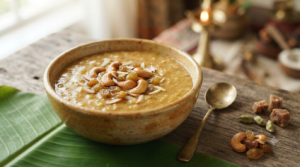
Creamy moong dal payasam sweetened with jaggery and finished with cardamom, cashews and raisins.
This recipe keeps the original Bhimas Cook ingredient profile, but fixes the points that can make the dessert gritty, split or too thick. It also gives pressure-cooker and stovetop methods, a clear jaggery-syrup step, texture fixes and safer storage guidance.
Moong Dal Payasam with Jaggery at a Glance
Moong dal payasam with jaggery, also called pasi paruppu payasam in many Tamil homes, is a lentil-based payasam sweetened with unrefined cane jaggery. Coconut milk gives it a rounded finish, while cardamom, ghee, cashews and raisins add the familiar festival aroma. Serve it warm for the best texture.
- Prep time: about 10 minutes
- Cook time: about 30 minutes
- Total time: about 40 minutes
- Serves: 6 small dessert portions
- Best texture: pourable when hot, softly thick after resting
- Key rule: do not boil thick coconut milk hard after adding it
If you want a fully dairy-free version, use coconut milk and replace ghee with a neutral plant fat. For a version designed specifically around coconut milk, see the moong dal payasam with coconut milk recipe. If you prefer no milk at all, the moong dal payasam without milk version is the better match.
Ingredients for Moong Dal Payasam with Jaggery
The ingredient list is short, so each item has a visible effect on the finished payasam. Yellow split moong dal gives body, while jaggery adds a deeper caramel note than white sugar. Coconut milk softens the lentil flavour without making the dessert heavy.
| Ingredient | Quantity | Why it matters |
|---|---|---|
| Yellow moong dal | 1 cup, about 200 g | Creates the creamy lentil base |
| Water | 2.5 cups, plus more if needed | Cooks the dal and adjusts consistency |
| Jaggery | 1 cup, about 200 g | Adds sweetness and caramel flavour |
| Coconut milk | 1 cup | Adds richness and smoothness |
| Ghee | 2 tbsp | Roasts the garnish and adds aroma |
| Cashews | 10 to 12 | Add crunch |
| Raisins | 10 to 12 | Add small bursts of sweetness |
| Cardamom powder | 1/2 tsp | Gives the classic payasam aroma |
| Salt | 1 small pinch | Balances sweetness |
Which jaggery works best?
Use fresh cane jaggery with a clean aroma and no sour or musty smell. Darker jaggery can give a stronger molasses-like taste, while pale jaggery may taste milder. Colour alone does not tell you whether jaggery is better, so buy from a reliable source and check the pack for proper labelling.
The Food Safety and Standards Authority of India defines standards for gur and jaggery, including limits for moisture and extraneous matter. You can review the official FSSAI jaggery standard if you want the regulatory definition. At home, dissolve and strain jaggery when you see visible grit or impurities.
How to Make Moong Dal Payasam with Jaggery
For smooth moong dal payasam with jaggery, roast the dry dal first, cook it until soft, then add strained jaggery syrup. Add coconut milk only after the dal and jaggery have blended. Keep the final simmer gentle because hard boiling can make coconut milk look oily or separated.
- Roast the dry moong dal. Heat a heavy pan or pressure cooker over medium-low heat. Add the dry dal and stir for 3 to 4 minutes, until it smells nutty and turns only slightly deeper in colour. Do not brown it heavily.
- Rinse and cook. Let the roasted dal cool for a minute, then rinse it quickly. Add 2.5 cups water and cook until very soft. In a pressure cooker, this is usually around 2 to 3 whistles, but cooker performance varies. Let the pressure release naturally.
- Make the jaggery syrup. Add 1 cup jaggery and about 1/4 cup water to a small pan. Warm on low heat until the jaggery dissolves. Do not chase a string consistency; you only need a fluid syrup.
- Strain if needed. Pour the syrup through a fine metal strainer when the jaggery contains grit or sediment. Clean, packaged jaggery may not need this step.
Finish the jaggery and coconut milk base
This moong dal payasam with jaggery should remain loose enough to flow from a ladle before the final rest. Finish the sweetener and coconut milk stages gently, because both texture and aroma can change with excessive heat.
- Combine dal and jaggery. Lightly mash the cooked dal so some grains remain visible. Add the jaggery syrup and a pinch of salt. Simmer gently for 3 to 5 minutes while stirring.
- Add coconut milk. Reduce the heat to low. Stir in 1 cup coconut milk and the cardamom powder. Heat only until the payasam is steaming and evenly combined, then switch off the flame.
- Temper the garnish. Heat ghee in a small pan. Fry cashews until golden, then add raisins and cook until they puff. Pour the hot tempering over the payasam and stir once.
- Rest before serving. Leave the payasam covered for 5 minutes. It thickens as it stands, so add a little hot water or warm coconut milk if you want a looser consistency.
Stovetop method without a pressure cooker
You can make the same recipe in a heavy saucepan. After roasting and rinsing the dal, add about 3 cups water and bring it to a boil. Lower the heat and simmer for 20 to 30 minutes, adding small splashes of hot water if the pan dries before the dal turns soft.
Once the dal crushes easily between two fingers, continue with the jaggery syrup and coconut milk steps above. The stovetop method takes longer, but it gives you more control over texture. Stir near the end because thick dal can catch on the bottom of the pan.
Why This Moong Dal Payasam with Jaggery Stays Smooth
The order of cooking matters more than any secret ingredient. Moong dal needs enough water to soften before sugar enters the pan because concentrated sugar can slow softening. Jaggery also varies in moisture and impurities, so dissolving it separately gives you better control over sweetness and grit.
Coconut milk should go in near the end. A gentle final heat keeps its fat better dispersed, while prolonged boiling can make the surface look split. This does not always mean the dessert is spoiled, but the texture is less creamy and harder to restore.
Should you wash the dal before roasting?
For this method, roast the dry dal first and rinse it afterwards. Wet dal takes longer to roast and tends to steam before it develops a nutty aroma. If you prefer to rinse first, drain it very well and let the surface moisture disappear before roasting.
Can you use cow milk instead of coconut milk?
Yes, but dairy milk needs more care because jaggery can sometimes make milk curdle. Do not boil cow milk aggressively with jaggery. For a dairy version with the sequence explained in detail, use the separate moong dal payasam with milk method.
How to Fix Moong Dal Payasam with Jaggery
Most payasam problems are texture problems, not recipe failures. Because moong dal keeps absorbing liquid after cooking, a perfect pan can become thick within 15 minutes. Jaggery strength also changes from batch to batch, so final adjustment should happen after the flavours settle.
| Problem | Likely cause | Best fix |
|---|---|---|
| Too thick | Dal absorbed more liquid | Stir in hot water or warm coconut milk, 2 tbsp at a time |
| Too thin | Too much cooking water | Simmer the dal-jaggery base briefly before adding coconut milk |
| Grainy texture | Jaggery sediment | Strain the melted jaggery before combining |
| Weak flavour | Dal was not roasted enough | Add fresh cardamom and a small spoon of ghee; roast better next time |
| Oily or split look | Coconut milk boiled too hard | Remove from heat and whisk gently; do not keep boiling |
| Too sweet | Jaggery was stronger than expected | Add more cooked dal or unsweetened coconut milk |
How sweet should the payasam be?
The original 1:1 cup ratio of dal to jaggery gives a clearly sweet festive dessert. For a lighter result, start with 3/4 cup jaggery and taste after it dissolves. You can add more syrup, but you cannot easily remove sweetness once it is mixed through the dal.
Jaggery is still a concentrated sweetener, so treat this as dessert rather than a low-sugar food. Its flavour is different from refined sugar, but that does not make unlimited portions advisable. A small bowl is usually enough after a full South Indian meal.
Moong Dal Payasam with Jaggery Variations
Small changes work well because the base is simple. Add 1 to 2 tablespoons finely chopped coconut to the ghee with the cashews for extra texture. A tiny pinch of dry ginger powder also works, especially when you want a warmer flavour behind the cardamom.
For a vegan version, keep the coconut milk and replace ghee with a mild plant fat. For a thinner temple-style consistency, increase hot water after cooking rather than increasing coconut milk too much. If you want a very rich dessert, use part thick coconut milk at the end instead of boiling all of it from the beginning.
Optional flavour additions
- Finely chopped fresh coconut, lightly fried in ghee
- A small pinch of dry ginger powder
- One or two cloves, fried briefly with the nuts
- A few toasted coconut flakes for serving
Avoid adding several strong flavours together. Moong dal payasam with jaggery tastes best when the roasted lentil and caramel notes remain easy to identify. Cardamom should perfume the dessert rather than dominate it.
Serving and Storing Moong Dal Payasam with Jaggery
Serve the payasam warm, either on its own or as part of a festive vegetarian meal. It thickens noticeably while cooling, so keep a little hot water ready before serving. If you make it ahead, prepare the payasam slightly looser than your ideal final texture.
For food safety, refrigerate leftovers promptly instead of leaving the pot at room temperature for hours. The Food Safety and Standards Authority of India advises keeping leftovers cold below 5°C, while the USDA recommends refrigerating perishable leftovers within two hours and using most cooked leftovers within three to four days. See FSSAI Food Safety at Home and the USDA leftovers guidance.
For best quality, use this payasam within 2 to 3 days because coconut milk desserts can change texture in the fridge. Reheat only the portion you need over low heat, adding a splash of water. Do not repeatedly boil and cool the full batch.
Common Mistakes That Change the Result
The first mistake is roasting wet dal. That step steams the lentils instead of giving them a clean nutty aroma. Roast dry dal gently, rinse afterwards, then cook it until fully tender.
The second mistake is cooking jaggery syrup to a thick candy stage. Payasam does not need that. You only need to dissolve jaggery, strain it if necessary, and let it merge with the cooked dal.
The third mistake is boiling coconut milk for too long. Add it near the end and keep the heat low. Finally, do not judge consistency straight from the stove because the dessert thickens while resting.
Final Notes Before You Serve
Moong dal payasam with jaggery is simple enough for a weekday sweet, but the technique still matters. Roast for aroma, cook the dal fully, dissolve jaggery separately and add coconut milk late. Those four choices solve most of the common texture problems.
Keep the first batch close to the base recipe before adding extra flavours. Once you know how thick your dal cooks and how sweet your jaggery tastes, the recipe becomes easy to adjust by feel. Serve it warm and slightly loose, because resting will do the final thickening for you.
Frequently Asked Questions
Can I make moong dal payasam with jaggery without a pressure cooker?
Yes. Roast and rinse the dal, then simmer it in a heavy pot with about 3 cups water until very soft. This usually takes 20 to 30 minutes, although dal age and pan size can change the timing. Continue with the jaggery syrup once the lentils mash easily.
Why did my payasam become too thick?
Moong dal keeps absorbing liquid as it cools, so payasam naturally thickens after cooking. Add hot water or warm coconut milk a little at a time until it becomes pourable again. Make the dessert slightly looser if you plan to serve it later.
Why should jaggery be dissolved separately?
Dissolving jaggery separately makes it easy to strain out grit or sediment before it reaches the dal. It also helps you control sweetness and consistency. Clean packaged jaggery may not need straining, but melting it first still gives a smoother mix.
Can I use milk instead of coconut milk?
Yes, but cow milk can curdle when it meets some jaggery. Keep the dairy method gentle and avoid hard boiling after combining them. If you want a milk-based version, follow the dedicated Bhimas Cook cow-milk recipe because its sequence is designed around that risk.
Can I make this payasam vegan?
Yes. Use coconut milk and replace ghee with a mild plant fat. The remaining core ingredients are plant-based, but check packaged ingredients if you are cooking for someone with strict dietary requirements.
Is jaggery healthier than white sugar?
Jaggery may contain small amounts of minerals, but it is still a concentrated source of sugar. Use it mainly for flavour and tradition, not as a reason to treat the dessert as sugar-free or unlimited. Portion size still matters.
Can I make the payasam one day ahead?
Yes. Cool it promptly, refrigerate it in a covered container, and make it slightly looser than usual because it will thicken overnight. Reheat gently with a splash of water or coconut milk before serving.
How long does moong dal payasam keep in the fridge?
For best quality, use it within 2 to 3 days and keep it properly chilled. General food-safety guidance allows many cooked leftovers for 3 to 4 days under refrigeration, but coconut milk texture is often better earlier. Discard it if storage conditions were unsafe or it develops an off smell.