Paruppu Payasam with Coconut Milk: Easy Moong Dal Recipe
Paruppu payasam with coconut milk is a South Indian lentil dessert made with roasted moong dal, jaggery, coconut milk and cardamom. The best version tastes nutty and caramel-like, yet still pours easily from a ladle. The key is simple: cook the dal until soft, simmer the jaggery with the dal, and add thick coconut milk only at the end.
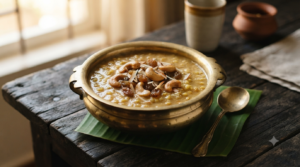
Creamy paruppu payasam made with roasted moong dal, jaggery, coconut milk, cardamom, cashews and raisins.
This recipe is also called pasi paruppu payasam, moong dal payasam or, in some Kerala homes, a style of parippu payasam. Regional versions differ, so some include sago, fried coconut pieces or dry ginger. This version keeps the ingredient list short and focuses on a smooth, rich coconut-milk finish.
Paruppu Payasam with Coconut Milk at a Glance
- Prep time: 10 minutes
- Cook time: about 30 minutes
- Total time: about 40 minutes
- Serves: 5 to 6
- Main ingredients: yellow moong dal, jaggery, coconut milk and cardamom
- Best texture: soft dal in a pourable, glossy payasam
- Vegan option: use coconut oil instead of ghee
The most useful rule is to treat thin and thick coconut milk differently. Thin coconut milk can simmer briefly with the dal, while thick coconut milk should only warm through. A hard boil after adding thick coconut milk can make the fat separate and leave the payasam oily.
Ingredients for Paruppu Payasam with Coconut Milk
| Ingredient | Quantity | Purpose |
|---|---|---|
| Yellow moong dal | 1/2 cup | Nutty body and soft texture |
| Water | 1 1/2 cups | For cooking the dal |
| Jaggery | 3/4 cup, grated or chopped | Deep caramel sweetness |
| Water for jaggery | 1/4 cup | Helps dissolve and strain jaggery |
| Thin coconut milk | 1 cup | Loosens the payasam |
| Thick coconut milk | 1 cup | Gives the final creamy finish |
| Green cardamom powder | 1/2 teaspoon | Aroma |
| Ghee | 1 tablespoon | For frying the garnish |
| Cashews | 10 to 12 | Crunch |
| Raisins | 1 tablespoon | Sweet garnish |
| Fresh coconut pieces | 2 tablespoons, optional | Traditional texture |
| Dry ginger powder | 1/8 teaspoon, optional | Warm spice note |
| Salt | 1 small pinch | Balances sweetness |
For paruppu payasam with coconut milk, use unsweetened coconut milk. If you have one can of rich coconut milk, reserve the thickest portion for the finish and dilute the rest with water for the thinner portion. Homemade first extract works as thick coconut milk, while the second extract works as thin coconut milk.
Jaggery varies in colour, moisture and sweetness, so 3/4 cup is a starting point rather than a rule. Taste the dal-jaggery mixture before adding the thick coconut milk. You can then add a little more dissolved jaggery if your family prefers a sweeter payasam.
How to Make Paruppu Payasam with Coconut Milk
- Roast the moong dal. Heat a heavy pan on low to medium heat. Add the dry moong dal and roast for 3 to 4 minutes, stirring often, until it smells nutty and turns slightly deeper yellow. Do not let it brown.
- Rinse and cook the dal. Rinse the roasted dal once, then add 1 1/2 cups water. Pressure cook until soft, usually 2 to 3 whistles in a standard stovetop cooker, then allow the pressure to release naturally. For a saucepan, cover and simmer for about 20 to 25 minutes, adding a splash of hot water if needed.
- Check the texture. The dal should crush easily between two fingers, but it should not look completely puréed. Mash only a few spoonfuls against the side of the pot because some visible lentil texture makes the payasam more satisfying.
- Make the jaggery syrup. Warm the jaggery with 1/4 cup water until it dissolves. If the jaggery contains grit or fibre, strain the syrup through a fine metal strainer before using it.
- Combine dal and jaggery. Add the jaggery syrup to the cooked dal and simmer on low heat for 3 to 4 minutes. Stir often because jaggery can catch at the bottom of a thick pan.
Finish the Paruppu Payasam with Coconut Milk
At this stage, the paruppu payasam with coconut milk should taste slightly sweeter than the final dessert because the thick coconut milk will soften the sweetness. Keep the heat low from here. Strong boiling is no longer useful.
- Add thin coconut milk. Pour in 1 cup thin coconut milk and add the pinch of salt. Keep the heat low and simmer for about 3 minutes, just until the mixture looks even and glossy.
- Finish with thick coconut milk. Lower the heat to its minimum setting. Stir in 1 cup thick coconut milk and cardamom, then warm for 1 to 2 minutes without a rolling boil. Switch off the heat as soon as the payasam is hot and creamy.
- Fry the garnish. Heat ghee in a small pan. Fry cashews until golden, then add raisins and optional coconut pieces. Once the raisins puff, pour the garnish and ghee over the payasam.
- Rest before serving. Leave the pot covered for 5 to 10 minutes. The payasam thickens slightly as it rests, so judge the final consistency only after this short pause.
If you use an electric pressure cooker, cook the roasted and rinsed dal with the water until tender, then finish the jaggery and coconut milk steps in sauté mode on low. The exact pressure time varies by cooker and dal age, so use softness rather than a fixed number as the final test.
Why This Method Gives Better Payasam
Roasting the dal before cooking changes the flavour more than adding extra spice later. It brings out a warm, nutty aroma, so the finished dessert does not taste like plain boiled lentils. Rinsing after roasting also removes surface dust without washing away the toasted aroma.
Separating the coconut milk into thin and thick portions solves another common problem in paruppu payasam with coconut milk. The thinner milk gives the dal enough liquid to loosen and blend, while the thick milk stays rich because it spends very little time over heat. That order gives better coconut flavour with less risk of oil separation.
The jaggery is cooked with the dal before the thick coconut milk goes in. This makes the sweetness easier to adjust and keeps you from reducing the final payasam too aggressively. It also means you can strain rough jaggery first, which prevents sandy bits at the bottom of the bowl.
Paruppu Payasam with Coconut Milk: Texture and Troubleshooting
Why did my payasam become too thick?
Moong dal absorbs liquid as it stands, so payasam naturally gets thicker after cooking. Add warm thin coconut milk or hot water, one tablespoon at a time, until it pours easily again. Avoid adding lots of thick coconut milk because that can make the dessert heavy rather than simply looser.
Why does the coconut milk look split or oily?
Coconut milk can separate when it boils hard for too long. It does not curdle in exactly the same way as dairy milk, but the fat can break out and form an oily layer. Keep thick coconut milk for the final 1 to 2 minutes and use only gentle heat.
Why does the payasam taste flat?
Flat payasam usually needs one of three things: better-roasted dal, a tiny pinch of salt or fresher cardamom. Add the salt before the thick coconut milk, then taste again. If the jaggery tastes one-dimensional, a very small pinch of dry ginger can add warmth without dominating the coconut.
Why is the payasam grainy?
Graininess often comes from unstrained jaggery rather than the dal. Dissolve jaggery separately and strain it when you see visible grit. If the dal itself feels hard, it simply needs more cooking before you add the jaggery.
Paruppu Payasam with Coconut Milk: Homemade or Canned?
Homemade coconut milk gives you a natural thick-and-thin system. Blend grated coconut with warm water, strain the first extract, and keep it as the thick milk. Blend the coconut pulp again with more water for a lighter second extract.
With canned coconut milk, the goal is the same even though the product is more concentrated. Stir the can well, reserve about one cup for the thick finish, and dilute another portion with water for the earlier simmer. If your carton coconut milk is already thin, use it for the first stage and add canned milk only at the end.
Do not use sweetened coconut cream unless you deliberately reduce the jaggery. Sweetened products can make the payasam cloying, and they make it much harder to control the final balance.
Variations Without Losing the Core Flavour
- Kerala-style touch: fry small coconut pieces in ghee with the cashews and raisins. Some homes also add a hint of dry ginger.
- With sago: cook soaked sabudana separately until transparent, then add it before the thick coconut milk. This makes the dessert more substantial.
- Fully vegan: replace ghee with coconut oil. Coconut milk itself is plant-based, but standard ghee is a dairy product.
- Less sweet: begin with 1/2 cup jaggery, then taste after it dissolves. Add more only if needed.
- Richer finish: reduce the thin coconut milk slightly and keep the full cup of thick coconut milk for the end.
If you specifically want a dairy-based version, use the site’s moong dal payasam without coconut milk instead of forcing dairy into this recipe. For a sweeter jaggery-forward variation, compare the moong dal payasam with jaggery. There is also a separate condensed milk moong dal payasam for readers who want a richer modern version.
Serving, Storage and Food Safety
Serve paruppu payasam with coconut milk warm if you want the roasted dal and cardamom aroma to stand out. Chilled payasam becomes thicker, so loosen it with a little coconut milk or water before serving. A small bowl is usually enough because jaggery and coconut milk make this a rich dessert.
For storage, cool leftovers promptly and transfer them to a clean covered container. The Food Safety and Standards Authority of India advises keeping prepared food cold, preferably below 5°C, and reheating cooked food thoroughly. General USDA leftovers guidance recommends using refrigerated cooked leftovers within 3 to 4 days.
For best texture, this coconut-milk payasam is nicest within about 2 to 3 days. Reheat only the portion you need on low heat, because repeated hard boiling can make the coconut milk separate. See FSSAI food safety at home guidance and the USDA leftovers guidance for general storage rules.
Nutrition: What This Dessert Actually Offers
Moong dal contributes plant protein, carbohydrate and fibre, while coconut milk supplies most of the fat. Jaggery is still an added sugar, even though it has a deeper flavour than white sugar. So this is best treated as a festive dessert, not as a health food.
Nutrition numbers can change sharply with the type of coconut milk, jaggery quantity and serving size. That is why this refresh removes the old one-size-fits-all calorie estimate. For ingredient-level nutrient data, the ICMR-National Institute of Nutrition Indian Food Composition Tables are a better reference than a guessed per-bowl figure.
What Most Recipes Get Wrong
The first common mistake is boiling thick coconut milk as if it were water. That weakens the fresh coconut aroma and can push the fat out of the emulsion. Add it late and keep the heat low.
The second mistake is mashing the dal into a completely smooth paste. A little texture separates paruppu payasam from a generic sweet purée. Cook the dal until tender, then mash only enough to thicken the base.
The third mistake is assuming jaggery makes the dessert automatically healthier. Jaggery brings flavour and trace minerals, but it remains a concentrated sweetener. Use the amount that tastes balanced rather than adding extra because it sounds more traditional.
Paruppu Payasam with Coconut Milk: Final Notes
Good paruppu payasam with coconut milk depends more on sequence than on a long ingredient list. Roast the dal, cook it fully, dissolve and strain the jaggery, then use thin coconut milk before thick coconut milk. That order gives you a payasam that tastes roasted, creamy and clean rather than heavy.
If the dessert thickens while you prepare the rest of a festive meal, do not panic. A splash of warm thin coconut milk brings it back quickly. Add the fried nuts only near serving time if you want them to stay crisp.
Frequently Asked Questions
Is paruppu payasam with coconut milk the same as moong dal payasam?
Usually, yes. In this recipe, paruppu refers to yellow moong dal, so the names describe the same basic dessert. However, regional recipes vary, and some parippu payasam versions use chana dal or include sago.
Can I make paruppu payasam with coconut milk without a pressure cooker?
Yes. Roast and rinse the dal, then simmer it in a heavy saucepan with water until very soft. It usually takes about 20 to 25 minutes, but older dal may need longer, so judge by texture rather than the clock.
Should I add jaggery before or after coconut milk?
Add jaggery to the cooked dal first, then add thin coconut milk and finish with thick coconut milk. This order lets you dissolve and strain the jaggery before the richest coconut milk enters the pot. It also makes sweetness easier to adjust.
Can I use coconut sugar instead of jaggery?
Yes, but the flavour will change. Coconut sugar has a darker toasted taste and may be less syrupy than jaggery. Start with a smaller amount, taste after it dissolves, and increase only if needed.
Can I make this payasam completely vegan?
Yes. Coconut milk is plant-based, so the only standard dairy ingredient here is ghee. Replace ghee with coconut oil and fry the cashews, raisins and coconut pieces in that instead.
Why should I use both thin and thick coconut milk?
Thin coconut milk loosens the cooked dal and can handle a short simmer. Thick coconut milk gives the final creamy body and stronger coconut flavour. Using both lets you cook the base properly without overboiling the richest milk.
Can I make the payasam a day ahead?
Yes. Cool it promptly, refrigerate it in a covered container, and reheat gently the next day. It will thicken in the fridge, so stir in a little warm water or thin coconut milk before serving.
What can I add besides cashews and raisins?
Fried coconut pieces are especially good because they echo the coconut-milk base. You can also use a few chopped almonds, but keep the garnish simple so it does not hide the roasted dal and jaggery flavour.