Putharekulu Recipe at Home: Andhra Paper Sweet, Step by Step
Every Putharekulu recipe at home lives or dies on one thing: the rice sheet.
Plain ground-rice batter tears the moment you lift it, so most first attempts end as a pile of broken flakes. The makers in Atreyapuram do not use plain batter at all. They work with settled rice starch instead, and that single difference is why their sheets peel away whole. Below you get that method as a full Putharekulu recipe at home, with three pan setups that suit a normal kitchen, honest timings and a fix for every way a sheet can fail.
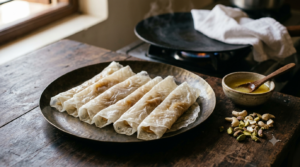
Homemade putharekulu rolls, folded from paper-thin rice starch sheets with ghee, powdered sugar and cardamom.
Bhimas Cook is an independent home-cooking blog. We are not connected with the GI-registered makers of Atreyapuram, so treat this as a faithful home adaptation of their technique rather than the certified original.
Putharekulu Recipe at Home: Quick Facts
- Active kitchen time: roughly 60 minutes, after 6 to 8 hours of soaking and 3 to 4 hours of starch settling.
- Yield: about 16 to 20 rolls, which serves eight people two pieces each.
- Core ingredients: raw rice, ghee, powdered sugar or bellam, cardamom and chopped nuts.
- Skill level: hard on batch one, comfortable by batch three, because this is pure hand technique.
- Wheat status: naturally wheat-free, since the sheet is rice starch and nothing else.
- Best made: a day before a festival, while the sheets are still crisp.
The steps below follow the order a Godavari kitchen actually works in. Read the starch section before you start, because it is the part almost every Putharekulu recipe at home leaves out.
What Putharekulu Actually Is
Putharekulu is a folded sweet built from wafer-thin rice-starch sheets, ghee and a dry sugar or jaggery filling. The Telugu name says it plainly. Pootha means coating and reku means sheet, so the word translates as coated sheets.
One piece is a poothareku. A boxful, which is how anyone actually buys them, is putharekulu. You will also see the spelling pootharekulu on shop boards across both Telugu states, and it refers to exactly the same sweet.
The dish comes from Atreyapuram, a village on the banks of the Godavari. Many recipe pages still place it in East Godavari district, yet that stopped being correct in 2022.
After Andhra Pradesh reorganised its districts, the village moved into the newly formed Dr B R Ambedkar Konaseema district. So if a Putharekulu recipe at home still names East Godavari, it has not been checked in years.
The GI Tag Worth Knowing About
The village version carries legal protection now. The Geographical Indications Registry, which sits under the Ministry of Commerce and Industry, granted a GI tag to “Atreyapuram Pootharekulu” in June 2023. The application came from a local manufacturers’ welfare association named after Sir Arthur Cotton.
That protection covers the village product, not your kitchen. So you can absolutely make this sweet at home and call it putharekulu. Describing your batch as Atreyapuram putharekulu, however, would be inaccurate. You can check the registration yourself on the Intellectual Property India portal, and the Wikipedia entry on Pootharekulu covers the wider history.
Ingredients for a Putharekulu Recipe at Home
This Putharekulu recipe at home makes roughly 18 rolls. Weigh the rice if you can, because cup measures drift and the batter is very sensitive to water.
- Raw rice: 2 cups, about 400 g
- Water: for soaking, plus 300 to 400 ml for grinding
- Ghee, melted: 1 cup, about 225 ml
- Powdered sugar or powdered bellam: 1 cup, about 200 g
- Cardamom powder: 1 teaspoon
- Cashews, almonds and pistachios, finely chopped: half a cup, optional
- Salt: a pinch, only if you are using jaggery
Which Rice Works, and Which Does Not
Atreyapuram uses Jaya rice, sold locally as bondalu biyyam and known in agricultural records as MTU-3626. It is a starchy delta variety, and its starch is the reason the sheets turn translucent rather than chalky.
You are unlikely to find it outside coastal Andhra. Sona masoori or any ordinary short-grain raw rice works as the substitute. Avoid basmati and avoid parboiled or idli rice, because both give you a cloudy, brittle film. Never use packaged rice flour either, since milled flour has lost the free starch this recipe depends on.
Three Ways to Form Sheets for a Putharekulu Recipe at Home
The traditional surface is a pootharekula kunda, an inverted clay pot seasoned with oil over several days and heated from below. Home kitchens rarely have one, so a Putharekulu recipe at home needs a workable stand-in. Here are the three realistic options side by side.
| Method | What you need | Best for |
|---|---|---|
| Non-stick tawa | Flat tawa, medium flame, cotton cloth | First-timers; easiest to control |
| Muslin over a steam pot | Wide pot of boiling water, muslin stretched and tied on top | Softer, more flexible sheets |
| Inverted clay kunda | Seasoned pot, high-output burner, wire fixing | Authentic texture; needs practice |
Start with the tawa. It gives you even, predictable heat, so you can learn the wrist motion before worrying about equipment. Move to the kunda later if you get hooked.
The Starch Step Every Putharekulu Recipe at Home Needs
Here is the correction that matters most. Nearly every Putharekulu recipe at home tells you to grind the rice to a dosa-batter consistency and dab that straight onto the pan. That advice is exactly why the sheets tear.
Real sheets come from strained, settled starch, not from whole batter. After grinding, you strain the batter through cloth and let the liquid rest undisturbed for three to four hours. Heavy starch sinks, clear water rises, and you pour the water off. What remains is a smooth, dense starch paste that films instantly on heat.
The difference is textural, not cosmetic. Whole batter carries rice solids that cook into a grainy pancake, so the film thickens and cracks. Settled starch carries almost nothing but pure starch, which sets into a translucent skin in seconds. Once you have felt both, you will never go back.
Step-by-Step Putharekulu Recipe at Home
Step 1: Soak the Rice (6 to 8 hours)
Rinse the rice two or three times, until the water runs clear. Then cover it generously with fresh water and leave it for six to eight hours. Overnight soaking suits most people, since the grinding happens the next morning.
Step 2: Grind and Strain (20 minutes)
Drain the rice and grind it with 300 to 400 ml of water until completely smooth. A wet grinder gives the finest result, although a strong mixer works if you grind in batches. Strain the batter through a thin cloth into a wide bowl and discard the gritty residue.
Step 3: Settle the Starch (3 to 4 hours)
Leave the strained liquid undisturbed on the counter. After three or four hours you will see two clear layers. Tip off the water on top slowly, then keep the thick paste at the bottom. Thin it with a spoon or two of water until it flows like light cream.
Step 4: Heat the Surface (5 minutes)
Set a non-stick tawa on medium heat for about five minutes. Wipe it with a lightly oiled cloth, and never let it smoke. Too hot and the film scorches before it sets, while too cool and it sticks in patches.
Step 5: Form the Sheets (20 to 25 minutes)
Dip a clean cotton cloth into the starch and squeeze out the excess. Sweep it across the hot surface in one smooth pass, so a thin film transfers evenly. Wait six to ten seconds, until the edges lift on their own.
Peel the sheet off from one corner and lay it flat on a plate. Repeat until you have 16 to 20 sheets. Your first three will tear, and that is normal, because the wrist motion takes a few tries to learn.
Step 6: Fill and Roll (10 minutes)
Stack two sheets together and brush them with melted ghee. Sprinkle two to three tablespoons of powdered sugar or bellam, a pinch of cardamom and some chopped nuts. Fold both long sides inward, then roll the sheet tightly into a slim log. Work quickly, since the ghee firms up as it cools.
Sugar or Bellam: Which Filling to Choose
Both fillings are traditional, yet they behave differently. Powdered sugar stays dry, so the roll keeps its crisp snap for longer. Bellam, or jaggery, carries moisture and molasses, which gives a deeper flavour but softens the sheet within a day.
Pick sugar if you are making these ahead for a festival. Choose bellam if you are serving the same evening and want the older, more rustic taste. Grind the jaggery to a fine powder either way, because coarse pieces tear the sheet from inside.
Why Your Sheets Tear, and How to Fix It
| Problem | Likely cause | Fix |
|---|---|---|
| Sheet tears while lifting | Whole batter used instead of settled starch | Strain and settle, then retry |
| Film will not set | Starch too thin, or pan too cool | Thicken slightly; raise heat a notch |
| Sheet scorches at the edges | Flame too high | Drop to medium-low and wipe the pan |
| Cloudy, opaque sheets | Parboiled or idli rice | Switch to raw sona masoori |
| Roll cracks when folded | Sheets too dry | Dab with a damp cloth before rolling |
Work through that table in order. In most kitchens the first row is the real culprit, and fixing it solves everything below.
What Home Cooks Get Wrong with a Putharekulu Recipe at Home
Handle the cloth the way you would a paintbrush, not a scrubbing pad. One light pass beats three heavy ones, because a second pass doubles the thickness and guarantees a tear.
Make a small test batch first. Five sheets tell you whether the starch and the heat are right, and adjusting after five is far cheaper than adjusting after twenty. Also keep the starch stirred between sheets, since it settles again inside ten minutes.
Timing matters too. Set your ghee, sugar and nuts out before the first sheet goes on, because a Putharekulu recipe at home falls apart when you are hunting for cardamom with six sheets cooling.
One more habit separates good batches from great ones. Warm your ghee slightly so it brushes on thin, because cold ghee sits in lumps and weighs the sheet down. If you enjoy this kind of hand-worked sweet, our gavvalu with jaggery uses a similar patience-first approach.
Putharekulu Recipe at Home: Storage and Kitchen Safety
Finish every Putharekulu recipe at home by cooling the rolls completely before packing them. Then store them in an airtight tin at room temperature, where sugar-filled rolls hold well for about four days and jaggery ones for two or three. Refrigeration ruins them, because condensation turns the sheets chewy.
Two safety notes are worth stating plainly. First, you are sweeping a damp cloth across a hot surface repeatedly, so keep your fingers behind the cloth and work with dry hands. Second, this is a rich sweet built on ghee and concentrated sugar, and portion sizes matter if you are managing diabetes or watching fat intake.
The sheet itself contains no wheat. Even so, a home kitchen is not a certified gluten-free facility, so anyone with coeliac disease should be cautious rather than assume it is safe.
Is a Putharekulu Recipe at Home Cheaper Than a Box?
Roughly yes, though not dramatically. Ghee is the dominant cost in a home batch, and it usually accounts for more than half of what you spend on ingredients.
Retail boxes of Atreyapuram putharekulu vary widely by brand, filling and city. Listings commonly sit somewhere between a few hundred rupees for a small assorted box and well over a thousand rupees per kilogram for dry-fruit versions, so confirm current prices with the seller before comparing. A home batch of 18 rolls generally costs less per piece, while the real trade-off is time rather than money.
The genuine reason to make these yourself is control. You choose the ghee, you decide how much sugar goes in, and you eat them within hours of making. That freshness is the one thing a shipped box cannot offer.
Nutrition per Piece (Approximate)
| Per roll | Approximate value |
|---|---|
| Energy | 115 to 130 kcal |
| Fat | 6 to 8 g, mostly from ghee |
| Carbohydrate | 14 to 16 g |
| Sugars | 9 to 11 g |
| Protein | about 1 g |
These figures are estimates calculated from the ingredient list, not laboratory results. A single roll lands near 120 kcal, and your actual numbers will shift with how heavily you brush the ghee.
Putharekulu Recipe at Home: Before Your First Batch
Three things decide whether a Putharekulu recipe at home works. Use settled starch rather than whole batter, keep the pan at steady medium heat, and accept that the first few sheets are practice. Everything else is arrangement.
Give yourself a quiet afternoon rather than a rushed hour, because the soaking and settling cannot be hurried. Make a five-sheet test run, adjust, then commit to the full batch. For more festive Andhra sweets to pair with these, our Sankranti special recipes collection is a good next stop, and the jaggery laddu recipe uses the same bellam you already have open.
Putharekulu Recipe at Home: Common Questions
Can I make putharekulu without a special clay pot?
Yes. A flat non-stick tawa carries a Putharekulu recipe at home perfectly well, and many cooks prefer it because the heat is easier to regulate. The clay kunda gives a slightly smokier, more authentic result, yet it needs days of oil seasoning and a high-output burner before it performs.
Why do my rice sheets keep tearing?
Almost always because you used whole ground batter instead of settled rice starch. Strain the batter, rest it for three to four hours, pour off the clear water and use the thick paste underneath. If tearing continues, your pan is probably too hot.
Can I use rice flour instead of soaking rice?
No, and this is a common shortcut that fails. Packaged rice flour has already lost the free starch that forms the film, so it produces a thick pancake rather than a translucent sheet. Soaking and grinding raw rice is not optional here.
How long does homemade putharekulu stay fresh?
A Putharekulu recipe at home keeps about four days with a sugar filling and two to three days with jaggery, stored airtight at room temperature. Never refrigerate them, since moisture makes the sheets chewy. They taste best on day one, while the layers are still crisp.
Is putharekulu gluten-free?
The traditional sheet uses only rice starch, so it contains no wheat. That said, a home kitchen is not a certified facility, and commercial versions sometimes vary. Anyone with coeliac disease should check ingredients carefully rather than assume.
Which rice is best for putharekulu?
Jaya rice, called bondalu biyyam in the Godavari delta, is the traditional choice. Outside that region, ordinary raw sona masoori is the practical substitute. Skip basmati, parboiled rice and idli rice, because none of them yield a clear sheet.
Sugar or jaggery, which is more traditional?
Both have long histories in Atreyapuram, and shops sell them side by side. Jaggery, or bellam, is the older village style and tastes deeper. Sugar versions stay crisp longer, which is why they travel and gift better.
How many sheets does one batch of starch make?
Two cups of raw rice typically yields 16 to 20 usable sheets once you are past the learning curve. Budget a few extra for tears on your first attempt. Since two sheets go into each roll, that gives you eight to ten finished pieces per batch.