Sambar Recipe Without Tamarind: Easy 45-Minute Home Method
This sambar recipe without tamarind gives you the same tangy, comforting bowl that South Indian kitchens run on, minus the one ingredient that causes most of the trouble. Tamarind is sharply sour, and it can trigger reflux in people who are prone to it. It also dries out in the jar, runs out mid-cook, or simply never made it into the shopping bag. So here is the practical version, along with one label check that almost every recipe online skips.
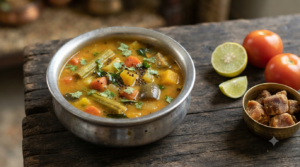
A tamarind-free sambar finished with lime juice, tomato and a mustard-seed tempering.
Sambar Recipe Without Tamarind at a Glance
- Total time: about 45 minutes, because the dal and the vegetables cook side by side.
- Serves: 4 generous bowls with rice, or 5 smaller portions with idli.
- Souring agent: fresh lime juice, ripe tomato, or raw mango when it is in season.
- Key check: read your sambar powder label first, since several popular blends already contain tamarind.
- Texture: pourable, not thick, so it soaks into rice instead of sitting on top.
- Best for: reflux-prone eaters, small children, and anyone cooking abroad where tamarind is hard to find.
One line worth remembering: sambar does not need tamarind, but it absolutely needs sourness, and the two are not the same thing.
Why Cooks Skip Tamarind in the First Place
Tamarind carries tartaric acid, which is what gives it that sharp, almost puckering edge. That edge is exactly why some people avoid it. Anyone managing acid reflux or a sensitive stomach often finds the tamarind version uncomfortable after a heavy lunch.
Then there is availability. Cooks living outside India frequently report that good wet tamarind is expensive or stale by the time it reaches the shelf. Households with young children also tone the sourness down, since kids usually prefer a milder, rounder taste.
Some kitchens keep a sambar recipe without tamarind for ritual reasons too. Certain festival and vratam meals leave out tamarind, chilli, or asafoetida entirely, so a tamarind-free method becomes the everyday default rather than a compromise.
If you avoid tamarind because of a diagnosed condition such as reflux, kidney stones, or a food allergy, treat this as a cooking swap and not as treatment. Talk to your doctor or a registered dietitian about the wider diet.
Check Your Sambar Powder Before You Start
Here is the correction that most tamarind-free recipes miss completely. Several popular ready-made blends already contain tamarind, so a cook who carefully leaves tamarind out of the pot still ends up eating it.
The distinction sits between two different products that look almost identical on the shelf. Sambar powder is usually a roasted spice blend of coriander, chilli, fenugreek, cumin, turmeric, and asafoetida. Sambar mix, on the other hand, is a near-complete base, and tamarind is often built into it.
- MTR Sambar Mix lists tamarind concentrate or tamarind powder among its main ingredients, alongside red gram dal, salt, and sugar.
- Everest Sambhar Masala also names tamarind directly in its ingredient list.
- Plain MTR Sambar Powder, by contrast, is sold as a tamarind-free masala so you can add sourness yourself.
So turn the packet over before you cook a sambar recipe without tamarind. If the ingredient list mentions tamarind, imli, or tartaric acid, that blend is not suitable for a genuinely tamarind-free bowl. Choose a plain masala instead, or use a homemade powder where you control every spice.
While you are reading labels, check the asafoetida too. Most compounded hing sold in Indian shops uses wheat flour as a carrier, which matters if anyone at the table avoids gluten. Rice-flour versions exist and say so clearly on the pack. India’s Food Safety and Standards Authority of India (FSSAI) requires packaged foods to declare such ingredients, so the information is there if you look.
Souring Agents That Replace Tamarind
Any good sambar recipe without tamarind has to replace two jobs at once, because tamarind does both. It adds acidity, and it adds a dark, fruity depth. No single substitute covers both, which is why the best results come from pairing an acid with something fruity.
| Souring agent | Amount for 4 servings | When to add | Character |
|---|---|---|---|
| Fresh lime juice | 1 tbsp | Off the heat, at the very end | Bright, clean, fades fast |
| Ripe tomato | 2 medium, chopped | With the vegetables | Mild, fruity, adds body |
| Raw mango | 1 inch piece, peeled | With the vegetables | Sharp and seasonal, closest to tamarind |
| Kokum | 2 to 3 petals | Last 10 minutes of simmering | Deep, dusky, slightly smoky |
| Amchur powder | 1 tsp | Last 5 minutes | Dry tang, no extra liquid |
| Thick curd | Half cup, whisked | Off the heat only | Creamy and gentle, splits if boiled |
A widely repeated claim online says tomato alone replaces tamarind. It does not, because tomato is far milder and mostly water. Use tomato for depth, then finish with lime for the actual tang, and the bowl tastes complete.
Ingredients for This Sambar Recipe Without Tamarind
- Toor dal (split pigeon peas): 1 cup, about 200 g
- Water: 4 cups in total, for cooking and for the gravy
- Mixed vegetables (drumstick, carrot, pumpkin, brinjal): 2 cups, about 300 g
- Ripe tomatoes: 2 medium, chopped
- Onion: 1 medium, sliced
- Green chilli: 1, slit lengthwise
- Sambar powder: 2 tbsp, tamarind-free (check the label)
- Turmeric powder: half tsp
- Asafoetida: quarter tsp
- Salt: 1.5 tsp, adjusted to taste
- Oil: 2 tbsp, groundnut or coconut
- Mustard seeds: 1 tsp
- Cumin seeds: half tsp
- Dried red chilli: 1, broken
- Curry leaves: 10 to 12
- Fresh lime juice: 1 tbsp
- Jaggery: 1 tsp, optional but recommended
- Coriander leaves: 2 tbsp, chopped
How to Make Sambar Recipe Without Tamarind Step by Step
Step 1: Cook the dal until it collapses
Rinse the toor dal until the water runs clear, because that starch is what makes sambar cloudy. Pressure cook it with 2.5 cups water, the turmeric, and a few drops of oil. Four whistles on medium heat is usually enough, so check after that and mash it smooth with a ladle.
Step 2: Soften the vegetables separately
While the dal cooks, heat 1 tbsp oil in a wide pan and add the onion with the green chilli. After two minutes, add the harder vegetables such as carrot and drumstick. Pour in 1.5 cups water, add half the salt, then cover and cook for eight to ten minutes.
Step 3: Add the tomatoes and the masala
Stir in the chopped tomatoes once the vegetables are almost tender. Cook them until they break down completely, since half-cooked tomato tastes raw and thin. Now add the sambar powder and asafoetida, and mix well so no lumps survive.
Step 4: Bring the dal and vegetables together
Pour the mashed dal into the pan and stir until the mixture looks uniform. Add water to reach a pourable consistency, because sambar should flow rather than sit. Let it simmer gently for five minutes so the spices bloom into the dal.
Step 5: Temper, then finish off the heat
Heat the remaining oil in a small pan and add mustard seeds. When they pop, add cumin, the broken red chilli, and curry leaves, then pour the whole tempering over the sambar. Switch off the flame, stir in the jaggery and the lime juice, and garnish with coriander leaves.
The Lime Juice Mistake Most Recipes Repeat
Plenty of published recipes tell you to add lime juice and then simmer for another five minutes. That instruction quietly ruins the dish. Prolonged boiling drives off the fresh top notes of citrus and leaves a flat, faintly bitter edge behind.
Add lime juice only after the flame is off, and taste before you add more. Curd behaves the same way, although the failure is more dramatic, because boiled curd splits into grainy curdles almost immediately.
Tomato, raw mango, kokum, and amchur are the opposite. They all need heat and time to release their sourness, so they go in while the sambar is still cooking.
Pressure Cooker or Open Pot: Which Works Better
A pressure cooker wins on speed, and it handles tough vegetables like drumstick well. One-pot cooker methods do exist, where dal and vegetables go in together, but the vegetables usually turn to mush by the time the dal is soft.
An open pot gives you far better control over texture. You can pull the pumpkin out while it still holds its shape, which matters when the sambar goes with rice rather than idli. The trade-off is roughly fifteen extra minutes.
The method in this sambar recipe without tamarind splits the difference deliberately. The dal goes in the cooker, while the vegetables cook in a pan, so nothing overcooks and the total time stays under an hour.
Troubleshooting a Sambar Recipe Without Tamarind
Tamarind-free sambar fails in predictable ways, and each problem has a specific fix rather than a vague suggestion to add more spice.
- Tastes flat or bland: the sourness is missing, so add lime juice off the heat, half a teaspoon at a time.
- Tastes sour but hollow: add a teaspoon of jaggery, because sweetness gives sourness something to push against.
- Faintly bitter: you either boiled the lime juice or burnt the fenugreek in the powder, so next time add citrus last.
- Too thin: simmer uncovered for a few minutes, or mash in a few extra spoons of cooked dal.
- Too thick after cooling: this is normal, since dal keeps absorbing water, so loosen it with hot water while reheating.
- Dal refuses to soften: old stock or hard water is usually the culprit, although a pinch of turmeric and a few extra whistles will rescue most batches.
Salt late rather than early when you are unsure. Sambar reduces as it sits, so a bowl seasoned perfectly at the stove can taste salty an hour later.
Three Variations Worth Trying
Tiffin sambar for idli and dosa
Use half the vegetables and add a tablespoon of moong dal to the toor dal. Keep it looser and slightly sweeter, because this style is meant to be scooped rather than mixed into rice.
No onion, no garlic version
Skip the onion entirely and lean harder on asafoetida in the tempering. Shallots normally carry the sweetness, so add an extra half teaspoon of jaggery to compensate. Our sambar recipe without onion and garlic covers this style in detail.
Curd or buttermilk sambar
Whisk half a cup of thick curd with a little water and stir it in after the flame is off. The result is gentle and creamy, and it suits anyone who finds both tamarind and lime too sharp.
For a single-vegetable version, the drumstick sambar method works beautifully with lime instead of tamarind. If coconut is the ingredient you need to avoid, the sambar recipe without coconut follows the same logic.
Storage, Reheating and Meal Prep
A cooked sambar recipe without tamarind keeps for three days in an airtight container in the refrigerator. Reheat it on the stovetop with a splash of hot water, since the dal thickens considerably overnight.
Freezing works for up to a month, although the vegetables soften noticeably after thawing. Freeze the dal base alone if texture matters to you, then cook fresh vegetables on the day.
One practical note for weekday cooking: refresh the sourness after reheating. Lime juice fades in storage, so a small squeeze before serving brings a two-day-old bowl back to life.
Nutrition Per Serving
The figures below are estimates for one of four servings, and they shift with your oil, vegetables, and portion size. Toor dal does the nutritional heavy lifting here.
| Nutrient | Per serving (approximate) |
|---|---|
| Calories | 150 to 180 kcal |
| Protein | 6 to 8 g |
| Carbohydrates | 18 to 25 g |
| Fat | 4 to 6 g |
| Fibre | 4 to 5 g |
For context, USDA FoodData Central records boiled pigeon peas at roughly 121 kcal, 6.8 g protein, and 6.7 g fibre per 100 g. Pairing lentils with rice also improves the overall protein quality, a point the Harvard T.H. Chan School of Public Health Nutrition Source makes about legumes generally.
What Beginners Get Wrong With Tamarind-Free Sambar
The most common mistake is treating a sambar recipe without tamarind as sambar with something missing. Cooks compensate by doubling the sambar powder, which makes the bowl harsh rather than tangy.
The second mistake is skipping jaggery. That single teaspoon is not there to sweeten anything, since its real job is rounding off the acid so the sourness reads as depth instead of a spike.
Third, many people under-cook the tomato. Tomato needs to break down fully, otherwise it floats as raw pieces and contributes almost nothing.
Finally, do not pour the tempering in early. The tadka loses its aroma within minutes of hitting liquid, so it belongs at the finish line rather than the starting block.
Before You Cook
A good sambar recipe without tamarind is not a diluted version of the original. It is a rebalanced one, where lime provides the tang, tomato provides the body, and jaggery holds the two together. Read your masala label first, add the acid off the heat, and taste before the last spoon of salt. Do that, and nobody at your table will ask where the tamarind went.
Sambar Recipe Without Tamarind: FAQs
Can I make sambar without tamarind and without lime?
Yes. Use raw mango, kokum, or amchur powder instead, all of which go in during cooking rather than at the end. Two chopped ripe tomatoes plus a teaspoon of amchur is the most reliable combination when no fresh citrus is available.
Does sambar powder already contain tamarind?
Sometimes, and this catches many cooks out. Instant sambar mixes such as MTR Sambar Mix list tamarind concentrate, and Everest Sambhar Masala names tamarind in its ingredients. Plain sambar masala powders usually leave it out, so always read the packet.
Is this sambar recipe without tamarind good for acid reflux?
A sambar recipe without tamarind is generally gentler, because tamarind is one of the sharper acids in Indian cooking. Tomato and lime are still acidic though, so kokum or curd suits sensitive stomachs better. Anyone managing a diagnosed condition should follow their doctor’s dietary advice.
What can I use instead of tomato as well?
Raw mango is the closest single replacement, since it supplies both sourness and fruitiness. Kokum works too, although it tints the sambar a darker shade. Whisked curd added off the heat is the mildest option of the three.
Will this taste like restaurant sambar?
Close, but not identical to a tamarind version. A restaurant-style sambar recipe without tamarind can get very near it. Tiffin sambar in hotels leans on shallots, extra jaggery, and a heavier tempering rather than tamarind alone. Add a handful of small onions and a little more jaggery if that is the flavour you want.
Can I make it in one pot in a pressure cooker?
You can, although the vegetables will be softer. Add the dal, vegetables, tomato, and turmeric together with three cups of water and cook for four whistles. Stir in the masala afterwards, then temper and finish with lime off the heat.
How much lime juice replaces one lemon-sized ball of tamarind?
Roughly one tablespoon of fresh lime juice matches a small lemon-sized ball of tamarind in acidity. Start with less, taste, then add more, because lime cannot be removed once it goes in.
Is this recipe gluten free and vegan?
It is vegan as written, since no dairy appears unless you choose the curd variation. Gluten depends entirely on your asafoetida, because most compounded hing uses wheat flour as a carrier. Choose a rice-flour or pure resin version if that matters.
Which vegetables work best in tamarind-free sambar?
Drumstick, pumpkin, carrot, and brinjal all hold up well and add natural sweetness. Avoid watery vegetables such as bottle gourd in large quantities, since they dilute an already milder gravy.