Bisibelebath Powder Recipe Karnataka: Homemade Masala
Bisibelebath Powder Recipe Karnataka is a homemade spice blend for the classic Karnataka rice-and-lentil dish, and the best results come from slow roasting each group of spices without burning them. This refreshed version keeps the original Bhimas Cook spice profile but focuses only on the powder, so you can make a dependable batch without wading through a second full meal recipe.
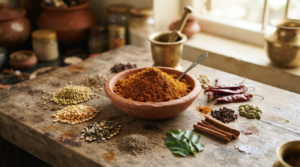
Freshly roasted Karnataka-style spices ground into aromatic homemade Bisibelebath powder.
The blend is warmer and more layered than ordinary sambar powder because it combines coriander, roasted dals, chillies, cumin, fenugreek, whole spices, curry leaves and optional dry coconut. Byadagi chillies are especially useful because they give strong red colour with moderate heat; the Spices Board of India lists Byadagi as a Karnataka chilli variety and a GI-registered spice.
Bisibelebath Powder Recipe Karnataka: Quick Summary
- Prep time: about 10 minutes.
- Roasting time: about 18 to 22 minutes on low heat.
- Cooling time: 15 to 20 minutes before grinding.
- Yield: about 2 cups, depending on chilli size and grinding fineness.
- Best use: start with 2 to 3 tablespoons for a 4-serving pot, then adjust to taste.
- Storage: use a clean, completely dry airtight jar and keep moisture away from the powder.
The most important rule is simple: roast for aroma and colour, not darkness. If coriander, dal, fenugreek or coconut scorches, the finished masala can taste bitter even after you add tamarind and jaggery.
Bisibelebath Powder Recipe Karnataka Ingredients
This Bisibelebath Powder Recipe Karnataka makes a family-size batch, so it suits cooks who prepare Bisi Bele Bath more than once. If you cook the dish rarely, halve every ingredient because fresher masala usually tastes better than a large jar kept for months.
| Ingredient | Quantity | Purpose in the blend |
|---|---|---|
| Coriander seeds | 3/4 cup | Body, citrusy aroma and the main masala base |
| Chana dal | 1/4 cup | Roasted nutty depth and body |
| Urad dal | 2 tablespoons | Toasty aroma and rounded flavour |
| Cumin seeds | 2 tablespoons | Earthy warmth |
| Fenugreek seeds | 1/2 teaspoon | Light bitterness that balances tamarind and jaggery |
| Sesame seeds | 2 tablespoons | Nutty richness; optional if avoiding sesame |
| Poppy seeds | 2 tablespoons | Traditional-style richness; optional |
| Byadagi dry red chillies | 10 to 12 | Colour and mild-to-medium chilli flavour |
| Guntur dry red chillies | 4 to 8 | Extra heat; reduce or omit for a milder powder |
| Cinnamon | 1 1/2-inch piece | Sweet woody warmth |
| Green cardamom | 6 pods | Sweet fragrance |
| Cloves | 5 | Sharp aromatic warmth |
| Black pepper | 1/2 teaspoon | Background heat |
| Curry leaves | 12 to 14 | South Indian aroma; roast until fully crisp |
| Asafoetida | 1/4 teaspoon | Savoury aroma |
| Dry coconut or desiccated coconut | 1/2 cup | Optional richness and roasted aroma |
Use fresh, dry spices because moisture shortens storage quality. The Food Safety and Standards Authority of India also stresses dry, well-ventilated storage for spices because excess moisture can encourage mould growth.
Why Byadagi Chilli Works So Well
For Bisibelebath Powder Recipe Karnataka, Byadagi chilli is a strong choice when you want deep red colour without aggressive heat. The Spices Board of India identifies Byadagi chilli with Karnataka and notes its high-colour, lower-pungency character.
You can still combine it with Guntur chilli when you want more heat. That combination lets you control colour and pungency separately, which is more useful than relying on one very hot chilli for both jobs.
Can Kashmiri chilli replace Byadagi chilli?
Yes, Kashmiri chilli can replace Byadagi chilli when the Karnataka variety is unavailable. It gives good colour and generally moderate heat, although the aroma will not be exactly the same. Avoid using only a very hot chilli unless you deliberately want a fiery powder.
Bisibelebath Powder Recipe Karnataka: Roasting Order
Bisibelebath Powder Recipe Karnataka works best when ingredients with similar roasting times go into the pan together. Roasting everything at once is faster, but it creates a common problem: small spices and coconut darken before coriander seeds and dals become aromatic.
- Heat the pan gently. Place a heavy kadai or skillet over low heat. Do not add oil because this is a dry-roasted spice powder.
- Roast the sturdy base ingredients. Add coriander seeds, chana dal, urad dal, cumin and fenugreek. Stir continuously until the dals look lightly golden and the coriander smells fragrant.
- Add sesame and poppy seeds. Roast briefly because these small seeds can colour quickly. Remove the mixture if the sesame starts popping hard or turning dark.
- Roast the whole spices. Add cinnamon, cardamom, cloves and black pepper. Heat them only until their aroma becomes clear.
- Crisp the chillies and curry leaves. Roast the dry chillies and curry leaves on low heat. The leaves should feel crisp and dry before grinding.
- Roast coconut separately. If using dry coconut, keep it for the end. Stir constantly until pale golden, then move it out of the hot pan immediately.
- Cool completely. Spread everything on a wide plate and wait until no warmth remains. Warm spices can create condensation inside the grinder jar.
- Grind with asafoetida. Pulse the cooled mixture until you get a fine, even powder. Let the ground masala cool again before sealing the jar.
How dark should the spices become?
Aim for light golden dals, fragrant coriander and crisp chillies rather than deep browning. Fenugreek and coconut turn bitter when over-roasted, so colour is not the goal. If you smell a sharp burnt note, stop and remove that batch before grinding.
Bisibelebath Powder Recipe Karnataka: Small-Batch Version
For Bisibelebath Powder Recipe Karnataka, a smaller batch gives you fresher aroma if you cook Bisi Bele Bath only occasionally. Use one-third of the main quantities: 1/4 cup coriander, about 4 teaspoons chana dal, 2 teaspoons urad dal and 2 teaspoons cumin, then scale the remaining spices in the same proportion.
Exact chilli count can vary because dried chillies differ greatly in size and heat. Start lower if you are unsure, since you can add chilli powder while cooking but cannot remove excess heat from the finished masala.
Bisibelebath Powder Recipe Karnataka: Grinding Tips
In Bisibelebath Powder Recipe Karnataka, let every roasted ingredient cool completely because trapped heat can create moisture and dull the aroma. Use short pulses instead of running a small mixer continuously, especially when the jar becomes warm.
Grind until the powder is fine enough to disappear into the rice-and-dal mixture. A slightly coarse homemade texture is fine, but large cinnamon shards or whole chilli flakes should not remain.
Should the powder be sieved?
Sieving is optional. If your mixer leaves hard spice pieces, pass the powder through a medium sieve and regrind the coarse bits. Otherwise, repeated sieving can remove flavourful particles and is unnecessary for everyday Bisi Bele Bath.
Bisibelebath Powder Recipe Karnataka: How Much to Use
Start with 2 to 3 tablespoons of this homemade powder for a pot serving about four people. Then taste the tamarind-and-dal base before adding more because chilli strength, tamarind sourness and vegetable quantity all change the final balance.
For the complete rice, dal, vegetable and tempering method, use the separate Karnataka-style Bisibelebath recipe. If you need a faster weekday route, compare it with the site’s Bisi Bele Bath recipe using readymade powder.
Can you use this powder like sambar powder?
Not as a direct one-for-one substitute. Bisi Bele Bath powder contains a different balance of roasted dals, whole spices and chilli, while many sambar powders lean more heavily on coriander and chilli. Substituting one for the other changes the dish noticeably.
Bisibelebath Powder Recipe Karnataka: Storage Guide
Bisibelebath Powder Recipe Karnataka should go into a clean, fully dry airtight jar only after the ground masala has cooled. Keep the spoon dry as well, since repeated moisture exposure is a bigger storage problem than ordinary room temperature.
If your batch contains dry coconut, make a smaller quantity and use it sooner because coconut contains fat that can turn stale or rancid. For longer keeping, refrigerate the sealed jar and bring out only the amount you need.
The FSSAI guidance for spices emphasizes dry storage conditions and moisture control. At home, discard the powder if you notice mould, damp clumps, an off smell or a rancid coconut aroma.
Can I store the powder for two months?
You may retain acceptable aroma for several weeks when the ingredients were dry and the jar stays tightly sealed. However, there is no single safe flavour deadline for every homemade batch because coconut, humidity and handling vary. Make smaller batches when possible and judge freshness by aroma, dryness and condition.
Bisibelebath Powder Recipe Karnataka: Adjusting the Heat
In Bisibelebath Powder Recipe Karnataka, the easiest heat control is the ratio of Byadagi to hotter chillies. Keep Byadagi for colour, then raise or lower the Guntur chilli count for heat. This approach protects the masala’s colour even when you reduce pungency.
- Mild: use 10 to 12 Byadagi chillies and omit the hotter chillies.
- Medium: use 10 to 12 Byadagi chillies plus 4 Guntur chillies.
- Hot: use 10 to 12 Byadagi chillies plus 6 to 8 Guntur chillies.
Chilli heat varies by crop and storage, so these levels are only practical starting points. If you are cooking for children or spice-sensitive guests, choose the mild batch and adjust heat in the final dish.
Optional Ingredients and Useful Substitutions
There is no single household formula for Bisi Bele Bath powder across Karnataka, so small variations are normal. Some cooks include Marathi moggu, while others use poppy seeds, sesame or dry coconut. Those differences create family-style character rather than making one version automatically “wrong.”
- No poppy seeds: omit them without replacing.
- No sesame: omit it if there is an allergy or preference concern.
- No dry coconut: leave it out for a leaner spice blend and simpler storage.
- No Byadagi chilli: use Kashmiri chilli for a similar colour-first role.
- Want more traditional perfume: add 1 or 2 Marathi moggu and roast them with the whole spices.
- Gluten-free cooking: check the asafoetida label because some compounded hing products use wheat-based carriers.
Bisibelebath Powder Recipe Karnataka: Mistakes to Avoid
Most Bisibelebath Powder Recipe Karnataka failures happen during roasting, cooling or storage rather than grinding. Fixing those three stages gives you a more reliable masala than simply adding more spices.
- Using high heat. The outside of the dal browns before the centre develops aroma, while fenugreek can become bitter.
- Roasting coconut with everything else. Coconut colours faster, so roast it separately and remove it promptly.
- Grinding warm spices. Heat can trap moisture and mute fresh aromas inside the grinder jar.
- Using soft curry leaves. Roast until crisp, since residual moisture works against storage quality.
- Storing in a damp jar. Even a good batch loses quality quickly when moisture enters.
- Making the chilli level too high initially. It is easier to add heat while cooking than to rescue an overly hot masala.
Why This Powder Tastes Different From Store-Bought Masala
Fresh grinding preserves volatile spice aromas that fade after long storage, while home roasting lets you stop before bitterness develops. You can also control chilli heat, coconut and optional spices instead of accepting one fixed commercial profile.
Store-bought powder still has a useful place because it is consistent and quick. Homemade powder makes the most sense when you want a distinct roasted aroma or need control over heat, sesame, coconut and other optional ingredients.
Before You Make the Next Batch
Keep the recipe simple: dry spices, low heat, complete cooling and a dry jar. Those four steps matter more than chasing an exact “restaurant secret” ingredient list. The powder should smell roasted, warm and chilli-forward without any burnt or stale note.
If your first batch feels too hot, change only the hotter chilli next time rather than cutting every spice. If it tastes flat, check spice freshness and roasting before increasing quantities.
Frequently Asked Questions
What is Bisibelebath powder made of?
Bisibelebath powder usually combines coriander seeds, roasted dals, dry red chillies, cumin, fenugreek and warm whole spices. Many Karnataka-style versions also include curry leaves, poppy seeds, sesame or dry coconut. The exact household ratio can vary.
Is Bisibelebath powder the same as sambar powder?
No. The two blends overlap in some spices, but Bisi Bele Bath powder usually has a distinct roasted-dal and whole-spice profile. Using sambar powder changes the characteristic aroma, so it is better as an emergency substitute than a direct equivalent.
Which chilli is best for Karnataka-style Bisibelebath powder?
Byadagi chilli is an excellent base because it gives deep colour with moderate heat. You can pair it with a hotter chilli, such as Guntur, when you want more pungency. Kashmiri chilli is a practical substitute when Byadagi is unavailable.
Do I need Marathi moggu?
No, Marathi moggu is optional. It adds a distinctive warm, woody aroma, so some Karnataka households value it highly. However, you can still make a balanced and recognisable Bisi Bele Bath powder without it.
Can I skip coconut in Bisibelebath powder?
Yes. Dry coconut adds richness and roasted sweetness, but the powder still works without it. Skipping coconut also makes it easier to prepare a batch intended for longer storage.
How much Bisibelebath powder should I add to four servings?
Start with 2 to 3 tablespoons, then taste and adjust. The correct amount depends on chilli strength, tamarind, vegetables and how concentrated your homemade batch is, so adding the full amount at once is less reliable.
Why did my homemade powder turn bitter?
Over-roasted fenugreek, dal, chillies or coconut are the most common causes. High heat can brown small ingredients before the larger ones become fragrant. Roast on low heat and remove each group once it smells aromatic.
Should I refrigerate homemade Bisibelebath powder?
Refrigeration is useful, especially when the blend contains dry coconut or your kitchen is humid. Keep the powder in a dry, airtight jar and avoid introducing moisture with a wet spoon. Discard it if you notice mould, dampness or rancid odour.