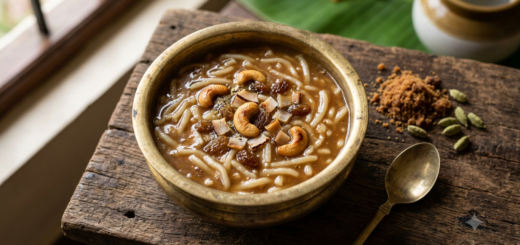
Moong Dal Payasam With Sabudana: Easy Jaggery Recipe
Moong dal payasam with sabudana is a creamy South Indian dessert made with roasted yellow moong, soft sago pearls, jaggery and coconut milk. The best version keeps the dal soft but not gluey, cooks the sabudana until translucent, and adds thick coconut milk only near the end. This method also avoids the common problem of hot jaggery splitting dairy milk.
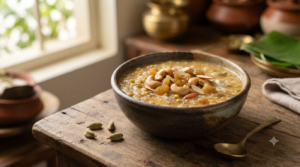
Creamy moong dal payasam with sabudana, jaggery and coconut milk, finished with ghee-roasted cashews and raisins.
For moong dal payasam with sabudana, the recipe below uses coconut milk as the main liquid because it works naturally with jaggery. You can still make a dairy version, but use sugar instead of jaggery for the most reliable result. The soaking and cooking times are guides, since sabudana size and brand can change how quickly the pearls soften.
Moong Dal Payasam With Sabudana at a Glance
This version balances three textures: creamy moong dal, chewy-soft sabudana and a pourable coconut-jaggery base. The key is to cook the dal and sago separately first, because they soften at different rates. Once both are ready, they come together quickly without turning the payasam into a thick paste.
- Prep time: about 35 minutes, including a 30-minute sabudana soak
- Cook time: about 30 to 35 minutes
- Total time: about 65 to 70 minutes
- Serves: 6 small dessert portions
- Sweetener: jaggery
- Milk base: coconut milk
- Best texture: soft dal with distinct, translucent sago pearls
A comparable professional payasam formula from Nestlé Professional India also pairs moong dal, tapioca, jaggery and coconut milk. That combination is useful because coconut milk handles jaggery more predictably than hot dairy milk.
Ingredients for Moong Dal Payasam With Sabudana
The ingredient ratio in moong dal payasam with sabudana matters because too much sago can overwhelm the dal. Use split yellow moong dal, also called husked mung dal. Small or medium sabudana works best because it cooks quickly and gives a pleasant pearl-like bite. If your sabudana is very large, allow more soaking time and rely on the softness test rather than the clock.
| Ingredient | Quantity | Why it is used |
|---|---|---|
| Yellow moong dal | 1/2 cup | Gives body and a nutty base |
| Sabudana | 1/4 cup | Adds soft, translucent pearls |
| Water | About 3 cups, divided | For cooking dal, sago and jaggery |
| Grated jaggery | 3/4 to 1 cup | Sweetens the payasam |
| Coconut milk | 1 1/2 cups | Adds richness without dairy curdling risk |
| Ghee | 2 tablespoons | Roasts the garnish and adds aroma |
| Cashews | 10 to 12 | Add crunch |
| Raisins | 1 tablespoon | Add sweetness and contrast |
| Cardamom powder | 1/2 teaspoon | Finishes the aroma |
| Salt | 1 small pinch | Balances the sweetness |
If you use fresh coconut milk, keep the thick first extract for the end. Use a thinner second extract during the simmer. If you use canned coconut milk, dilute about 1 cup with a little warm water for the simmer, then reserve the remaining 1/2 cup for the finish.
How to Make Moong Dal Payasam With Sabudana
For moong dal payasam with sabudana, the easiest way to control the texture is to cook the dal and sabudana separately. Moong dal needs enough time to turn soft, while sabudana can become gummy if it cooks too long. Separate cooking gives you a clear stopping point for each ingredient.
Cook the Dal and Sabudana Separately
- Soak the sabudana. Rinse 1/4 cup sabudana two or three times until the water looks mostly clear. Soak it in about 3/4 cup water for 30 minutes. Press one pearl between your fingers; it should flatten with light pressure. If the centre is still hard, soak longer.
- Roast the moong dal. Add 1/2 cup dry yellow moong dal to a heavy pan. Roast over low to medium heat for 3 to 4 minutes, stirring often, until it smells nutty and looks slightly deeper in colour. Cool for a minute, then rinse quickly.
- Cook the dal. Pressure cook the roasted, rinsed dal with 1 1/2 cups water for about 2 whistles, then let the pressure settle naturally. For stovetop cooking, simmer covered until the dal is soft, usually 20 to 25 minutes. Mash only a few spoonfuls so some texture remains.
- Cook the sabudana. Transfer the soaked sabudana and its remaining water to a saucepan. Add up to 1/2 cup extra water if needed. Cook over medium-low heat for 8 to 12 minutes, stirring often, until the pearls look mostly translucent and feel soft.
- Make the jaggery syrup. Heat 3/4 to 1 cup grated jaggery with 1/4 cup water just until dissolved. Strain the syrup if your jaggery contains grit. Do not boil it for a long time, because a concentrated syrup can make the finished payasam sticky.
Sweeten and Finish the Payasam
Once both components are tender, moong dal payasam with sabudana comes together quickly. Keep the heat gentle from this point because the mixture is already starchy and can catch on the base.
- Combine the base. Put the cooked dal and sabudana in a heavy pan. Add about 1 cup diluted or thin coconut milk and mix well. Simmer gently for 3 to 4 minutes, adding hot water if the mixture looks too thick.
- Add jaggery. Pour in the strained jaggery syrup and stir over low heat for 2 to 3 minutes. Add a pinch of salt. Taste and add a little more jaggery only if needed.
- Finish with thick coconut milk. Lower the heat completely or switch it off. Stir in the reserved 1/2 cup thick coconut milk and cardamom. Avoid a hard boil after this point because high heat can dull the fresh coconut flavour.
- Temper the nuts. Heat ghee in a small pan. Fry the cashews until golden, then add raisins and cook until they puff. Pour everything over the payasam and stir once.
- Rest before serving. Leave the payasam covered for 5 to 10 minutes. It will thicken as the dal and sabudana absorb more liquid, so keep it slightly looser than your final target while it is hot.
Why Jaggery and Hot Dairy Milk Can Split
Milk proteins become less stable when acid is added, especially while the milk is hot. India’s Department of Science and Technology explains that lowering milk’s pH makes casein proteins clump, and warmer temperatures speed that process. Jaggery can contain mild acids and minerals, so adding it to boiling dairy milk may cause curdling.
That is why this refreshed recipe uses coconut milk with jaggery. If you prefer a dairy payasam, use regular sugar for the simplest result. Another option is to cool both the jaggery syrup and milk mixture before combining them off the heat, although the result can still vary with the jaggery.
For a dairy-based alternative on Bhimas Cook, see the pal payasam recipe. For a closer moong-dal variation, the site also has moong dal payasam with coconut milk and a separate moong dal payasam with jaggery.
Moong Dal Payasam With Sabudana: Common Problems and Fixes
Most failures in moong dal payasam with sabudana come from texture, not flavour. Sabudana needs enough soaking and frequent stirring, while moong dal needs enough water to soften without turning dry. The payasam also thickens after cooking, so the hot consistency should be more fluid than the bowl you plan to serve.
| Problem | Likely cause | Fix |
|---|---|---|
| Sabudana has a hard centre | Not soaked or cooked long enough | Add hot water and simmer gently until the centre softens |
| Sabudana forms lumps | Too little water or not enough stirring | Loosen with hot water and separate clumps gently with a spoon |
| Payasam is too thick | Dal and sago absorbed liquid while resting | Add warm water or thin coconut milk a little at a time |
| Payasam tastes flat | Not enough salt, cardamom or jaggery | Add a tiny pinch of salt first, then adjust sweetness |
| Coconut milk looks oily | Boiled too hard after adding thick coconut milk | Use low heat and add the thick portion at the end |
| Dairy milk curdled | Hot milk met jaggery | Use coconut milk with jaggery, or use sugar with dairy milk |
Moong Dal Payasam With Sabudana: How to Judge Doneness
In moong dal payasam with sabudana, sabudana varies by pearl size and processing, so a fixed soaking time is not always reliable. After 30 minutes, press a soaked pearl between your thumb and finger. It should flatten without a chalky, hard centre. If it cracks rather than softens, give it more time.
During cooking, the pearls should turn translucent around the edges and become tender through the middle. A tiny white dot can remain until the final minutes. Stir often because starch released from the surface can make the bottom catch quickly.
Do not chase perfect glass-like transparency if the pearls are already soft. Overcooking can break them down and make the payasam pasty. Texture matters more than appearance here.
Best Consistency: Thick Enough to Coat a Spoon, Loose Enough to Pour
Moong dal payasam with sabudana should look slightly thinner while hot than you want to serve. Both cooked moong dal and sabudana continue absorbing liquid as the dessert cools. A batch that looks perfect on the stove can become very thick 20 minutes later.
If that happens, add warm water or thin coconut milk in small amounts. Stir gently and stop once the payasam pours easily from a ladle. Avoid adding a large splash at once because it can dilute the sweetness and cardamom flavour.
For chilled payasam, make it even looser before refrigeration. After chilling, stir well and adjust with a little coconut milk before serving.
Variations That Keep the Recipe Reliable
You can change moong dal payasam with sabudana without changing the basic cooking order. Keep the dal and sabudana cooking steps the same, then adjust the sweetener or finishing milk. That way, you change one variable at a time and avoid texture surprises.
- Vegan version: The coconut-milk base is already dairy-free. Replace ghee with coconut oil or a neutral oil.
- Dairy version: Use whole milk, but sweeten with sugar instead of jaggery for a lower curdling risk.
- More coconut flavour: Add 2 tablespoons lightly toasted coconut pieces with the cashews.
- Thinner payasam: Increase warm water or thin coconut milk after the final rest.
- Less sweet: Start with 3/4 cup jaggery. Taste after it dissolves, then add more only if needed.
- More sabudana texture: Increase sabudana to 1/3 cup, but add extra cooking water and expect a thicker final dessert.
Moong Dal Payasam With Sabudana Storage and Reheating
Cool leftovers promptly and refrigerate them in a covered container. The U.S. Department of Agriculture advises using most cooked leftovers within 3 to 4 days, although moong dal payasam with sabudana is best in texture during the first 2 to 3 days. Do not leave a dairy or coconut-based dessert sitting at room temperature for long periods.
Reheat only the portion you plan to serve. Warm it over low heat, then loosen it with water or coconut milk because chilled sabudana and dal become much thicker. Stir from the bottom so the starch does not stick.
Freezing is not ideal for this recipe. Sabudana can become soft and uneven after thawing, while coconut milk may separate. Refrigeration gives a better texture.
What the Old Method Got Wrong
The earlier version used whole dairy milk, jaggery and coconut milk in the same hot pot. It also suggested adding jaggery syrup directly while the milk mixture was simmering. That method can work sometimes, but it carries an avoidable curdling risk.
The refreshed method separates the jobs more clearly. Dal supplies the creamy body, sabudana supplies the soft pearls, jaggery sweetens the cooked base, and thick coconut milk finishes the dessert without a hard boil. The result is easier to repeat because each ingredient has a clear stopping point.
The old nutrition table has also been removed because it was described as an estimate based on similar recipes rather than this exact formula. For a home recipe, an unsupported precise calorie figure can look more certain than it really is.
Before You Serve
For the best bowl of moong dal payasam with sabudana, taste only after the jaggery and coconut milk are fully mixed. Check sweetness first, then add a tiny pinch of salt if the flavour seems dull. Finally, adjust the thickness because that is the detail most likely to change while the payasam rests.
Serve it warm for the strongest roasted-dal and cardamom aroma. Serve it chilled if you prefer a thicker pudding-like texture. Either way, keep a little coconut milk nearby so you can loosen each bowl just before serving.
Frequently Asked Questions
Can I make moong dal payasam with sabudana ahead of time?
Yes. You can make it several hours ahead and refrigerate it after cooling. It will thicken as it rests, so stir in a little coconut milk or warm water before serving. For the best texture, make it the same day or the day before.
Do I need to soak sabudana before making payasam?
Yes, soaking gives the most even texture. Start with 30 minutes for small pearls, then press one between your fingers. If the centre is still hard, continue soaking until the pearl flattens easily.
Can I pressure cook moong dal and sabudana together?
You can, but the texture is harder to control because sabudana may turn mushy before the dal reaches the softness you want. Cooking them separately is more reliable, especially for beginners. Combine them only after both are tender.
Why does my sabudana payasam become very thick after cooling?
Both sabudana and moong dal keep absorbing liquid after cooking. That is normal. Keep the hot payasam a little loose, then add warm water or coconut milk later until it returns to a pourable consistency.
Can I use sugar instead of jaggery?
Yes. Sugar works well and is especially useful if you want to make the recipe with dairy milk. Add it after the dal and sabudana are cooked, then simmer briefly until the sugar dissolves.
Can I use dairy milk instead of coconut milk?
Yes, but sugar is the easier sweetener with dairy milk. If you combine jaggery with hot dairy milk, the milk may split. Coconut milk is the more forgiving choice when jaggery is part of the recipe.
Why is my sabudana still white in the centre?
A hard white centre means the pearl needs more soaking or cooking. Add a little hot water and continue on low heat while stirring. Stop when the centre becomes soft, even if a faint white dot remains.
How do I stop the payasam from sticking to the pan?
Use a heavy-bottomed pan and keep the heat low once the dal and sabudana come together. Stir from the base every minute or two. Add a splash of hot water as soon as the mixture starts looking dry.