Bisi Bele Bath Recipe in Rice Cooker: Easy Two-Stage Method
Bisi Bele Bath Recipe in a rice cooker works best when you treat the dal and rice as two cooking stages, not one blind cycle. A basic cook/warm machine can make a creamy Karnataka-style meal, but the dal must become soft before tamarind enters the pot. This method gives you exact quantities, a safer sequence, and fixes for the common “rice done, dal still firm” problem.
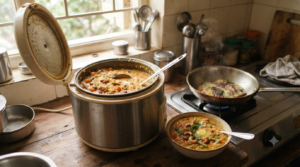
Creamy bisi bele bath cooked for a basic electric rice cooker, finished with vegetables, curry leaves, cashews and tempering.
Karnataka Tourism describes bisi bele bath as a Karnataka rice-and-lentil dish served hot with a special spice blend, vegetables, ghee, cashews, curry leaves and other seasonings. The rice cooker changes the equipment, not the character of the dish. The goal is still a soft, flowing texture with balanced spice, tang and a small touch of sweetness.
Bisi Bele Bath Recipe in Rice Cooker at a Glance
- Prep time: about 20 minutes, including soaking and chopping.
- Cook time: about 50 to 65 minutes in a basic electric rice cooker.
- Servings: 4 generous portions.
- Best rice: sona masuri or another short- to medium-grain white rice.
- Dal: toor dal, soaked for 30 minutes so it softens more reliably.
- Key technique: soften the dal first, then cook the rice and vegetables.
- Tamarind rule: add it only after the dal has softened.
Rice cookers vary widely, so judge the dal by texture rather than the switch position alone.
Why the Old Rice-Cooker Method Can Fail
The earlier version of this recipe asked you to cook rice and dal at the same time. That can work in some machines, yet it is not dependable in every basic rice cooker. Rice often softens before toor dal does, especially when the dal is older or the machine runs a short cycle.
Acid also matters. Tamarind is acidic, so adding it before the dal turns soft can slow the softening of legumes. North Carolina Cooperative Extension gives the same general advice for dried beans: acidic ingredients should go in after the legumes are tender. The practical lesson here is simple: cook the dal soft first, then bring in the tamarind and masala.
Do not defeat a rice cooker’s safety switch or hold the lever down. If the cooker moves to “Warm” too early, let it rest briefly and start another normal cycle after adding hot water. That is slower, but it respects the appliance design.
Ingredients for This Bisi Bele Bath Recipe
| Ingredient | Quantity | Why it matters |
|---|---|---|
| Sona masuri rice | 1 cup | Softens without becoming gluey |
| Toor dal | 1/2 cup | Gives the creamy lentil body |
| Mixed vegetables | 2 cups | Use carrot, beans, peas and potato |
| Bisi bele bath powder | 2 1/2 tbsp | Start here, then adjust for brand strength |
| Thick tamarind extract | 2 tbsp | Add after the dal is soft |
| Jaggery | 1 to 2 tsp | Optional; rounds the sour edge |
| Ghee or neutral oil | 2 tbsp | Use oil for a vegan version |
| Mustard seeds | 1 tsp | For the tempering |
| Curry leaves | 10 to 12 | Adds the classic South Indian aroma |
| Asafoetida | 1/4 tsp | Optional; check the label if gluten-free |
| Dried red chilli | 1 or 2 | Optional extra heat |
| Cashews | 10 | Optional garnish and crunch |
| Turmeric | 1/4 tsp | Goes into the dal stage |
| Salt | To taste | Add mainly near the final simmer |
| Hot water | About 5 to 5 1/2 cups | Added in stages, not all at once |
Packet masalas vary in chilli, salt and sourness. Start with 2 1/2 tablespoons, because you can always add another teaspoon during the final simmer. If you use a salty commercial blend, taste before adding the full amount of salt.
Vegetables that work best in a rice cooker
Carrot, French beans, green peas and small potato cubes are the easiest combination. Cut carrot and potato into pieces around 1 to 1.5 cm so they finish with the rice. Peas can go in frozen, while beans should be cut small enough to soften in one cycle.
Brinjal breaks down faster, so add larger pieces during the final masala stage. Onion is optional, and garlic is not required.
Bisi Bele Bath Recipe: Rice Cooker Steps
- Rinse and soak. Rinse the toor dal and rice separately. Soak the dal for 30 minutes and the rice for 15 minutes. Drain both before cooking.
- Cook the dal first. Put the dal, turmeric and 2 cups hot water into the rice cooker. Run one normal “Cook” cycle. When it switches to “Warm,” check the dal. It should mash easily between two fingers or against the side of the pot.
- Restart if the dal is firm. If the centre still feels chalky, add 1/2 cup hot water. Let the cooker rest for a minute or two, then start another normal cycle. Never force the switch to stay down.
- Add rice and firm vegetables. Stir in the drained rice, carrot, beans, peas and potato. Add 2 to 2 1/2 cups hot water. Start another “Cook” cycle and let the cooker switch to “Warm” by itself.
Finish the Bisi Bele Bath Recipe with masala and texture
- Make the masala liquid. Heat 1 tablespoon ghee or oil in a small pan. Add mustard seeds, curry leaves, dried chilli, asafoetida and cashews. When fragrant, lower the heat and stir in the bisi bele bath powder for a few seconds.
- Add tamarind after the dal is soft. Pour 3/4 cup water into the tempering pan, then add tamarind extract and jaggery. Simmer for about 5 minutes so the raw tamarind edge softens and the powder disperses.
- Combine and loosen. Pour the masala liquid into the cooked rice-dal mixture. Add salt, then mix gently. Mash only a little because the final texture should be cohesive, not completely pureed.
- Finish the consistency. Add 1/2 cup hot water if the mixture looks stiff. Use another short “Cook” period if your model allows it, or keep the mixture on “Warm” for 10 minutes and stir once halfway through.
This Bisi Bele Bath Recipe should look slightly looser than you want when you switch off the cooker. Rice and dal keep absorbing water as they stand. Therefore, a perfect serving texture in the pot can become too thick ten minutes later.
How Much Water Should You Use?
For 1 cup rice and 1/2 cup toor dal, plan on roughly 5 to 5 1/2 cups of hot water across the whole recipe. Do not pour it all in at once. The dal needs about 2 cups first, the rice and vegetables need another 2 to 2 1/2 cups, and the final masala stage uses the rest.
The exact amount depends on rice age, dal age and cooker size. Therefore, adjust with hot water only after checking the texture.
What consistency should bisi bele bath have?
It should be soft, spoonable and slightly flowing when hot. Karnataka Tourism’s description of the dish also centres on rice, lentils and masala cooked to a combined consistency rather than separate fluffy grains. If you can mound it like pulao, it is too dry for this style.
Add hot water in 1/4- to 1/2-cup amounts, because a large splash can wash out the seasoning. After each addition, stir and wait two minutes before deciding again.
The Tamarind Timing That Improves Texture
The old page mixed tamarind into the vegetables while the rice and dal were still cooking separately. The refreshed method moves that acid later. This small change makes the process more forgiving because the dal reaches a soft stage before acidity enters the cooker.
Fresh tamarind pulp and bottled paste can differ sharply in strength. Therefore, treat the 2-tablespoon amount as a starting point for thick extracted pulp, not a universal rule for concentrates. Add a little more only after the final simmer if the dish tastes flat.
Jaggery is optional. One or two teaspoons should round the sourness rather than make the dish sweet. If your masala blend already contains sugar or jaggery, skip it first and taste at the end.
What If the Rice Cooker Switches to Warm Too Soon?
A basic rice cooker switches to “Warm” when the pot no longer behaves like it contains enough free boiling water. That can happen even while older toor dal remains firm. The fix is more hot water and another normal cycle, not forcing the switch.
| Problem | Likely cause | Best fix |
|---|---|---|
| Dal is firm | Short cycle or older dal | Add 1/2 cup hot water and run another cycle |
| Rice is soft but dal is grainy | Rice and dal started together | Use the two-stage method next time |
| Bath is too thick | Rice absorbed liquid on standing | Add hot water in 1/4-cup amounts |
| Bath is too thin | Too much finishing water | Use “Cook” briefly or rest on “Warm” uncovered |
| Bottom tastes scorched | Thick masala settled before enough liquid | Transfer the top layer; do not scrape the burnt base |
| Dal stays hard after two cycles | Very old dal or hard water | Cook the dal separately until soft before continuing |
This troubleshooting section is the main advantage of the refreshed Bisi Bele Bath Recipe. A rice cooker is convenient, yet it does not guarantee one-cycle success. Your result depends on the dal and the cooker, so the recipe needs a safe fallback.
Masala Options: Homemade, MTR or Another Packet
You can use homemade bisi bele bath powder or a commercial packet. A packet is quicker, but brands differ in chilli and salt. Start slightly low, then increase after the final five-minute simmer because raw powder tastes harsher than cooked powder.
If you specifically want an MTR-powder method, BhimasCook already has a separate Bisi Bele Bath with MTR powder recipe. Keep that page focused on packet-masala ratios, while this page stays focused on the rice-cooker technique.
For pressure cooking, use the separate Instant Pot bisibelebath method. Pressure cookers soften dal much faster, so copying those timings into a basic rice cooker is not reliable.
Serving, Storage and Reheating
Serve this Bisi Bele Bath Recipe hot with boondi, papad, potato chips or a simple raita. A small spoon of ghee on top adds aroma, but it is optional. For a vegan version, use a neutral oil or coconut oil throughout.
Cool leftovers promptly and refrigerate them in a covered container. The U.S. Department of Agriculture advises using most cooked leftovers within 3 to 4 days and reheating leftovers thoroughly. Rice-based dishes also thicken in the refrigerator, so loosen each portion with water before reheating.
Reheat only the amount you plan to eat. Add 1 to 2 tablespoons water per serving, stir midway, and heat until steaming hot throughout. If the dish has sat at room temperature for an extended period, follow food-safety guidance rather than relying on smell alone.
Approximate nutrition per serving
A four-serving pot made with 1 cup dry rice, 1/2 cup dry toor dal, vegetables and about 2 tablespoons fat will usually land around 390 to 430 kcal per serving. Protein is roughly 11 to 13 g per serving. These are kitchen estimates, not laboratory values, because rice, masala, vegetables and added ghee vary.
Treat nutrition as an estimate because extra ghee, cashews or boondi can change the final numbers.
Small Changes That Make This Bisi Bele Bath Recipe Better
- Soak the dal, not just the rice. This gives a basic rice cooker a better chance of softening it in one or two cycles.
- Use hot water for corrections. Cold water cools the pot and stretches the next cooking cycle.
- Add tamarind late. The dal softens first, while the sour flavour stays clearer.
- Keep the final mix loose. Bisi bele bath thickens fast after cooking.
- Cut vegetables by cooking speed. Potato and carrot need small cubes, while peas can remain whole.
- Do not chase a fixed cycle time. Texture matters more because cook/warm rice cookers vary by wattage and pot size.
This Bisi Bele Bath Recipe also benefits from BhimasCook’s sambar recipe with sambar powder, especially if your spice blend tastes dusty or raw.
Before You Serve
The best Bisi Bele Bath Recipe for a rice cooker comes from patience rather than a shortcut. Get the dal soft first, use the second cycle for rice and vegetables, then add the tamarind-masala liquid. That order protects the texture and gives you several chances to correct the pot before serving.
If your cooker is very small, cook a half batch because thick rice-and-dal mixtures can foam and rise. Leave headroom, follow the appliance manual, and never bypass its switch. Once you know how your model behaves, this Bisi Bele Bath Recipe becomes much easier to repeat.
Bisi Bele Bath Recipe FAQ
Can I make Bisi Bele Bath Recipe in a basic cook/warm rice cooker?
Yes. A basic cook/warm rice cooker can make bisi bele bath, but the two-stage method is more reliable than cooking everything at once. Soften the toor dal first, then add rice and vegetables, and add tamarind only after the dal is tender.
Should rice and toor dal be cooked together?
They can be, but they do not always soften at the same speed. In a pressure cooker that mismatch matters less. In a basic rice cooker, cooking the dal first reduces the chance of soft rice with firm, grainy dal.
How much water do I need for bisi bele bath in a rice cooker?
For 1 cup rice and 1/2 cup toor dal, use about 5 to 5 1/2 cups hot water in stages. Start with 2 cups for the dal, add 2 to 2 1/2 cups with the rice and vegetables, then use the rest to adjust the final texture.
When should I add tamarind?
Add tamarind after the dal has softened. Acidic ingredients can slow the softening of legumes, so late addition gives a basic rice cooker more margin for error. Simmer the tamarind with the masala for about five minutes before combining.
Can I use MTR Bisi Bele Bath powder?
Yes. Start with about 2 1/2 tablespoons for this four-serving batch, then adjust after simmering because packet strength varies. If you want a recipe built specifically around MTR powder, use the dedicated MTR version on BhimasCook.
Can I make this without onion and garlic?
Yes. Onion is optional in this recipe, and garlic is not required. The flavour still comes from the bisi bele bath powder, tamarind, curry leaves, mustard, vegetables and finishing fat.
Why does my rice cooker switch to Warm before the dal is soft?
The cooker may sense that little free boiling water remains even though the dal still needs time. Add 1/2 cup hot water, let the cooker rest briefly, and start another normal cycle. Do not hold the switch down or defeat its safety mechanism.
Is bisi bele bath gluten-free?
The core ingredients are gluten-free, but asafoetida and packet masalas can contain wheat or other additives. Check each label if you need a strictly gluten-free meal. Use a certified gluten-free hing or omit it.
How long can I keep leftovers?
Refrigerate leftovers promptly in a covered container and use them within 3 to 4 days, following USDA guidance for cooked leftovers. Add a splash of water before reheating because the rice and dal continue to absorb moisture in the refrigerator.