Sambar Recipe Without Dal: Easy 35-Minute Home Method
This Sambar Recipe Without Dal solves a problem every South Indian kitchen hits eventually. The idli are steaming, the dosa batter sits ready, and there is no cooked toor dal in the house. Because gram flour and mashed vegetables carry the body here, the whole pot finishes in about 35 minutes.
It tastes tangy, spiced and properly comforting. It will not match a lentil sambar for protein, though, and this guide says so plainly.
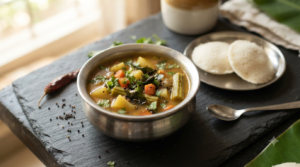
A dal-free sambar thickened with roasted gram flour, served hot with soft idli.
Most versions of this Sambar Recipe Without Dal stop at the method. This guide also fixes the two things that quietly ruin a no-dal sambar. One is gram flour that tastes raw. The other is a gravy that turns lumpy the second the slurry hits it.
Sambar Recipe Without Dal at a Glance
- Ready in roughly 35 minutes, since no lentil needs soaking or pressure-cooking.
- A Sambar Recipe Without Dal uses gram flour or roasted gram flour in place of toor dal.
- Dry-roast the gram flour first, because unroasted besan leaves a raw, pasty aftertaste.
- A teaspoon of jaggery balances the tamarind, so the pot never tips sharply sour.
- Protein lands near 2-3 g a bowl, while a toor dal sambar gives roughly 5-7 g.
- Best with idli, dosa and pongal, though it suits rice too when you keep the gravy thick.
Recipe Card
| Detail | Value |
|---|---|
| Prep time | 10 minutes |
| Cook time | 25 minutes |
| Total time | 35 minutes |
| Servings | 4 bowls |
| Cuisine | South Indian |
| Difficulty | Easy |
Why This Sambar Recipe Without Dal Actually Works
Toor dal does two jobs in classic sambar. It thickens the gravy, and it carries most of the protein. This Sambar Recipe Without Dal replaces only the first job, using dry-roasted gram flour plus a few mashed potato cubes. The tang still comes from tamarind, while sambar powder and a curry-leaf tempering supply the aroma.
Sambar is normally defined as a lentil-based stew, as the entry on sambar notes. So a no-dal pot is honestly a cousin rather than a copy. Restaurant tiffin sambar has worked this way for decades, because a besan-thickened gravy pours cleanly over idli instead of clinging in lumps.
Besan or Pottukadalai: Picking the Right Thickener
Two flours dominate any Sambar Recipe Without Dal, and they behave differently. Choosing correctly is the single biggest quality decision in this recipe.
| Thickener | What it is | How to use it |
|---|---|---|
| Gram flour (besan) | Milled from raw split Bengal gram, so it keeps a beany smell until heat cooks it out | Dry-roast 2 minutes first, then whisk into cool water |
| Roasted gram flour (pottukadalai maavu) | Roasted before milling, which is why many Tamil households prefer it | Use straight from the packet, adding an extra half spoon |
Besan thickens more strongly, though pottukadalai gives a cleaner finish with no roasting effort. Either one works, so pick whichever already sits in your pantry.
Ingredients for Sambar Recipe Without Dal
Quantities for this Sambar Recipe Without Dal serve four. Measurements use standard Indian spoons, where one tablespoon is roughly 15 ml.
For the tempering
- 2 tbsp groundnut oil, sesame oil or ghee
- 1 tsp mustard seeds
- 1/4 tsp fenugreek seeds (methi)
- 1 sprig curry leaves
- 1/4 tsp asafoetida (hing)
- 1 tsp urad dal, optional and only for crunch
For the gravy
- 1 medium onion, finely chopped
- 2 medium tomatoes, chopped
- 1-2 green chillies, slit
- 2-3 garlic cloves, crushed (optional)
- 2 medium potatoes, peeled and cubed small
- 1 cup diced carrot
- 1 cup drumstick pieces or chopped beans
- 1/2 tsp turmeric powder
- 2 tbsp sambar powder
- 3 tbsp gram flour, or 3.5 tbsp roasted gram flour
- 1 tbsp tamarind paste soaked in 1 cup warm water
- 1 tsp grated jaggery
- 1 1/4 tsp salt, or to taste
- 3 1/2 cups water
- A handful of coriander leaves
About that teaspoon of urad dal
Readers do ask about this, and fairly so. The dal this recipe removes is toor dal, the cooked lentil base that gives regular sambar its body. Urad dal in a tempering is a crunchy garnish, not a base, and it adds under a gram of protein to the whole pot. Skip it entirely if you want a strictly dal-free bowl, because the recipe works without it.
Sambar Recipe Without Dal: Prep and Tempering
- Soak the tamarind (5 minutes). Stir 1 tbsp tamarind paste into 1 cup warm water until it dissolves, then set it aside. If you use whole tamarind, soak a lime-sized ball and squeeze out the pulp.
- Dry-roast the gram flour (2 minutes). Warm a dry pan on low heat and add the gram flour. Stir constantly until it smells nutty and turns a shade darker. Tip it onto a plate immediately, since residual pan heat will scorch it. Skip this step only when you are using pottukadalai.
- Temper the spices (3 minutes). Heat the oil in a heavy pan on medium and add mustard seeds. Wait for the popping to slow, then lower the flame and add fenugreek seeds, urad dal, curry leaves and asafoetida. Fenugreek burns fast and turns the pot bitter, so keep this under 20 seconds.
Sambar Recipe Without Dal: Simmer and Thicken
- Build the base (6 minutes). Add onion, green chillies and garlic, then cook until the onion turns translucent. Stir in the tomatoes, turmeric and sambar powder, and cook until the tomatoes collapse. Roasting the sambar powder briefly in oil deepens the flavour noticeably.
- Simmer the vegetables (10 minutes). Add potato, carrot and drumstick, along with 3 1/2 cups water, the salt and the jaggery. Bring it to a boil, then lower the heat and simmer until the vegetables turn tender. Mash three or four potato cubes against the side of the pan, because that starch adds body no flour can copy.
- Add tamarind and thicken (6 minutes). Pour in the tamarind water and simmer three minutes to cook off its rawness. Meanwhile, whisk the roasted gram flour into 1/2 cup cool water until no lumps remain. Lower the flame, pour the slurry in a thin stream while stirring, then simmer another three minutes until the gravy coats a spoon lightly.
- Finish and rest (3 minutes). Scatter coriander leaves over the pot and switch off the heat. Cover it and rest for five minutes before serving, since the flavours settle noticeably in that gap. Serve hot with idli, dosa, pongal or rice.
Pressure Cooker and Instant Pot Timing
A pressure cooker trims roughly eight minutes off this Sambar Recipe Without Dal. Temper and build the base directly in the cooker, add the vegetables, water, salt and jaggery, then cook for two whistles on medium. Release the pressure, add tamarind water and simmer three minutes, and stir in the flour slurry last.
On an Instant Pot, use Saute mode for steps 3 and 4. Pressure cook on high for 3 minutes with a quick release. Finish the tamarind and slurry stages back on Saute, because the slurry needs an open pot to thicken evenly.
Sambar Recipe Without Dal for Rice or for Idli
Consistency decides where a Sambar Recipe Without Dal belongs, not the ingredients. For idli, dosa and pongal, keep the gravy pourable so it soaks in properly. Use 3 tbsp gram flour against 4 1/2 cups total liquid, which is the ratio written above.
For rice, thicken it further. Add an extra tablespoon of gram flour and hold back half a cup of water. Also add a second vegetable such as pumpkin or brinjal, since a rice sambar needs more substance in the spoon. A thin no-dal sambar over rice is the usual reason people call this version disappointing.
Sambar Recipe Without Dal Troubleshooting
Six problems account for nearly every failed Sambar Recipe Without Dal. Each one has a quick correction.
| Problem | Cause | Fix |
|---|---|---|
| Raw, pasty aftertaste | Gram flour went in unroasted | Simmer 5 more minutes; roast the flour next time |
| Lumps in the gravy | Slurry poured into a rolling boil | Whisk with cool water, lower the flame, pour slowly |
| Sharply sour | Too much tamarind | Add 1/2 tsp jaggery and 1/2 cup hot water |
| Watery gravy | Too much water for the flour | Whisk 1 tsp flour with water, stir in, simmer 3 minutes |
| Flat, thin flavour | Sambar powder never met hot oil | Roast it 30 seconds with the tomatoes |
| Bitter edge | Burnt fenugreek or asafoetida | Temper on low heat and move fast |
Pro Tips Most Sambar Guides Skip
- Salt the pot before the tamarind goes in, because acid slows how vegetables soften.
- Grate a small piece of jaggery rather than adding sugar, since jaggery rounds the tang without tasting sweet.
- Add drumstick five minutes after the other vegetables, so it holds shape instead of shredding.
- Keep the slurry water cool. Warm water starts gelling the flour before it reaches the pot.
- Reheat with a splash of water, since besan-thickened gravy sets firmly in the fridge.
Substitutions and Storage
The swaps below all hold up, so cook with whatever the kitchen offers.
- Rice flour replaces gram flour at the same quantity, though the gravy turns glossier.
- Two tablespoons of lemon juice replace tamarind, added off the heat at the end.
- Homemade sambar powder beats most packets. Roast coriander seeds, cumin, dried red chillies and a pinch of fenugreek, then grind.
- Pumpkin, brinjal, ash gourd or radish all substitute for carrot and beans by season.
Refrigerate leftovers in an airtight container for up to 3 days. Reheat gently on low, adding a splash of water to loosen it. Freezing is not worth it here, because potato turns grainy after thawing.
Sambar Recipe Without Dal Nutrition and Protein Reality
Figures below are estimates for one of four bowls, calculated from standard ingredient values rather than laboratory testing. They shift with your oil quantity and vegetable mix.
| Nutrient | Per bowl (approx.) |
|---|---|
| Calories | 120-140 kcal |
| Protein | 2-3 g |
| Carbohydrates | 18-22 g |
| Fat | 6-7 g |
| Fibre | 3-4 g |
The protein number deserves a plain explanation, because several recipes overstate it. Gram flour carries about 22 g of protein per 100 g according to USDA FoodData Central figures for chickpea flour. Three tablespoons weigh roughly 25 g, so the flour contributes about 5 g across the entire pot.
Split four ways, that is a little over 1 g a bowl, with vegetables adding another gram or so. A traditional sambar using half a cup of toor dal delivers closer to 5-7 g a bowl. Treat this Sambar Recipe Without Dal as a fast, tasty gravy, then, not as your protein source for the meal. Pair it with curd rice or a handful of peanuts when protein matters.
Dietary and Allergy Notes
This Sambar Recipe Without Dal is vegan when you temper with oil instead of ghee. It is also naturally free of dairy and nuts.
Gluten needs one check, though. Gram flour itself is gluten-free, as the reference page on gram flour confirms. Most commercial compounded asafoetida, however, uses wheat flour as a carrier. Buy a labelled gluten-free hing if anyone at the table has coeliac disease or wheat sensitivity.
Gram flour is a chickpea product, so it is unsuitable for anyone with a legume allergy. Rice flour is the safer thickener in that case. Anyone managing a medical condition should confirm dietary swaps with a qualified doctor or dietitian.
The Bottom Line
A Sambar Recipe Without Dal earns its place on a weeknight because it delivers familiar flavour in half the usual time. Roast the gram flour, balance the tamarind with jaggery, and mash a few potato cubes for body. Those three habits separate a decent pot from a watery one.
Just keep expectations honest on protein, since no flour replaces a lentil nutritionally. When cooked dal is already sitting in your fridge, the classic version still wins on richness.
Working through the rest of the sambar variations helps too. The sambar recipe without coconut suits Andhra-style cooking, while the sambar recipe without vegetables covers days when the fridge is empty. There is also a version without tamarind for anyone avoiding acidity, and it pairs neatly with instant ven pongal.
Frequently Asked Questions
Is this Sambar Recipe Without Dal vegan?
Yes, provided you temper with oil rather than ghee. Every other ingredient is plant-based. Check your sambar powder label as well, because a few branded blends include milk solids or anti-caking agents.
Can I cook this Sambar Recipe Without Dal without gram flour?
You can. Rice flour works at the same quantity, and roasted gram flour works slightly better. Alternatively, mash more of the cooked potato and skip flour completely, though the gravy stays thinner and separates as it cools.
Why does my no-dal sambar taste raw?
Unroasted gram flour is almost always the cause. Besan needs real heat to lose its beany smell, and three minutes of simmering rarely does it. Dry-roast the flour before making the slurry, or switch to pottukadalai.
Does sambar without dal work for rice?
It does, once you thicken it. Add an extra tablespoon of gram flour and reduce the water by half a cup. Many cooks find the standard tiffin consistency too thin over rice, so this adjustment matters more than any spice change.
How much protein is in sambar without dal?
Roughly 2-3 g per bowl, which is about half of what a toor dal sambar provides. The gram flour supplies a little over a gram, while the vegetables add the rest. Serve it alongside curd, peanuts or a protein-rich side dish.
Can I skip the tamarind?
Yes, although the flavour shifts. Two tablespoons of lemon juice added at the end give a brighter, sharper tang. Raw mango or tomato-heavy versions also work, and our no-onion no-garlic sambar follows a similar approach.
Is besan sambar gluten-free?
Gram flour is gluten-free, so the answer depends on your asafoetida. Compounded hing sold in India commonly uses wheat flour as a filler. Choose a certified gluten-free brand, or leave the hing out altogether.
How long does it keep?
Three days refrigerated in an airtight container. Reheat gently with a splash of water, since the gravy firms up considerably once chilled. Freezing is not recommended, because the potato texture suffers.