Rasam Podi Recipe Iyengar: Authentic Homemade Spice Blend
The Rasam Podi Recipe Iyengar style is a coriander-forward, pepper-warm spice blend that turns a plain pot of tamarind rasam into the fragrant version served in Iyengar homes across Karnataka and Tamil Nadu. Because it leans on roasted coriander seeds, toor dal and mild Byadagi chilies rather than fiery heat, this podi tastes rounded and aromatic instead of sharp.
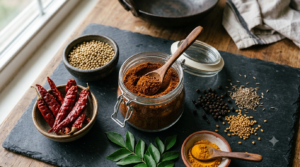
Freshly ground Rasam Podi Recipe Iyengar style in a glass jar with roasted coriander, dried red chilies, and peppercorns.
It also does double duty: the same blend seasons a bowl of rasam and, with a small tweak, flavours puliyogare (tamarind rice). In my mother’s Andhra kitchen we grind a big batch every couple of months, so the house smells of roasting spice for an afternoon and one jar lasts through many rainy-evening meals.
Quick Summary: Rasam Podi Recipe Iyengar At A Glance
Here is the short version before the detailed steps. Keep this handy while you shop and roast.
- Core ratio: 3 parts coriander seeds to 1 part toor dal to 1 part red chilies, so coriander always dominates.
- Signature note: mild Byadagi chilies for colour, with black pepper and cumin carrying the warmth.
- Roast style: dry-roast each spice separately, since they brown at different speeds.
- Yield: the batch below makes roughly 20 tablespoons of podi.
- Shelf life: up to 3 months in an airtight glass jar kept away from moisture.
- Bonus use: the same podi doubles as a base for puliyogare and vathal kuzhambu.
What Makes Rasam Podi Recipe Iyengar Different
The Rasam Podi Recipe Iyengar version is built on the classic South Indian rasam powder, yet a few choices set it apart. Iyengar cooks favour a high proportion of coriander seeds and a gentle chili, so the aroma comes forward before the heat does. Many families also sun-dry the spices first, which keeps the roast even and the flavour clean.
Another quiet marker is versatility. In Iyengar and Mysore Iyengar households this same “saatramudhu podi” or “saaru podi” is stored in bulk and used for both rasam and puliyogare. That practical, one-jar-for-two-dishes habit is a genuine hallmark of the tradition. You will rarely see a Chettinad or Andhra podi described that way.
Heat level is the third difference. Where some Tamil Nadu and Andhra blends push bold pepper and hot Guntur chilies, the Iyengar style stays balanced. Byadagi chilies give the podi a deep red colour while keeping the burn mild, which suits children and elders at a family meal.
Rasam Podi Recipe Iyengar vs Other Regional Styles
Every region tweaks the same handful of spices, so the differences are in proportion, not in exotic ingredients. The table below compares the main South Indian styles at a glance, because seeing them side by side makes the Iyengar choices clear.
| Style | Defining tweak | Typical heat |
|---|---|---|
| Iyengar | Coriander-heavy, Byadagi chilies, doubles as puliyogare powder | Mild, aromatic |
| Tamil Iyer / Brahmin | Balanced coriander and chili, often no mustard | Medium |
| Andhra (charu podi) | More red chili, extra pepper | Hot |
| Kerala | Equal toor dal and chana dal for body | Medium |
| Mysore | Ground mustard added to the blend | Medium |
Because the base is shared, you can shift one style toward another by adjusting chili and pepper. Add more Guntur chili for an Andhra lean, or a spoon of mustard for a Mysore twist. If you like the Iyer version, our Brahmin rasam powder recipe follows that slightly hotter balance.
Ingredients For Rasam Podi Recipe Iyengar
These are the exact quantities for a family-sized batch. Measure by volume with the same cup throughout, since the ratio matters more than the absolute amount.
- 3 cups coriander seeds
- 1 cup toor dal (split pigeon peas)
- 1 cup dried red chilies, preferably Byadagi for colour and Guntur for extra heat
- ½ cup black peppercorns
- ½ cup cumin seeds
- ¼ cup fenugreek seeds (methi)
- ¼ cup mustard seeds
- 1 cup dried curry leaves (optional but traditional)
- 1–2 teaspoons asafoetida (hing), powdered
- 1 teaspoon turmeric powder
Strict Iyengar “saatramudhu podi” often skips the fenugreek and mustard and keeps only coriander, dal, chili, cumin, pepper and turmeric. The version above adds methi and mustard for a rounder aroma, which is how many Andhra-Iyengar homes make it. Either path is authentic, so choose the one your family prefers.
How To Choose The Right Chilies
Chili choice decides both colour and heat, so pick with intent. Byadagi chilies from Karnataka give a rich red tone with gentle warmth, which is why a one-to-one chili-to-coriander feel works for them. Guntur or Kashmiri chilies bring more punch, so reduce the quantity if you use them alone.
For a crowd that includes children or elders, lean heavily on Byadagi and add just a few Guntur chilies for lift. Because dried chilies vary batch to batch, taste your first small rasam and adjust the podi next time.
Equipment You Will Need
Nothing fancy is required, and you likely own all of it already.
- Heavy-bottomed pan or skillet for even dry-roasting
- Spice grinder or a high-power blender
- Fine-mesh strainer or sieve for a smooth texture
- Airtight glass jar for storage
Step-By-Step Rasam Podi Recipe Iyengar Method
Follow these steps in order, and roast each spice separately so nothing burns while something else is still raw. The whole process takes about an hour, most of which is hands-off cooling time.
- Sun-dry the spices. Spread the coriander, dal, chilies and seeds on a clean cloth in sunlight for about 20 minutes. This removes surface moisture, so the roast stays crisp rather than steamy.
- Roast the dal and hard seeds. Heat a dry pan on medium flame. Roast the toor dal for 5–6 minutes until light golden, then set it aside. Roast the mustard and fenugreek separately for about 3 minutes each, because methi turns bitter if it darkens too far.
- Roast coriander and chilies. In the same pan, roast coriander seeds for roughly 4 minutes. Add the red chilies and roast 3–4 minutes more, until the chilies crisp slightly but do not scorch.
- Add cumin and pepper. Toss in the cumin seeds and peppercorns, then roast 2–3 minutes until they pop and turn fragrant. If you are using curry leaves, add them now and roast 1–2 minutes until crisp.
- Cool completely. Turn off the heat and spread everything on a plate. Let it cool for 20–25 minutes, since warm spices trap moisture and clump in the grinder.
- Grind and sift. Add the turmeric and asafoetida, then grind to a fine powder. Sift through a fine strainer, and re-grind the coarse bits left behind for an even texture.
- Store the podi. Transfer to an airtight jar once fully cool. Label it with the date, so you always know how fresh the batch is.
How To Make Rasam With This Iyengar Podi
A ready jar of Rasam Podi Recipe Iyengar turns a bowl of rasam into a ten-minute job. Here is the quick method for a light, tangy rasam that serves three to four people with rice.
- Soak a lemon-sized ball of tamarind in 2 cups of warm water, then extract the juice.
- Bring the tamarind water to a boil with 1 chopped tomato, ¼ teaspoon turmeric and salt for 5–6 minutes.
- Stir in 1 to 1.5 teaspoons of rasam podi, then simmer 7–8 minutes until frothy but not boiling hard.
- Temper mustard seeds, curry leaves and a pinch of hing in hot ghee or oil, and pour it over the rasam.
- Garnish with fresh coriander, and serve hot over steamed rice.
Do not let the rasam reach a rolling boil after adding the podi, because hard boiling dulls the aroma. A gentle froth is the sign it is ready.
Common Mistakes That Ruin Rasam Podi
Most podi problems trace back to roasting, and they are easy to avoid once you know them. Read these before your first batch, since fixing a bitter podi after grinding is nearly impossible.
- Over-roasting fenugreek: methi turns bitter fast, so pull it the moment it darkens a shade.
- Grinding warm spices: residual heat creates steam, which makes the powder clump and spoil sooner.
- Roasting everything together: dal needs longer than cumin, so a single mixed roast leaves some raw and some burnt.
- Too much chili: when in doubt use less, because you can always add extra podi to the pot but cannot remove heat from the jar.
Scaling And Measuring The Batch
The recipe uses cups, yet many cooks want gram figures for accuracy. As a rough guide, 1 cup of coriander seeds weighs about 90–100 grams, while 1 cup of toor dal is closer to 200 grams because it is denser. Since the ratio is what counts, halving or doubling every ingredient keeps the balance intact.
For a small trial batch of Rasam Podi Recipe Iyengar, use tablespoons instead of cups at the same 3:1:1 ratio. That way you can taste the result before committing to a large grind. Store the trial jar separately, so you remember which mix you liked.
How To Store Your Rasam Podi Recipe Iyengar
Good storage protects the aroma you worked to build. Keep the podi in an airtight glass jar in a cool, dry cupboard, and it stays fresh for up to 3 months. Glass holds the fragrance better than plastic, so reach for a jar rather than a container.
In humid weather, drop a food-safe silica sachet or a few dry rice grains into the jar to absorb moisture. Avoid the refrigerator, because condensation each time you open it will shorten the shelf life instead of extending it. Always use a dry spoon, since even a little water invites clumping.
Nutrition Information (Per ~1 Tablespoon / 10g)
These figures are approximate, since podi is almost entirely a spice blend and exact values shift with your ingredient brands. Treat them as a guide rather than a precise label.
| Nutrient | Approx. per 10g |
|---|---|
| Calories | ~32 kcal |
| Protein | 1.3 g |
| Carbohydrates | 4.8 g |
| Fat | 1 g |
| Fibre | 0.9 g |
| Iron | ~4% of daily value |
The turmeric and pepper in rasam are traditionally valued for aiding digestion, and many families reach for a hot rasam when someone has a cold. These are long-held kitchen beliefs rather than medical claims, so enjoy rasam as comforting food, not as a treatment. Anyone managing a specific health condition should still follow a doctor’s advice.
Before You Grind: Key Points
A great Rasam Podi Recipe Iyengar comes down to three habits: keep coriander dominant, roast each spice on its own, and grind only when everything is cool. Choose Byadagi chilies for colour and add heat cautiously, because a mild base always welcomes more spice later.
Make a small batch first, taste it in a simple rasam, then scale up the mix you love. Do that, and one jar will carry your kitchen through months of quick meals. For more South Indian spice blends, try our Karivepaku podi recipe or a comforting Kerala-style rasam.
Frequently Asked Questions
What makes the Rasam Podi Recipe Iyengar style different from other rasam powders?
The Iyengar style keeps coriander dominant and heat mild, usually with Byadagi chilies for colour. Unlike many blends, this same podi is traditionally used for both rasam and puliyogare. That coriander-forward, dual-purpose character is its clearest signature.
Can I make Iyengar rasam podi without fenugreek and mustard?
Yes, and the strictest traditional version does exactly that. Classic “saatramudhu podi” uses only coriander, toor dal, chilies, cumin, pepper and turmeric. Adding methi and mustard simply rounds the aroma, so both versions are authentic.
Which chilies are best for this podi?
Byadagi chilies give deep red colour with gentle heat, which fits the mild Iyengar profile. Guntur or Kashmiri chilies add more punch, so use fewer of them if you want extra heat. A mix of mostly Byadagi with a few Guntur works well for most families.
How long does homemade rasam podi last?
Stored in an airtight glass jar in a cool, dry place, it stays fresh for about 3 months. Keep it away from moisture and use a dry spoon each time. A silica sachet helps in humid climates.
Why did my rasam podi turn bitter?
Bitterness almost always comes from over-roasted fenugreek or burnt chilies. Roast methi only until it darkens a shade, and pull the chilies before they scorch. Grinding warm spices can also spoil the taste.
Can I use store-bought rasam powder instead?
You can, and it is convenient on a busy day. Still, a fresh homemade podi keeps far more aroma and lets you control the heat. Most cooks find the homemade jar worth the one afternoon it takes.
Can the same podi be used for puliyogare?
Yes, that is one of the joys of the Iyengar blend. With a little extra tamarind and a tempering of peanuts and sesame, the same powder flavours puliyogare rice. This dual use is why Iyengar homes grind it in bulk.
Is rasam podi the same as sambar powder?
No, though they share several spices. Rasam podi leans on coriander, pepper and cumin for a thin, tangy broth, while sambar powder uses more chili and dal for a thicker gravy. The proportions and purpose are different.