Rava Laddu with Coconut: Soft, Foolproof Recipe
A good rava laddu with coconut should melt the moment it touches your tongue, never crumble in your palm or set rock-hard overnight. That soft, grainy, cardamom-scented bite is the whole reason this sweet has stayed on Indian festival tables for generations. Get the roast and the sugar syrup right, and the rest is easy. This is my mother’s Andhra recipe, tested in her kitchen with her exact measurements, so it binds the first time instead of falling apart.
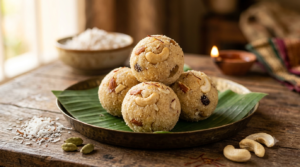
Soft, melt-in-mouth rava laddu with coconut, garnished with cashews and saffron.
Rava Laddu with Coconut at a Glance
- What it is: soft semolina-and-coconut sweet balls bound with one-string sugar syrup.
- Total time: about 45 minutes of work, plus 1–2 hours of cooling.
- Makes: 20–24 laddus from 2 cups of rava.
- Hardest part: the sugar syrup, because overcooking it is what makes laddus turn hard.
- Best for: Diwali, Ganesh Chaturthi, Raksha Bandhan, Navratri, or a quick sweet craving.
Recipe Card
| Detail | Value |
|---|---|
| Prep time | 15 minutes |
| Cook time | 30 minutes |
| Cooling time | 1–2 hours |
| Total time | 1 hour 45 minutes |
| Servings | 20–24 laddus |
| Difficulty | Medium |
Ingredients for Rava Laddu with Coconut
You need pantry basics, so nothing here is hard to find. Because measurements decide whether the mixture binds, stick to these amounts closely on your first try.
- Fine semolina (rava/sooji): 2 cups (about 340 g)
- Fresh grated coconut: 1 cup, loosely packed
- Ghee: ½ cup (about 100 g)
- Sugar: 1½ cups (about 300 g)
- Water: ¾ cup (180 ml), for the syrup
- Cardamom powder: 1 tsp
- Saffron strands: a pinch, optional, for colour and aroma
- Cashews: 10–12, halved, optional
- Raisins: 10–12, optional
Fine rava gives smooth, soft laddus, while coarse rava leaves them slightly crumbly. If you only have coarse semolina, pulse it in a mixer a few times before you start.
How to Make Rava Laddu with Coconut Step by Step
The method has six stages, though only two really matter: roasting the rava slowly and cooking the syrup to a single thread. Follow them in order and work while the mixture is still warm.
Step 1: Roast the semolina and coconut (10–12 minutes)
Heat a heavy-bottomed pan on medium flame and add ½ cup ghee. Once it melts, add the semolina and stir constantly so it never browns. Roast for 8–10 minutes until it smells nutty and turns pale gold.
Then add the grated coconut and roast for 2 more minutes, until the coconut aroma lifts. Move everything to a plate to cool slightly.
Step 2: Fry the nuts (2–3 minutes)
Add a tablespoon of ghee to the same pan. Roast the halved cashews until light gold, then toss in the raisins until they puff up. Tip the nuts onto the plate with the semolina. This small step adds crunch that guests always notice.
Step 3: Make one-string sugar syrup (8–10 minutes)
In a separate saucepan, combine 1½ cups sugar with ¾ cup water. Stir on medium heat until the sugar dissolves, then lower the flame and simmer. After 6–8 minutes, lift the spoon and watch the last drops form a single thin thread. That one-string stage is your signal, so do not walk away from the pan.
Step 4: Combine the syrup with the roasted mix
Pour the hot syrup over the roasted semolina, coconut, and nuts. Sprinkle in the cardamom powder and saffron, then mix until the syrup coats every grain. Let the mixture rest for about 10 minutes while it stays warm, because binding works best before it cools.
Step 5: Shape the laddus (15–20 minutes)
Grease your palms lightly with ghee. Scoop 3–4 tablespoons of the mixture and press it firmly between your palms into a tight ball. Work quickly while the mix is warm, since it stops binding once the ghee hardens. Set each laddu on a parchment-lined tray.
Step 6: Cool and set (1–2 hours)
Leave the laddus at room temperature for at least an hour. They firm up as they cool and develop that melt-in-mouth texture. Once fully set, store them in an airtight container.
Fresh, Desiccated, or Frozen Coconut: Which to Use
Your coconut choice changes both the flavour and how long the laddus keep. Fresh coconut tastes richest but shortens shelf life, while desiccated coconut lasts longest. Here is how the three compare so you can pick the right one for your plan.
| Coconut type | Flavour | Shelf life impact | Prep note |
|---|---|---|---|
| Fresh grated | Richest, most fragrant | Shortens it — refrigerate and finish in 3–4 days | Use straight away |
| Desiccated | Mild, nutty | Longest keeping, up to a week | Soak briefly in warm water to soften |
| Frozen grated | Close to fresh | Similar to fresh once thawed | Thaw and pat dry before roasting |
For festival batches you plan to gift or store, desiccated coconut is the safer choice. When you want the best possible taste for the same day, reach for fresh. Whichever you pick, roast the coconut only briefly, since over-roasting dries it out and dulls the flavour.
The Sugar Syrup Is Make-or-Break
Nearly every failed batch traces back to the syrup, so this step deserves real attention. One-string consistency means a single unbroken thread forms when you stretch a drop between your thumb and finger. Undercook it and the laddus stay crumbly; overcook it and they turn hard as stones.
Use a timer, because a minute too long changes everything. In most kitchens the syrup reaches one string in 6–8 minutes on a low simmer. If you double the batch, expect roughly 8 minutes instead. Test early and often rather than trusting the clock alone.
If you accidentally reach a two-string stage, where two threads form instead of one, the syrup has gone too far for soft laddus. You can rescue it by stirring in a spoon of hot water to loosen it again. Keep the flame low throughout, since a hard boil rushes past the one-string point in seconds.
Pro Tips for Soft Rava Laddu with Coconut
These are the small kitchen details that decide the result, drawn from years of making this sweet at home.
- Roast the rava by smell, not colour. When I watched my grandmother make these at Diwali, she waited for the fragrance, never a deep golden shade.
- Keep the flame low and stir without stopping, since rava burns fast at the edges.
- If the syrup overcooks and the mix feels dry, sprinkle a splash of warm milk or a little extra hot syrup before shaping.
- Saffron is optional, yet it lifts both the colour and aroma when you are serving guests.
- In winter the mixture cools faster, so add 1–2 teaspoons of warm ghee to help it bind.
Why Your Rava Laddu with Coconut Won’t Bind
A rava laddu with coconut fails to bind for a handful of common reasons, and each has a quick fix. Use this table the moment your mixture misbehaves, before it cools too far to save.
| Problem | Likely cause | Fix |
|---|---|---|
| Mixture won’t hold shape | Too little syrup or it cooled down | Add a spoon of warm milk or ghee and press firmly |
| Laddus turned hard | Syrup overcooked past one string | Sprinkle warm milk, mix, and reshape quickly |
| Crumbly and dry | Undercooked syrup or coarse rava | Add a little hot syrup or warm water while warm |
| Sticky, won’t roll | Rava under-roasted | Little can be done now — roast longer next time |
Easy Rava Laddu with Coconut Variations
Once you master the base recipe, several swaps open up. Each keeps the method almost identical, so you can experiment freely.
- Jaggery version: swap sugar for jaggery for a deeper, earthier sweetness — see our jaggery version for the exact ratios.
- No sugar syrup: mix powdered sugar straight into the roasted rava for a faster fix, as in our no-syrup sooji laddu.
- Condensed milk version: bind with condensed milk for extra richness using our condensed milk rava laddu.
- Without coconut: skip the coconut entirely if you prefer a plainer sweet, as shown in our coconut-free version.
- Vegan: replace ghee with coconut oil, though the laddus will turn a touch softer.
Storing Rava Laddu with Coconut
Storage depends entirely on the coconut you used. Because fresh coconut carries moisture, those laddus spoil faster and belong in the fridge.
At room temperature in an airtight container, laddus made with desiccated coconut keep for 3–4 days. Refrigerated, they last up to a week, though they harden in the cold. Bring them back to room temperature before serving, or warm one for a few seconds so it softens again.
Rava Laddu with Coconut Nutrition (Per Laddu)
One laddu carries roughly 132 calories, with moderate carbs and no cholesterol. Treat these figures as a guide, since they shift with the exact ghee and sugar you use.
| Nutrient | Amount |
|---|---|
| Calories | ~130–135 kcal |
| Carbohydrates | ~16 g |
| Fat | ~7 g |
| Protein | ~1 g |
| Fibre | ~1 g |
| Cholesterol | 0 mg |
These are rich in sugar and ghee, so anyone watching their sugar intake should enjoy them in moderation. Using slightly less sugar or swapping in jaggery will lower the intensity a little.
Serving and Gifting Ideas
These laddus sit comfortably on any festival thali and travel well too. Pair them with hot masala chai in the evening, or offer them as prasad during a home pooja. A single laddu alongside coffee also makes a simple after-meal sweet.
For gifting, box a rava laddu with coconut batch in a lined tin so the pieces stay separate and hold their shape. Because desiccated coconut keeps longer, use it whenever the box has to survive a day or two of travel before reaching someone.
Before You Start Rolling
A great rava laddu with coconut rewards patience at just two moments: the slow roast and the one-string syrup. Nail those, and even a first attempt sets beautifully. Use fine rava, keep the flame low, and shape while the mixture is warm.
For festival gifting, choose desiccated coconut so the batch keeps longer; for the richest taste at home, pick fresh. Everything else is forgiving, which is exactly why this sweet has stayed a family favourite for so long.
Frequently Asked Questions
Can I make rava laddu with coconut without sugar syrup?
Yes. You can mix powdered sugar directly into the roasted rava and coconut for a quicker method. The laddus turn out slightly less moist and a little more crumbly, but they still taste great and save you the syrup step.
Why are my laddus crumbly?
Crumbly laddus usually mean the syrup was undercooked or the mixture cooled before shaping. Warm it slightly and add a little hot water, milk, or ghee to help it bind. Always press firmly and roll while the mix is still warm.
Can I use desiccated coconut instead of fresh?
Absolutely. Desiccated coconut works well and actually helps the laddus keep longer. Soak it briefly in warm water first so it softens and blends smoothly into the mixture.
What type of rava is best for laddu?
Fine rava, also called Bombay rava or chiroti rava, gives the softest, smoothest laddus. Coarse upma rava works too, but it leaves a grainier bite. If you prefer a slight crunch, coarse rava is fine.
Why did my laddus turn hard?
Hard laddus almost always come from syrup cooked past the one-string stage. If you catch it early, sprinkle warm milk over the mixture, combine well, and reshape quickly before it cools completely.
How long does rava laddu with coconut last?
With desiccated coconut, they keep 3–4 days at room temperature and up to a week refrigerated. Fresh coconut shortens that, so refrigerate those and finish them within a few days for the best flavour.
Can I use jaggery instead of sugar?
Yes, jaggery gives a darker colour and a deeper, caramel-like sweetness. Melt it into a syrup the same way, though you may need to adjust the water slightly since jaggery holds more moisture.
Which festivals is this sweet made for?
Rava laddu appears at Diwali, Ganesh Chaturthi, Raksha Bandhan, and Navratri, among others. Its long shelf life with desiccated coconut makes it a practical choice for gifting during festival season.