Banana Payasam Recipe: Easy Kerala-Style Pazham Pradhaman
Banana payasam recipe works best when ripe Nendran banana, jaggery and coconut milk are cooked in the correct order. This refreshed method gives a thick, spoonable Kerala-style pazham pradhaman without boiling the rich coconut milk at the end. The result is fruity, caramel-like and creamy rather than watery or split.
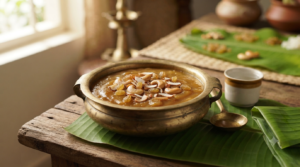
Kerala-style banana payasam made with ripe Nendran banana, jaggery, coconut milk, cashews and raisins.
Kerala Tourism lists pazham pradhaman among the many payasam varieties associated with Kerala food traditions. Its payasam overview also notes the broader use of coconut milk, jaggery, nuts and spices in these desserts. There is no single fixed “hotel-style” formula, so this version focuses on a repeatable home texture.
Banana Payasam Recipe at a Glance
- Main fruit: very ripe Nendran banana, also called Kerala banana or ethapazham
- Sweetener: jaggery, added as a strained syrup
- Liquid: thin coconut milk for simmering, thick coconut milk for the final finish
- Prep time: about 15 minutes
- Cook time: about 35 to 40 minutes
- Servings: 6 small dessert portions
- Texture: thick but pourable while warm, thicker after cooling
- Key rule: do not vigorously boil after adding thick coconut milk
The first coconut-milk extract is the thick one, while later extraction gives thinner milk. This matters because the thin milk tolerates simmering better, while the thick milk keeps its richer taste when added near the end. Kerala Tourism uses the same thin-to-thick sequence in its Ada Pradhaman method.
Ingredients for This Banana Payasam Recipe
| Ingredient | Quantity | Purpose |
|---|---|---|
| Ripe Nendran bananas | 4 medium-large, about 650-750 g peeled | Fruit base and natural sweetness |
| Jaggery | 180-220 g | Caramel-like sweetness |
| Water | 1/3 cup | For dissolving jaggery |
| Thin coconut milk | 2 cups | Main simmering liquid |
| Thick coconut milk | 1 cup | Rich final finish |
| Ghee | 2 tbsp | Roasting and flavour |
| Cardamom powder | 1/2 tsp | Aroma |
| Dry ginger powder | 1/4 tsp | Warm spice note |
| Cumin powder | 1 small pinch, optional | Traditional-style spice note |
| Cashews | 10-12 | Garnish |
| Raisins | 1 tbsp | Garnish |
| Coconut pieces | 2 tbsp, optional | Texture and toasted flavour |
| Salt | 1 small pinch | Balances sweetness |
Jaggery sweetness varies, so start near 180 g if your bananas are very ripe. You can add a little more syrup after tasting the cooked banana base. This avoids the very common problem of a payasam that tastes mostly of jaggery and hides the fruit.
How to make thin and thick coconut milk
If you extract coconut milk at home, squeeze grated coconut first with a small amount of warm water for the thick first extract. Add more warm water to the same coconut and squeeze again for the thinner second extract. Keep them separate because they enter the pan at different stages.
For a convenient version, use unsweetened packaged coconut milk. Keep 1 cup undiluted for the thick portion, then mix another 1 cup with 1 cup water to make roughly 2 cups of thinner coconut milk. Check the label first because packaged products vary in richness.
How to Make Banana Payasam Recipe Step by Step
Cook the banana and jaggery base
- Cook the bananas. Steam the whole Nendran bananas until the flesh turns soft, usually about 8 to 12 minutes depending on size and ripeness. Cool slightly, peel, then mash the fruit until mostly smooth.
- Make the jaggery syrup. Put jaggery and 1/3 cup water in a small pan. Warm on low heat until dissolved, then strain through a fine sieve so grit or impurities do not enter the payasam.
- Roast the fruit. Heat 1 tablespoon ghee in a heavy kadai or saucepan. Add the mashed banana and cook on medium-low heat for 5 to 7 minutes, stirring often, until it looks glossy and slightly darker.
- Add the jaggery. Pour in the strained syrup and stir well. Cook for 6 to 8 minutes until the banana-jaggery mixture thickens and a spoon drawn through the pan leaves a brief path.
Add coconut milk and finish
- Simmer with thin coconut milk. Add the thin coconut milk gradually while stirring. Keep the heat low to medium-low and simmer for 8 to 10 minutes, because this stage builds the final body of the payasam.
- Add the spices. Stir in cardamom, dry ginger, optional cumin and a tiny pinch of salt. Cook for another minute so the spice aroma spreads through the mixture.
- Finish with thick coconut milk. Reduce the heat to its lowest setting, then add the thick coconut milk. Warm for 1 to 2 minutes while stirring, but do not bring it to a rolling boil.
- Fry the garnish. Heat the remaining ghee in a small pan. Fry cashews and coconut pieces until light golden, then add raisins and cook only until they puff.
- Rest and serve. Pour the garnish into the payasam and switch off the heat. Rest for 10 minutes before serving because the texture thickens as it settles.
This banana payasam recipe should flow slowly from a ladle when warm. If it sits like a paste, it has reduced too far, so loosen it with a little warm thin coconut milk. If it looks watery, simmer only before the thick coconut milk goes in.
Why Nendran Banana Works Better
Nendran banana gives pazham pradhaman a firmer, deeper-flavoured fruit base than many soft dessert bananas. When fully ripe, its flesh becomes sweet and dense enough to cook with jaggery without disappearing into a thin puree. That makes the final payasam taste distinctly of banana rather than only coconut and sugar.
For the most reliable banana payasam recipe, choose fruit with a deep yellow skin and plenty of dark speckling. However, avoid bananas that smell fermented or have leaking flesh. Regular ripe bananas can work in a pinch, but use slightly less jaggery because some varieties taste sweeter and soften faster.
Banana Payasam Recipe: Thin Milk First, Thick Milk Last
The thin-first, thick-last order is the most important technique in this banana payasam recipe. Thin coconut milk can simmer with the fruit and jaggery as the mixture reduces. Thick coconut milk goes in near the end because prolonged hard boiling can dull its fresh coconut flavour and may make the mixture look oily or separated.
Kerala Tourism’s traditional Ada Pradhaman recipe follows this same progression from thinner coconut milk toward thick coconut milk. That does not make every pradhaman identical, but it supports the cooking logic used here. Keep the last stage gentle, and the dessert will stay smoother.
How Sweet Should Banana Payasam Be?
Banana payasam should taste first of ripe fruit, then jaggery and coconut. The exact jaggery quantity cannot be universal because banana ripeness and jaggery intensity change from batch to batch. Start lower, taste after the syrup cooks into the banana, then adjust before the thick coconut milk is added.
Do not treat jaggery as a free pass for unlimited sweetness. It is still an added sweetener, so the best recipe is the one that uses enough for flavour without burying the fruit. A small pinch of salt also sharpens the banana and cardamom notes.
What Beginners Get Wrong
- Using underripe bananas: they stay starchy and give the payasam a flat fruit flavour.
- Skipping the jaggery strain: natural jaggery can contain fine particles, so straining gives a cleaner texture.
- Calling the extracts backwards: first extract is thick; later extract is thinner.
- Boiling thick coconut milk hard: add it at the end and warm gently instead.
- Adding too much jaggery at once: ripe Nendran already contributes sweetness, so adjust gradually.
- Serving immediately: a short rest improves body because the banana and coconut milk settle together.
Another common mistake is calling a ghee-finished version vegan. Ghee is a dairy product, so the recipe is vegetarian but not vegan as written. For a plant-based banana payasam, use coconut oil instead of ghee and confirm that every packaged ingredient is dairy-free.
Banana Payasam Recipe Troubleshooting
| Problem | Likely cause | Fix |
|---|---|---|
| Too thin | Not reduced enough before final coconut milk | Simmer longer before adding thick milk |
| Too thick | Over-reduced or cooled fully | Stir in warm thin coconut milk |
| Oily or split look | Thick coconut milk boiled too hard | Use lower heat and shorter final warming |
| Too sweet | Jaggery added before tasting ripe fruit | Add less jaggery in the next batch; loosen this batch with coconut milk |
| Weak banana flavour | Underripe fruit or too much jaggery | Use riper Nendran and rebalance sweetener |
| Burnt taste | Banana-jaggery base caught on the pan | Use heavy cookware and stir more often |
If the payasam catches badly on the bottom, do not scrape the burnt layer into the dessert. Transfer the unburnt portion to a clean pan, then continue on lower heat. Burnt jaggery spreads quickly, so acting early can save most of the batch.
Can You Make It Without Ghee?
Yes. Replace ghee with coconut oil if you want a fully plant-based version, and the flavour still fits the coconut-and-banana base. Use a mild coconut oil if you want the fruit to remain dominant, while a stronger virgin coconut oil gives a more pronounced coconut aroma.
If you simply want a lighter finish, you can also reduce the fat and dry-toast the cashews separately. However, a small amount of fat helps carry the cardamom aroma and gives the dessert a rounder mouthfeel.
Serving, Cooling and Storage
Serve pazham pradhaman warm, at room temperature, or chilled. It thickens after cooling, so keep a little coconut milk aside if you plan to refrigerate it. For a Kerala meal, payasam can be served as part of a festive spread rather than only as a stand-alone dessert.
For food safety, do not leave cooked payasam at room temperature for long periods. FSSAI’s Food Safety at Home guidance recommends keeping leftovers cold below 5°C and reheating cooked food thoroughly. Refrigerate the cooled payasam in a clean covered container, preferably within two hours.
For best quality, use this banana payasam recipe within about 2 days after refrigeration because coconut milk and fruit flavours change quickly. Reheat gently over low heat, and add a spoonful of water or thin coconut milk if it has become too thick.
More Payasam Recipes on Bhimas Cook
If you want a rice-based dessert next, try this creamy rice payasam recipe. For a jaggery version with a milk base, see the paal payasam with jaggery method, which explains how to reduce curdling risk.
You can also compare this fruit-based pradhaman with the site’s instant pal payasam. The key difference is the thickener: banana supplies most of the body here, while rice starch builds the texture in paal payasam.
Before You Serve It
A good banana payasam recipe is less about a fixed hotel formula and more about control. Use very ripe Nendran banana, strain the jaggery, reduce with thin coconut milk, then finish gently with thick coconut milk. Taste before adding extra sweetener because ripe fruit can change the balance dramatically.
The most useful upgrade from the older version is the corrected coconut-milk order. That one detail improves both texture and flavour, while the ghee-to-coconut-oil swap gives a clear vegan option without incorrectly calling ghee dairy-free.
Frequently Asked Questions
What is banana payasam?
Banana payasam is a South Indian sweet made by cooking ripe banana with jaggery, coconut milk and aromatic spices. In Kerala, a version made with ripe Nendran banana is commonly described as pazham pradhaman. Recipes vary by household, so sweetness, spice and coconut-milk thickness are not completely fixed.
Is banana payasam the same as pazham pradhaman?
They are often used as overlapping names when the dessert uses ripe Kerala banana, jaggery and coconut milk. However, family recipes differ, so some versions include sago, cow’s milk, extra coconut pieces or different spice mixes. The method here follows the thick Kerala-style coconut-milk approach.
Can I use regular bananas instead of Nendran banana?
Yes. A banana payasam recipe can use regular dessert bananas, but the flavour and texture will change because they are usually softer and can be sweeter. Use very ripe but not fermented fruit, then reduce the jaggery at first. Cook gently because softer bananas can break down much faster than Nendran.
Why should thick coconut milk be added last?
Thick coconut milk gives the richest coconut flavour, so adding it near the end keeps that flavour fresher. It also needs less aggressive heat than the thinner extraction used for simmering. After it goes in, keep the flame low and warm the payasam instead of boiling it hard.
Is banana payasam vegan?
Not if you make it with ghee, because ghee comes from dairy. The recipe becomes plant-based when you replace ghee with coconut oil and use coconut milk throughout. Also check packaged coconut milk labels if avoiding dairy strictly, since formulations can vary by brand.
Can I make banana payasam ahead of time?
Yes. Make it earlier the same day or the day before, then cool and refrigerate it promptly in a covered container. The payasam becomes thicker in the refrigerator, so stir in a little warm water or thin coconut milk while reheating gently.
Why did my banana payasam become too thick after cooling?
Banana pulp and concentrated coconut solids continue to give the dessert body as it cools. A warm payasam that looks slightly loose can therefore become quite thick later. Loosen it gradually with warm thin coconut milk, adding only a spoonful at a time.
Can I use sugar instead of jaggery?
You can, but the result will taste different because jaggery provides deeper caramel and molasses notes. If you use sugar, add it gradually after the banana has cooked down. The dessert will look lighter and taste cleaner, but it will lose some of the classic jaggery character.